Sardinella maderensis, Madeiran sardinella : fisheries, bait

You can sponsor this page

Sardinella maderensis (Lowe, 1838)

Madeiran sardinella
Adicionar as suas observações no Fish Watcher
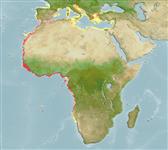
Native range | All suitable habitat | Point map | Year 2050
This map was computer-generated and has not yet been reviewed.
Sardinella maderensis   AquaMaps   Data sources: GBIF OBIS
Adicionar o seu Fotografias e vídeos
Fotografias | Imagem do Google
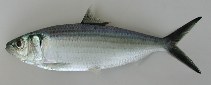
Image of Sardinella maderensis (Madeiran sardinella)
Sardinella maderensis
Fotografia de Freitas, R.


Nigeria territory information

Common names: Duruku, Sardinella, Sawa
Occurrence: native
Salinity: brackish
Abundance: | Ref:
Importance: | Ref:
Aquaculture: | Ref:
Regulations: | Ref:
Uses: live export: yes;
Comments: Known from coast of Atlantic Ocean (Ref. 121227), including near Lagos (Ref. 3031) and Ologe Lagoon (Ref. 95249). Also Ref. 188, 26112.
National Checklist:
Territory Information: https://www.cia.gov/library/publications/resources/the-world-factbook/geos/ni.html
National Fisheries Authority:
Occurrences: Occurrences Point map
Main Ref: Regan, C.T., 1917
National Database:

Common names from other countries

Classificação / Nomes Nomes comuns | Sinónimos | Catalog of Fishes(Género, Espécies) | ITIS | CoL | WoRMS | Cloffa

> Clupeiformes (Herrings) > Dorosomatidae (Gizzard shads and sardinellas)
Etymology: Sardinella: Latin and Greek, sarda = sardine; name related to the island of Sardinia; diminutive (Ref. 45335).
More on author: Lowe.

Ambiente: milieu / zona climática / intervalo de profundidade / gama de distribuição Ecologia

marinhas; estuarina pelagic-neritic; oceanódromo (Ref. 51243); intervalo de profundidade 0 - 80 m (Ref. 27000). Subtropical; 24°C - ? (Ref. 54872); 46°N - 23°S, 17°W - 36°E (Ref. 54872)

Distribuição Territórios | Áreas FAO | Ecossistemas | Ocorrências | Mapa dos pontos | Introduções | Faunafri

Atlantic Ocean: southern and eastern parts of Mediterranean Sea, also penetrating the Suez Canal (Ref. 188, 50345), and eastern Atlantic Ocean, from Gibraltar southward to Angola and a single recorded specimen from Walvis Bay in Namibia (Ref. 188, 5286, 81269, 81631, 86940).

Comprimento na primeira maturidade / Tamanho / Peso / Idade

Maturidade: Lm 13.4, range 11 - 19.5 cm
Max length : 30.0 cm SL macho/indeterminado; (Ref. 188); common length : 25.0 cm SL macho/indeterminado; (Ref. 188); peso máx. Publicado: 927.00 g (Ref. 3808)

Descrição breve Chaves de identificação | Morfologia | Morfometria

Espinhos dorsais (total) : 0; Raios dorsais moles (total) : 18 - 23; Espinhos anais: 0; Raios anais moles: 17 - 23; Vértebras: 44 - 48. Diagnosis: Body elongate, but variable in depth, belly fairly sharply keeled; with 14-20 pre-pelvic and 12-15 post-pelvic scutes, total scutes 31-34; lower gillrakers 70-166, increasing with growth; upper pectoral finrays white on outer side, the membrane between black (Ref. 188, 3259, 81269, 81631). It resembles Sardinella aurita, but pelvic fin with 1 unbranched and 7 branched rays vs. 1 unbranched and 8 branched rays in S. aurita and no black spot on hind part of gill cover, but faint gold or black area just behind gill opening (Ref. 187, 188). It is distinguished from S. rouxi by having more lower gillrakers, which is only 30-40 in S. rouxi, and the caudal fin grey, its tips almost black vs. pale yellow with distal margin dusky in S. rouxi (Ref. 187, 188, 81269).
Body shape (shape guide): fusiform / normal; Cross section: compressed.

Biologia     Glossário (ex. epibenthic)

A coastal, pelagic species, but tolerant of low salinities (Ref. 188, 5286, 27000, 86940); sometimes in estuaries and lagoons (Ref. 188, 2683). It forms schools, preferring waters of 24°C, at surface or at bottom down to 50m, strongly migratory (Ref. 188, 5286). It feeds on a variety of small planktonic invertebrates, also fish larvae and phytoplankton (Ref. 188, 27165). It breeds only once in the year, during the warm season between July and September, in coastal waters; juveniles and adults show clear north-south migrations in the Gabon-Congo-Angola sector and the Sierra Leone-Mauritania sector of the Atlantic Ocean, each area having nurseries; these movements are correlated with the seasonal upwelling (Ref. 188). It is of considerable importance off West African coasts, but combined with Sardinella aurita in most statistics, partly because both species are often caught together (Ref. 188).

Ciclo de vida e comportamento de acasalamento Maturidade | Reprodução | Desova | Ovos | Fecundidade | Larvas

Referência principal Carregar as suas referências | Referências | Coordenador | Colaboradores

Whitehead, P.J.P., 1985. FAO Species Catalogue. Vol. 7. Clupeoid fishes of the world (suborder Clupeoidei). An annotated and illustrated catalogue of the herrings, sardines, pilchards, sprats, shads, anchovies and wolf-herrings. FAO Fish. Synop. 125(7/1):1-303. Rome: FAO. (Ref. 188)

Categoria na Lista Vermelha da IUCN (Ref. 130435: Version 2025-2)

  Vulnerável (VU) (A2d); Date assessed: 23 July 2014

CITES

Not Evaluated

CMS (Ref. 116361)

Not Evaluated

Ameaça para o homem

  Harmless


Utilização humana

Pescarias: altamente comercial; isco: usually
FAO - pescarias: desembarques, perfil da espécie; Publication: search | FIRMS - Stock assessments | FishSource | Sea Around Us

Mais informação

Ecologia Trófica
Produtos alimentares (presas)
Composição da dieta
Consumo alimentar
Rações alimentares
Predadores
Ecologia
Ecologia
Home ranges
Ciclo de vida
Reprodução
Maturidade
Maturidade/Rel. das guelras
Fecundidade
Desova
Agregações de desova
Ovos
Desenvolvimento dos ovos
Larvas
Dinâmica larvar
Distribuição
Territórios
Áreas FAO
Ecossistemas
Ocorrências
Introduções
BRUVS - Vídeos
Anatomia
Área branquial
Cérebro
Otólitos
Fisiologia
Composição corporal
Nutrientes
Consumo de oxigénio
Tipo de natação
Velocidade de natação
Pigmentos visuais
Som de peixe
Doenças e Parasitas
Toxicidade (LC50s)
Genética
genoma
Genética
Heterozigotia
Hereditariedade
Relacionado com o ser humano
Sistemas de aquacultura
Perfis para aquacultura
Estirpes
Casos de Ciguatera
Selos, moedas, diversos.
Divulgação
Colaboradores
Referências
Referências

Ferramentas

Relatórios especiais

Descarregue XML

Fontes da internet

AFORO (otoliths) | Aquatic Commons | BHL | Cloffa | Websites from users | Consultar FishWatcher | CISTI | Catalog of Fishes: Género, Espécies | DiscoverLife | ECOTOX | FAO - pescarias: desembarques, perfil da espécie; Publication: search | Faunafri | Fishipedia | Fishtrace | GloBI | Google Books | Google Scholar | Google | IGFA World Record | Bases de dados nacionais | OneZoom | Open Tree of Life | Otolith Atlas of Taiwan Fishes | PubMed | Reef Life Survey | Socotra Atlas | TreeBase | Árvore da vida | Wikipedia: ir para, procurar | World Records Freshwater Fishing | Registo zoológico

Estimativas baseadas em modelos

Temperatura preferida (Ref. 123201): 18 - 27.9, mean 21 °C (based on 208 cells).
Índice de diversidade filogenética (Ref. 82804):  PD50 = 0.5000   [Uniqueness, from 0.5 = low to 2.0 = high].
Bayesian length-weight: a=0.00851 (0.00693 - 0.01045), b=3.04 (3.01 - 3.07), in cm total length, based on LWR estimates for this species (Ref. 93245).
Nível Trófico (Ref. 69278):  3.2   ±0.38 se; based on food items.
Generation time: 3.2 (1.8 - 3.7) years. Estimated as median ln(3)/K based on 12 growth studies.
Resiliência (Ref. 120179):  Médio, tempo mínimo de duplicação da população 1,4 - 4,4 anos (K=0.34; tm=3; tmax=6).
Prior r = 0.57, 95% CL = 0.38 - 0.86, Based on 6 data-limited stock assessments.
Vulnerabilidade da pesca (Ref. 59153):  Moderate vulnerability (35 of 100). 🛈
Vulnerabilidade climática (Ref. 125649):  Low to moderate vulnerability (32 of 100). 🛈
Categoria de preço (Ref. 80766):   Medium.
Nutrientes (Ref. 124155):  Calcium = 112 [59, 177] mg/100g; Iron = 1.65 [0.98, 2.68] mg/100g; Protein = 21.3 [20.4, 22.1] %; Omega3 = 0.457 [0.231, 0.866] g/100g; Selenium = 39.4 [20.0, 76.9] μg/100g; VitaminA = 30.2 [9.4, 98.4] μg/100g; Zinc = 0.755 [0.542, 1.131] mg/100g (wet weight); based on nutrient studies.