Common names from other countries
>
Clupeiformes (Herrings) >
Alosidae (Shads and Sardines)
Etymology: Alosa: Latin, alausa = a fish cited by Ausonius and Latin, halec = pickle, dealing with the Greek word hals = salt; it is also the old Saxon name for shad = "alli" ; 1591 (Ref. 45335).
More on author: Bennett.
محیط زیست: محیط زیست / منطقه آب و هوایی / تغييرات عمق / محدوده توزیع
بوم شناسي
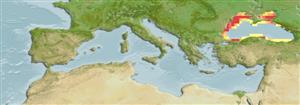
دريايي; آب شيرين; لب شور pelagic-neritic; رود کوچ (Ref. 138126); تغييرات عمق 3 - 90 m (Ref. 10439). Temperate; 50°N - 41°N, 27°E - 44°E
Eurasia: Black Sea and Sea of Azov ( in sea and in the Don, Danube and other rivers, as much as 567 km up the Don and as far as Kiev on the Dneiper before the dam was built). Recognized sub-species (Ref. 683): Alosa pontica pontica in the Black Sea and rivers feeding it; Alosa pontica kessleri and Alosa pontica volgensis in the Caspian Sea.
اندازه / وزن / سن
بلوغ: Lm ? range ? - 23.4 cm
Max length : 39.0 cm SL جنس نر / بدون خواص جنسي; (Ref. 188); بيشينه سن گزارش شده: 7 سال ها (Ref. 10439)
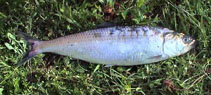
خارهاي باله پشتي (کل) : 0; خارهاي باله مخرجي: 0. Body fairly elongate, more `herring-like' than `shad-like'. Gill rakers rather thin, usually equal to or a little shorter than gill filaments. Teeth well developed in both jaws. Resembles A. caspia, which usually has more Gill rakers (50 to 180, much longer than gill filaments), poorly developed teeth and a deeper, `shad-like' body; A. maeotica has fewer Gill rakers (33 to 36).
Body shape (shape guide): fusiform / normal; Cross section: compressed.
Thai species is pelagic at sea, in deep water. It migrates to middle reaches of large rivers, spawning where current is strongest, close to the surface, often at 2-3 m depth in the main channel. Migrates upriver to spawn at 3 years, rarely earlier and only a few individuals spawn two seasons. It appears along the coast in March to April, enters rivers when temperatures reach about 6-9°C, between late March and late April; migration usually peaks in May. Spawning starts when temperature rises above 15°C in April to August; usually between 1 and 8 p.m. Pelagic eggs. Spent individuals return to the sea to feed. Juveniles inhabit floodplain and shallow riverine habitats, migrate to the sea or estuarine habitats during first summer; in autumn return to the sea until maturity. When at sea, it feeds on a wide variety of zooplankton (mainly crustaceans, (Crangon, Upogebia, Idothea, gammarids) and small fish (Engraulis, Clupeonella, Sprattus). Reduction of spawning sites and migration routes are caused by impoundment of main rivers. Heavy over fishing apparently reduced all populations during the first decade of the 20th century (Ref. 59043). Reaches a smaller size (30 cm SL, usually 14-18) in Don River; a smaller form reaches only 21 cm.
Eggs are pelagic (Ref. 59043).
Kottelat, M., 1997. European freshwater fishes. An heuristic checklist of the freshwater fishes of Europe (exclusive of former USSR), with an introduction for non-systematists and comments on nomenclature and conservation. Biologia, Bratislava, 52/Suppl. 5:1-271. (Ref. 13696)
وضعيت در فهرست قرمز IUCN (Ref. 130435: Version 2025-2 (Global))
خطر برای انسان ها
Harmless
استفاده انسانی
ماهي گيري – شيلات: ارزش تحاري اندك
ابزارها
گزارش های ويژه
بارگيری XML
منابع اينترنتي
تخمینها بر اساس مدلها
دمای ترجیحی (مرجع
123201): 8.6 - 14.8, mean 13.3 °C (based on 68 cells).
شاخص تنوع فیلوژنتیکی (مرجع
82804): PD
50 = 0.5000 [Uniqueness, from 0.5 = low to 2.0 = high].
Bayesian length-weight: a=0.00741 (0.00616 - 0.00892), b=3.08 (3.04 - 3.12), in cm total length, based on LWR estimates for this species (Ref.
93245).
سطح تروفیک (مرجع
69278): 4.0 ±0.6 se; based on diet studies.
جهندگی (مرجع
120179): متوسط, كمينه زمان لازم براي دو برابر شدن جمعيت 4/1 – 4/4 سال (K=0.32; tm=2; tmax=9).
آسیبپذیری ماهیگیری (Ref.
59153): Low to moderate vulnerability (35 of 100).
🛈
آسیبپذیری اقلیمی (Ref.
125649): High to very high vulnerability (67 of 100).
🛈
مواد مغذی (Ref.
124155): Calcium = 14.6 [7.1, 77.2] mg/100g; Iron = 0.56 [0.23, 1.34] mg/100g; Protein = 19.6 [17.1, 22.4] %; Omega3 = 1.44 [0.75, 2.79] g/100g; Selenium = 9.61 [4.44, 21.22] μg/100g; VitaminA = 17.7 [4.5, 66.4] μg/100g; Zinc = 0.335 [0.208, 0.588] mg/100g (wet weight); based on
nutrient studies.