Alosa immaculata, Pontic shad : fisheries

You can sponsor this page

Alosa immaculata Bennett, 1835

Pontic shad
เพิ่มการสังเกตของคุณใน Fish Watcher
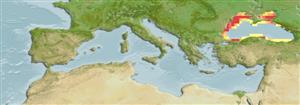
Native range | All suitable habitat | Point map | Year 2050
This map was computer-generated and has not yet been reviewed.
Alosa immaculata   AquaMaps   Data sources: GBIF OBIS
อัพโหลดของคุณ ภาพถ่าย และ วิดีโอ
รูปภาพหลายรูป | แสตมป์ เหรียญ อื่นๆ | Google image
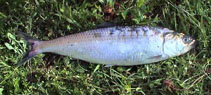
Image of Alosa immaculata (Pontic shad)
Alosa immaculata
ภาพโดย Kutsarov, Y.


Russia / Russian Federation territory information

Common names: Black Sea herring, Chernomorskaya sel'd, Chernomorsko-azovskaya sel'd'
Occurrence: native
Salinity: freshwater
Abundance: | Ref:
Importance: | Ref:
Aquaculture: | Ref:
Regulations: | Ref:
Uses: no uses
Comments: Occurs in the Black Sea and Sea of Azov, entering rivers (the Don and others) (Ref. 26334). Introduced for fisheries (Ref. 93375). Also Ref. 188. EurRus
National Checklist:
Territory Information: https://www.cia.gov/library/publications/resources/the-world-factbook/geos/rs.html
National Fisheries Authority:
Occurrences: Occurrences Point map
Main Ref: Reshetnikov, Y.S., N.G. Bogutskaya, E.D. Vasil'eva, E.A. Dorofeeva, A.M. Naseka, O.A. Popova, K.A. Savvaitova, V.G. Sideleva and L.I. Sokolov, 1997
National Database:

Common names from other countries

การจำแนกประเภท / ชื่อ ชื่อสามัญ | ชื่อพ้อง | Catalog of Fishes(สกุล, ชนิด) | ITIS | CoL | WoRMS | Cloffa

> Clupeiformes (Herrings) > Alosidae (Shads and Sardines)
Etymology: Alosa: Latin, alausa = a fish cited by Ausonius and Latin, halec = pickle, dealing with the Greek word hals = salt; it is also the old Saxon name for shad = "alli" ; 1591 (Ref. 45335).
More on author: Bennett.

สิ่งแวดล้อม : สิ่งแวดล้อม / เขตภูมิอากาศ / ระดับความลึก / ระยะการกระจายสินค้า นิเวศวิทยา

เกี่ยวกับทะเล,น้ำเค็ม; น้ำจืด; กร่อย pelagic-neritic; ปลาที่อพยพจากแหล่งน้ำเค็มไปวางไข่ในแหล่งน้ำจืด (Ref. 138126); ระดับความลึก 3 - 90 m (Ref. 10439). Temperate; 50°N - 41°N, 27°E - 44°E

การแพร่กระจาย อาณาเขต | พื้นที่จำแนกตาม FAO | ระบบนิเวศหลายระบบ | การปรากฏขึ้น,การเกิดขึ้น,พบ | ตำแหน่งบนแผนที่ | การแนะนำ | Faunafri

Eurasia: Black Sea and Sea of Azov ( in sea and in the Don, Danube and other rivers, as much as 567 km up the Don and as far as Kiev on the Dneiper before the dam was built). Recognized sub-species (Ref. 683): Alosa pontica pontica in the Black Sea and rivers feeding it; Alosa pontica kessleri and Alosa pontica volgensis in the Caspian Sea.

ขนาด / น้ำหนัก / อายุ

วัยเจริญพันธุ์: Lm ?  range ? - 23.4 cm
Max length : 39.0 cm SL เพศผู้/กระเทย; (Ref. 188); อายุสูงสุดที่ได้รายงาน: 7 ปี (Ref. 10439)

คำอธิบายสั้นๆ เครื่องมือที่ใช้ในการแยกชนิดสัตว์,สิ่งมีชีวิตออกจากกัน | สัณฐานวิทยา | ความยาวต่างๆ

เงี่ยงครีบหลัง (รวม) : 0; เงี่ยงครีบก้น: 0. Body fairly elongate, more `herring-like' than `shad-like'. Gill rakers rather thin, usually equal to or a little shorter than gill filaments. Teeth well developed in both jaws. Resembles A. caspia, which usually has more Gill rakers (50 to 180, much longer than gill filaments), poorly developed teeth and a deeper, `shad-like' body; A. maeotica has fewer Gill rakers (33 to 36).
Body shape (shape guide): fusiform / normal; Cross section: compressed.

ชีววิทยา     ภาคผนวก (เช่น epibenthic)

Thai species is pelagic at sea, in deep water. It migrates to middle reaches of large rivers, spawning where current is strongest, close to the surface, often at 2-3 m depth in the main channel. Migrates upriver to spawn at 3 years, rarely earlier and only a few individuals spawn two seasons. It appears along the coast in March to April, enters rivers when temperatures reach about 6-9°C, between late March and late April; migration usually peaks in May. Spawning starts when temperature rises above 15°C in April to August; usually between 1 and 8 p.m. Pelagic eggs. Spent individuals return to the sea to feed. Juveniles inhabit floodplain and shallow riverine habitats, migrate to the sea or estuarine habitats during first summer; in autumn return to the sea until maturity. When at sea, it feeds on a wide variety of zooplankton (mainly crustaceans, (Crangon, Upogebia, Idothea, gammarids) and small fish (Engraulis, Clupeonella, Sprattus). Reduction of spawning sites and migration routes are caused by impoundment of main rivers. Heavy over fishing apparently reduced all populations during the first decade of the 20th century (Ref. 59043). Reaches a smaller size (30 cm SL, usually 14-18) in Don River; a smaller form reaches only 21 cm.

วงจรชีวิตและพฤติกรรมการผสมพันธุ์ วัยเจริญพันธุ์ | การสืบพันธุ์ | การวางไข่ | เซลสืบพันธ์ของเพศเมีย(ไข่) | ความดกของไข่ | ตัวอ่อน

Eggs are pelagic (Ref. 59043).

อ้างอิงหลัก อัพโหลดข้อมูลอ้างอิงของคุณ | อ้างอิง | ผู้ประสานงาน | ผู้ร่วมมือ

Kottelat, M., 1997. European freshwater fishes. An heuristic checklist of the freshwater fishes of Europe (exclusive of former USSR), with an introduction for non-systematists and comments on nomenclature and conservation. Biologia, Bratislava, 52/Suppl. 5:1-271. (Ref. 13696)

สถานะบัญชีแดงของ IUCN (Ref. 130435: Version 2025-2 (Global))

  Least Concern (LC) ; Date assessed: 28 June 2022

CITES

Not Evaluated

CMS (Ref. 116361)

Not Evaluated

ภัยคุกคามต่อมนุษย์

  Harmless


การใช้ของมนุษย์

การประมง: มีการค้าเพียงเล็กน้อย
FAO - การประมง: การลงจอด; Publication: search | FishSource | ทะเลรอบๆเรา

ข้อมูลเพิ่มเติม

นิเวศวิทยาเขตร้อน
รายการอาหาร (เหยื่อ)
องค์ประอบของอาหาร
การบริโภคอาหาร
การจัดสรรอาหาร
ผู้ล่า
นิเวศวิทยา
นิเวศวิทยา
Home ranges
พลวัตของประชากร
พารามิเตอร์การเจริญเติบโต
อายุสูงสุด / ขนาด
ความยาว-น้ำหนักสัมพันธ์
ความยาว-ความยาวสัมพันธ์
ความยาว-ความถี่
การแปลงมวล
การทดแทนที่
อุดมสมบรูณ์
วงจรชีวิต
การสืบพันธุ์
วัยเจริญพันธุ์
ความสมบูรณ์พันธุ์/เหงือกที่เกี่ยวข้อง
ความดกของไข่
การวางไข่
การรวมตัวของสปอน
เซลสืบพันธ์ของเพศเมีย(ไข่)
การพัฒนาไข่
ตัวอ่อน
พลวัตของสัตว์น้ำวัยอ่อน
กายวิภาคศาสตร์
พื้นที่เหงือก
สมอง
หินโสต
สรีรวิทยา
องค์ประกอบของร่างกาย
สารอาหาร
การใช้ออกซิเจน
ประเภทการว่ายน้ำ
ระดับความเร็วในการว่ายน้ำ
เม็ดสีที่มองเห็นได้
เสียงปลา
โรคและปรสิต
ความเป็นพิษ (LC50s)
พันธุศาสตร์
จีโนม
พันธุศาสตร์
ความไม่สมดุลทางเชื้อชาติ
อัตราพันธุกรรม
เกี่ยวข้องกับมนุษย์
ระบบการเพาะเลี้ยงสัตว์น้ำ
ประวัติการเพาะเลี้ยงสัตว์น้ำ
สายพันธุ์
กรณีซิเกวเทอรา
แสตมป์ เหรียญ อื่นๆ
การเข้าถึง
ผู้ร่วมมือ
อ้างอิง
อ้างอิง

เครื่องมือ

รายงานพิเศษ

ดาวน์โหลด XML

แหล่งที่มาจากอินเตอร์เน็ต

การประมาณค่าตามแบบจำลอง

อุณหภูมิที่ต้องการ (อ้างอิง 123201): 8.6 - 14.8, mean 13.3 °C (based on 68 cells).
ดัชนีความหลากหลายทางวิวัฒนาการ (อ้างอิง 82804):  PD50 = 0.5000   [Uniqueness, from 0.5 = low to 2.0 = high].
Bayesian length-weight: a=0.00741 (0.00616 - 0.00892), b=3.08 (3.04 - 3.12), in cm total length, based on LWR estimates for this species (Ref. 93245).
ระดับชั้นอาหาร (อ้างอิง 69278):  4.0   ±0.6 se; based on diet studies.
ความสามารถในการกลับคืนสู่ปกติ (อ้างอิง 120179):  ขนาดกลาง, เวลาต่ำสุดที่จะทำให้ประชากรเพิ่มขึ้นเป็น 2 เท่าใช้เวลา 1.4 - 4.4 ปี (K=0.32; tm=2; tmax=9).
ความเสี่ยงต่อการตกปลา (Ref. 59153):  Low to moderate vulnerability (35 of 100). 🛈
ความเสี่ยงต่อสภาพภูมิอากาศ (Ref. 125649):  High to very high vulnerability (67 of 100). 🛈
หมวดหมู่ราคา (Ref. 80766):   High.
สารอาหาร (Ref. 124155):  Calcium = 14.6 [7.1, 77.2] mg/100g; Iron = 0.56 [0.23, 1.34] mg/100g; Protein = 19.6 [17.1, 22.4] %; Omega3 = 1.44 [0.75, 2.79] g/100g; Selenium = 9.61 [4.44, 21.22] μg/100g; VitaminA = 17.7 [4.5, 66.4] μg/100g; Zinc = 0.335 [0.208, 0.588] mg/100g (wet weight); based on nutrient studies.