Common names from other countries
Milieu: milieu / Klimaatzone / Diepte / verspreidingsgebied
Ecologie
; zoet water; brak water benthopelagisch; pH range: 7.0 - 7.5; dH range: 15 - ?; potamodroom (Ref. 51243); diepte 1 - ? m (Ref. 9696). Temperate; 10°C - 24°C (Ref. 2059); 75°N - 40°N, 11°W - 73°E
Europe and Asia: most European drainages from Adour (France) to Pechora (White Sea basin); Aegean Sea basin, in Lake Volvi and Struma and Maritza drainages. Naturally absent from Iberian Peninsula, Adriatic basin, Italy, Scotland, Scandinavia north of Bergen (Norway) and 67°N (Finland). Locally introduced in Ireland, Spain and northeastern Italy. In Asia, from Marmara basin (Turkey) and eastward to Aral basin. Introduced in Lake Baikal and upper Ob and Yenisei drainages.
Lengte bij maturiteit / Grootte / Gewicht / Leeftijd
Maturiteit: Lm ? range ? - ? cm
Max length : 82.0 cm TL mannelijk / geslacht onbekend; (Ref. 6114); common length : 25.0 cm TL mannelijk / geslacht onbekend; (Ref. 3561); max. gepubliceerd gewicht: 6.0 kg (Ref. 4699); max. gerapporteerde leeftijd: 23 Jaren (Ref. 796)
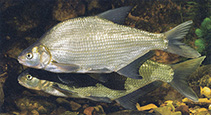
Dorsale stekels (totaal) : 3; Dorsale zachte stralen (totaal) : 9 - 10; Anale stekels: 3; Anale zachte stralen: 23 - 30; Wervels: 43 - 45. The only species of the genus which can be diagnosed from other species of Ballerus, Blicca and Vimba by the following characters: mouth sub-inferior, which can be extended as a tube; lateral line with 51-60 scales; anal fin with 30½ branched rays; eye diameter about 2/3 of snout length in individuals larger than 10 cm SL; pharyngeal teeth 5-5; and base of paired fins hyaline or grey (Ref. 59043). Caudal fin with 19 rays (Ref. 2196). Tall, laterally compressed body. Fins darker in adults. Anal fin base twice as long as the dorsal fin (Ref. 35388).
Body shape (shape guide): fusiform / normal.
Adults inhabit a wide variety of lakes and large to medium sized rivers. Most abundant in backwaters, lower parts of slow-flowing rivers, brackish estuaries and warm and shallow lakes (Ref. 59043). Adults occur usually in still and slow-running waters where they travel in large shoals (Ref. 9696). Larvae and juveniles live in still water bodies, feeding on plankton. One to two years old juveniles move from backwaters to river to feed. In the absence of opportunity to leave backwaters, juveniles may adapt but have a slower growth and attain maturity at a smaller size. They also drift to brackishwater estuaries to forage when water level of flooded areas drops in lower reaches of large rivers. Foraging juveniles in brackish waters stay in lower parts of rivers to overwinter in freshwater (Ref. 59043). Feed on insects, particularly chironomids, small crustaceans, mollusks and plants. Larger specimens may feed on small fish. Juveniles feed on zooplankton (Ref. 30578). Able to shift to particle feeding or even filter feeding at high zooplankton abundance. Usually spawn in backwaters, floodplains or lakes shores with dense vegetation (Ref. 59043). Can survive out of the water for extended periods (Ref. 9988). The flesh is bony, insipid and soft (Ref. 30578). Marketed fresh or frozen. Eaten steamed, broiled, fried and baked (Ref. 9988).
Undergo upriver migration (100 km in Dniepr) to spawn. Many populations start spawning migration in autumn ( especially semi-anadromours forms), slow down during winter and continue in spring. Males often defend spawning territories along shorelines. Eggs are sticky and eggs size increases with age of female. Frequently forms fertile hybrids with Rutilus rutilus (Ref. 59043).
Kottelat, M. and J. Freyhof, 2007. Handbook of European freshwater fishes. Publications Kottelat, Cornol and Freyhof, Berlin. 646 pp. (Ref. 59043)
Status op de Rode Lijst van het IUCN (Ref. 130435: Version 2025-2)
Gevaar voor de mens
Harmless
Gebruik door de mens
Visserij: van groot commercieel belang; Aquacultuur: commercieel; sportvis: ja; aas: usually
Tools
Speciale rapporten
Download XML
Internetbronnen
Schattingen op basis van modellen
Fylogenetische diversiteitsindex (Ref.
82804): PD
50 = 1.0000 [Uniqueness, from 0.5 = low to 2.0 = high].
Bayesian length-weight: a=0.00759 (0.00693 - 0.00830), b=3.14 (3.11 - 3.17), in cm total length, based on LWR estimates for this species (Ref.
93245).
Trofisch niveau (Ref.
69278): 3.1 ±0.1 se; based on diet studies.
Generation time: 9.0 (7.2 - 10.8) years. Estimated as median ln(3)/K based on 50
growth studies.
Weerstandsvermogen (Ref.
120179): laag, minimale populatieverdubbelingstijd 4,5-14 jaar (K=0.06-0.17; tm=3-5; tmax=17; Fec=90,000-340,000).
Kwetsbaarheid van de visserij (Ref.
59153): High vulnerability (62 of 100).
🛈
Voedingsstoffen (Ref.
124155): Calcium = 19.3 [11.8, 39.1] mg/100g; Iron = 0.257 [0.166, 0.467] mg/100g; Protein = 18.6 [17.2, 19.9] %; Omega3 = 0.628 [0.335, 1.215] g/100g; Selenium = 12.2 [6.5, 22.9] μg/100g; VitaminA = 18.5 [7.7, 48.4] μg/100g; Zinc = 0.412 [0.333, 0.737] mg/100g (wet weight); based on
nutrient studies.