This website uses cookies to enhance your browsing experience and ensure the functionality of our site. For more detailed information about the types of cookies we use and how we protect your privacy, please visit our Privacy Information page.
×
Cookie Settings
This website uses different types of cookies to enhance your experience. Please select your preferences below:
分類 / 名稱 俗名 | 同種異名 | Catalog of Fishes(屬, 種) | ITIS | CoL | WoRMS | Cloffa
Teleostei > Cichliformes (Cichlids, convict blennies) 鱸形目 (Cichlids, convict blennies) > Cichlidae (Cichlids) 慈鯛科魚類 (Cichlids) > Pseudocrenilabrinae
Etymology: Maylandia:In honour of Hans J. Mayland, German ictiologist (Ref. 45335); usisyae:The specific epithet usisyae is the genitive of Usisya, the village near which the type specimens were collected (Ref. 119465). Eponymy: Hans-Joachim Mayland (1928–2004) was a German ichthyologist, aquarist, photographer and writer. [...] This is a toponym referring to Usisya, a village on Lake Malawi near the type locality. (Ref. 128868), visit book page.
背棘 (總數) : 17 - 18; 背的軟條 (總數) : 8 - 9; 臀棘: 3; 臀鰭軟條: 7 - 8. Diagnosis: The presence of bicuspid teeth in the outer rows on both the upper and lower jaws and a moderately sloped vomer block with a swollen rostral tip place this species in Maylandia (Ref. 119465). Male and female M. usisyae are distinguished by an elongate body, body depth 25.9-30.6% of standard length, from all other species in Maylandia, body depth 28.8-40.8% of standard length, except M. tarakiki, body depth 25.8-32.9% of standard length, and M. flavicauda, body depth 23.6-28.5% of standard length (Ref. 119465). It differs from M. tarakiki by a smaller eye, vertical eye diameter 23.1-28.1% of head length vs. 30.2-36.5% in M. tarakiki; and a shorter lower jaw length, lower jaw length 29.9-33.4% of head length vs. 34.8-38.9% on M. tarakiki (Ref. 119465). Based on the colour pattern, male M. usisyae possess a yellow dorsal fin with a black submarginal band, yellow pelvic fins and yellow anal fin with a black leading edge; male M. flavicauda possess black pelvic and anal fins, and a black dorsal fin with yellow/orange spots distally; the ground colouration of male M. flavicauda is blue with 2 light/purple interorbital bars vs. yellow with 2 white/light blue interorbital bars in male M. usisyae; females of M. usisyae cannot reliably be distinguished by colour from those of M. flavicauda; Maylandia flavicauda also possess a deeper preorbital bone, preorbital depth 18.0-26.9% of head length, and a longer snout, snout length 34.3-47.3% of head length, which are 17.6-21.2% and 32.0-37.6% in M. usisyae respectively (Ref. 119465).
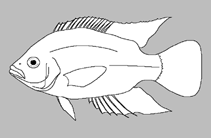
Body shape (shape guide): elongated.
Li, S., A.F. Konings and J.R. Stauffer Jr., 2016. A revision of the Pseudotropheus elongatus species group (Teleostei: Cichlidae) with description of a new genus and seven new species. Zootaxa 4168(2):353-381. (Ref. 119465)
系統發育多樣性指數 (參考文獻 82804): PD50 = 0.5000 [Uniqueness, from 0.5 = low to 2.0 = high].
Bayesian length-weight: a=0.01000 (0.00244 - 0.04107), b=3.04 (2.81 - 3.27), in cm total length, based on all LWR estimates for this body shape (Ref. 93245).
營養階層 (參考文獻 69278): 2.3 ±0.1 se; based on size and trophs of closest relatives
回復力 (參考文獻 120179): 高度, 族群倍增時間少於 15個月 (Preliminary K or Fecundity.).
釣魚的脆弱性 (Ref. 59153): Low vulnerability (10 of 100). 🛈