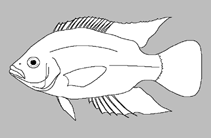
Common names from other countries
Klassifizierung / Names
Namen | Synonyme | Catalog of Fishes(Gattung, Arten) | ITIS | CoL | WoRMS | Cloffa
>
Cichliformes (Cichlids, convict blennies) >
Cichlidae (Cichlids) > Pseudocrenilabrinae
Etymology: kumwera: The name kumwera means 'south' in Chichewa, alluding to the species' distribution in the southern part of Lake Malawi, and it is used as a noun in apposition (Ref. 119465).
Umwelt: Milieu / Klimazone / Tiefenbereich / Verbreitungsgebiet
Ökologie
; süßwasser benthopelagisch. Tropical
Africa: Lake Malawi in Malawi (Ref. 119465).
Größe / Gewicht / Alter
Geschlechtsreife: Lm ? range ? - ? cm
Max length : 7.1 cm SL Männchen/unbestimmt; (Ref. 119465)
Kurzbeschreibung
Bestimmungsschlüssel | Morphologie | Morphometrie
Rückenflossenstacheln (insgesamt) : 17 - 19; Rückenflossenweichstrahlen (insgesamt) : 8 - 10; Afterflossenstacheln: 3; Afterflossenweichstrahlen: 7 - 8. Diagnosis: The steeply-sloped vomer without a swollen rostral tip, a small mouth, retrognathic jaws, and the presence of bicuspid teeth in the outer rows of the oral jaws and enlarged conical teeth at the back of the jaws place this species in Tropheops (Ref. 119465). Tropheops kumwera, body depth 23.6-31.0% of standard length, cannot reliably be distinguished from other Tropheops in body depth, 26.6-34.5% of standard length; it does have relatively smaller eye than other Tropheops, horizontal eye diameter 25.8-32.6% of head length and vertical eye diameter 24.2-31.4% of head length vs. 31.2-43.8% and 29.9-43.3% respectively, except T. kamtambo with 26.3-30.2% and 24.0-29.7% respectively (Ref. 119465). It can often be distinguished from T. kamtambo by a shallower head depth than in T. kamtambo, head depth 70.2-84.5% of head length vs. 79.4-97.1%; males of T. kumwera in territorial colour are distinguished from those of T. biriwira by their blue ground colouration and a blue dorsal fin, which are olive green/light blue and yellow-green in T. biriwira respectively; breeding male T. kumwera usually exhibit only the first 3-4 flank bars while male T. kamtambo exhibit all 9-10 bars; female T. kumwera lack a submarginal band in the dorsal fin which is present in female T. kamtambo (Ref. 119465).
Body shape (shape guide): elongated.
Lebenszyklus und Paarungsverhalten
Geschlechtsreife | Fortpflanzung | Ablaichen | Eier | Fruchtbarkeit | Larven
Li, S., A.F. Konings and J.R. Stauffer Jr., 2016. A revision of the Pseudotropheus elongatus species group (Teleostei: Cichlidae) with description of a new genus and seven new species. Zootaxa 4168(2):353-381. (Ref. 119465)
IUCN Rote Liste Status (Ref. 130435: Version 2025-2)
Bedrohung für Menschen
Harmless
Nutzung durch Menschen
Tools
Zusatzinformationen
Download XML
Internet Quellen
Schätzungen auf der Grundlage von Modellen
Phylogenetischer Diversitätsindex (Ref.
82804): PD
50 = 0.5005 [Uniqueness, from 0.5 = low to 2.0 = high].
Bayesian length-weight: a=0.01000 (0.00244 - 0.04107), b=3.04 (2.81 - 3.27), in cm total length, based on all LWR estimates for this body shape (Ref.
93245).
Widerstandsfähigkeit (Ref.
120179): hoch, Verdopplung der Population dauert weniger als 15 Monate. (Preliminary K or Fecundity.).
Anfälligkeit der Fischerei (Ref.
59153): Low vulnerability (10 of 100).
🛈