Melanogrammus aeglefinus, Haddock : fisheries, aquaculture, gamefish

You can sponsor this page

Melanogrammus aeglefinus (Linnaeus, 1758)

Haddock
Adicionar sua observação em Fish Watcher
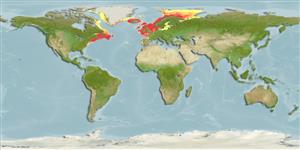
Native range | All suitable habitat | Point map | Year 2050
This map was computer-generated and has not yet been reviewed.
Melanogrammus aeglefinus   AquaMaps   Data sources: GBIF OBIS
Carregue seu(sua) Fotos e vídeos
Fotos | vídeos | Selos, moedas, diversos. | Imagem do Google
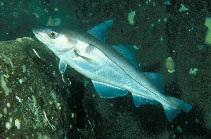
Image of Melanogrammus aeglefinus (Haddock)
Melanogrammus aeglefinus
Foto de Salesjö, A.


Saint Pierre and Miquelon territory information

Common names: [No common name]
Occurrence: native
Salinity: marine
Abundance: | Ref:
Importance: | Ref:
Aquaculture: | Ref:
Regulations: | Ref:
Uses: no uses
Comments:
National Checklist:
Territory Information: https://www.cia.gov/library/publications/resources/the-world-factbook/geos/sb.html
National Fisheries Authority:
Occurrences: Occurrences Point map
Main Ref: Simian, G., D. Abraham, N. Bailly, P. Béarez, F. Urtizberea, A. Perrot, H. Goraguer, R. Langlois, P. Daszkiewicz, F. Teletchea, S. Tercerie and G. Denys, 2022
National Database:

Common names from other countries

Classificação / Nomes Nomes comuns | Sinônimos | Catalog of Fishes(Gênero, Espécies) | ITIS | CoL | WoRMS | Cloffa

> Gadiformes (Cods) > Gadidae (Cods and haddocks)
Etymology: Melanogrammus: Greek, melan, -anos = black + Greek, gramma = letter, signal (Ref. 45335).
More on author: Linnaeus.

Meio ambiente: milieu / Zona climática / intervalo de profundidade / faixa de distribuição Ecologia

marinhas demersal; oceanódromo (Ref. 51243); intervalo de profundidade 10 - 450 m, usually 10 - 200 m (Ref. 35388). Temperate; 79°N - 36°N, 76°W - 62°E

Distribuição Territórios | Áreas da FAO | Ecossistemas | Ocorrências | Mapa de pontos | Introduções | Faunafri

North Atlantic and adjacent Arctic. Mediterranean Sea to southern Greenland, Iceland, and southern Barents Sea.

Comprimento de primeira maturação / Tamanho / Peso / Idade

Maturidade: Lm 34.9  range ? - ? cm
Max length : 112 cm TL macho/indeterminado; (Ref. 5951); common length : 35.0 cm TL macho/indeterminado; (Ref. 4645); peso máx. publicado: 16.8 kg (Ref. 9988); idade máx. registrada: 20 anos (Ref. 4645)

Descrição suscinta Chaves de identificação | Morfologia | Morfometria

Espinhos dorsais (total) : 0; Espinhos anais: 0. Mouth relatively small; lower jaw shorter than the upper jaw; chin barbel rather small. Lateral line dark, uninterrupted to about the end of the body. Lateral-line pores present on head. Scales overlapping. A large dark blotch is above the pectoral fin just below the lateral line.
Body shape (shape guide): fusiform / normal; Cross section: circular.

Biologia     Glossário (p.ex. epibenthic)

Adults are found more commonly from 80 to 200 m, over rock, sand, gravel or shells, usually at temperatures between 4° and 10°C. Feed mainly on small bottom-living organisms including crustaceans, mollusks, echinoderms, worms and fishes (sand lance, capelin, silver hake, American eels, herring and argentines) (Ref. 5951). A batch spawner (Ref. 51846). Undertakes extensive migrations in the Barents Sea and Iceland. Sold fresh, chilled as fillets, frozen, smoked and canned. Also utilized for fish meal and animal feeds. Can be steamed, fried, broiled, boiled, microwaved and baked (Ref. 9988).

Ciclo de vida ou comportamento de acasalamento Maturidade | Reprodução | Desova | Ovos | Fecundidade | Larvas

Oviparous, sexes are separate (Ref. 205). Spawning occurs in typically marine waters between 50 and 150 m depth (Ref. 1371).

Referência principal Carregar suas referências | Referências | Coordenador | Colaboradores

Cohen, D.M., T. Inada, T. Iwamoto and N. Scialabba, 1990. FAO species catalogue. Vol. 10. Gadiform fishes of the world (Order Gadiformes). An annotated and illustrated catalogue of cods, hakes, grenadiers and other gadiform fishes known to date. FAO Fish. Synop. 125(10). Rome: FAO. 442 p. (Ref. 1371)

Status na Lista Vermelha da UICN (Ref. 130435: Version 2025-2 (Global))

  Vulnerável (VU) (A1d+2d); Date assessed: 01 August 1996

CITES

Not Evaluated

CMS (Ref. 116361)

Not Evaluated

Ameaça para os humanos

  Harmless


Uso pelos humanos

Pescarias: altamente comercial; Aquacultura: experimental; peixe esportivo: sim
FAO - Sistemas de aquicultura: produção; pescarias: desembarques, perfil da espécie; Publication: search | FIRMS - Stock assessments | FishSource | Sea Around Us

Mais informação

Ciclo de vida
Reprodução
Maturidade
Maturidade/Rel. das guelras
Fecundidade
Desova
Agregações de desova
Ovos
Desenvolvimento dos ovos
Larvas
Dinâmica larval
Distribuição
Territórios
Áreas da FAO
Ecossistemas
Ocorrências
Introduções
BRUVS - Vídeos
Anatomia
Área branquial
Cérebro
Otólito
Genética
genoma
Genética
Heterozigosidade
Hereditariedade
Relacionado a humanos
Sistemas de aquicultura
Perfis para aquacultura
Estirpes
Casos de Ciguatera
Selos, moedas, diversos.
Divulgação
Colaboradores
Referências
Referências

Ferramentas

Relatórios especiais

Baixar XML

Fontes da internet

Estimativas baseadas em modelos

Temperatura preferida (Ref. 123201): 1.4 - 12.1, mean 8.4 °C (based on 1651 cells).
Índice de diversidade filogenética (Ref. 82804):  PD50 = 1.0000   [Uniqueness, from 0.5 = low to 2.0 = high].
Bayesian length-weight: a=0.00661 (0.00583 - 0.00748), b=3.08 (3.04 - 3.12), in cm total length, based on LWR estimates for this species (Ref. 93245).
Nível Trófico (Ref. 69278):  4.0   ±0.1 se; based on diet studies.
Generation time: 5.0 (4.6 - 5.6) years. Estimated as median ln(3)/K based on 36 growth studies.
Resiliência (Ref. 120179):  médio(a), tempo mínimo de duplicação da população 1,4 - 4,4 anos (rm=0.54-1.2; K=0.12-0.30; tm=2-6.5; tmax=20; Fec=100,000).
Prior r = 0.50, 95% CL = 0.33 - 0.75, Based on 41 full stock assessments.
Vulnerabilidade da pesca (Ref. 59153):  Moderate to high vulnerability (55 of 100). 🛈
Vulnerabilidade climática (Ref. 125649):  Moderate vulnerability (40 of 100). 🛈
Categoria de preço (Ref. 80766):   Low.
Nutrientes (Ref. 124155):  Calcium = 10.2 [3.2, 40.2] mg/100g; Iron = 0.175 [0.075, 0.825] mg/100g; Protein = 18 [16, 20] %; Omega3 = 0.617 [0.316, 1.243] g/100g; Selenium = 32.9 [12.1, 89.8] μg/100g; VitaminA = 7.92 [2.06, 29.85] μg/100g; Zinc = 0.309 [0.168, 0.623] mg/100g (wet weight); based on nutrient studies.