This website uses cookies to enhance your browsing experience and ensure the functionality of our site. For more detailed information about the types of cookies we use and how we protect your privacy, please visit our Privacy Information page.
×
Cookie Settings
This website uses different types of cookies to enhance your experience. Please select your preferences below:
Teleostei (teleosts) > Scombriformes (Mackerels) > Centrolophidae (Medusafishes)
Etymology: Schedophilus:Name from Greek words 'phylos' (Φίλος), t) meaning 'one who likes' and "s 'shedia' (Σχεδία) which means raft; literally means 'the one who likes rafts'. This probably refers to the lifestyle ot the juveniles of this genus (Michail Ragousis, mar10091@marine.aegean.gr, pers. Comm. 01/16) which are epipelagic and associate with floating jellyfish. More on author: Poll.
Environment: milieu / climate zone / depth range / distribution range Ecology
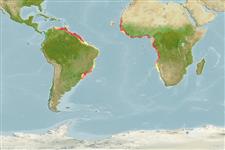
Marine; benthopelagic; depth range 50 - 500 m (Ref. 2683), usually 100 - 500 m (Ref. 26999). Deep-water; 21°N - 29°S, 71°W - 16°E
Eastern Atlantic: Cape Blanc, Mauritania to the Kunene River, Angola. Reported from Namibia (Ref. 27121). Western Atlantic: occurrence in Venezuela is based on 4 samples taken from the coast, of which only one is larger than 20 cm TL (Ref. 13628).
Size / Weight / Age
Maturity: Lm? range ? - ? cm Max length : 50.0 cm TL male/unsexed; (Ref. 2683); common length : 30.0 cm TL male/unsexed; (Ref. 2683)
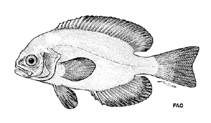
Dorsalspines (total): 5 - 7; Dorsalsoft rays (total): 23 - 26; Analspines: 3; Analsoft rays: 16 - 18. Dark grey-blue to brownish in color; juveniles with irregular horizontal stripes on flanks; fins darker than body; pelvic fins black; eye bluish (Ref. 4410). Body shape (shape guide): short and / or deep.
Haedrich, R.L., 1990. Centrolophidae. p. 1011-1013. In J.C. Quero, J.C. Hureau, C. Karrer, A. Post and L. Saldanha (eds.) Check-list of the fishes of the eastern tropical Atlantic (CLOFETA). JNICT, Lisbon; SEI, Paris; and UNESCO, Paris. Vol. 2. (Ref. 6942)
IUCN Red List Status (Ref. 130435: Version 2025-2)