Sardinella maderensis, Madeiran sardinella : fisheries, bait

You can sponsor this page

Sardinella maderensis (Lowe, 1838)

Madeiran sardinella
Add your observation in Fish Watcher
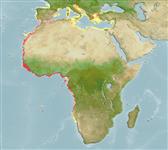
Native range | All suitable habitat | Point map | Year 2050
This map was computer-generated and has not yet been reviewed.
Sardinella maderensis   AquaMaps   Data sources: GBIF OBIS
Upload your photos and videos
Φωτογραφίες | Google image
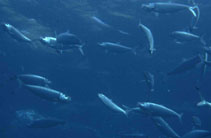
Image of Sardinella maderensis (Madeiran sardinella)
Sardinella maderensis
Picture by Wirtz, P.


Senegal country information

Common names: Eba, Itass, Sardinelle plate
Occurrence: native
Salinity: brackish
Abundance: | Ref:
Importance: highly commercial | Ref: FAO, 1994
Aquaculture: | Ref:
Regulations: | Ref:
Uses: live export: yes;
Comments: Type locality of the lectotype of Alausa eba: 'Gorée' (Ref. 104876; lectotype by Ref. 104885). Known from coast of Atlantic Ocean (Ref. 188, 814, 43850, 43853), Sine-Saloum estuary (Ref. 28587, 97744) and Casamance River estuary (Ref. 33587).
National Checklist:
Country Information: https://www.cia.gov/library/publications/resources/the-world-factbook/geos/sg.html
National Fisheries Authority: http://www.refer.sn/sngal_ct/eco/oeps/
Occurrences: Occurrences Point map
Main Ref: Pandaré, D., S. Niang, H. Diadhiou and B. Capdeville, 1997
National Database:

Common names from other countries

Classification / Names Κοινά ονόματα | Συνώνυμα | Catalog of Fishes(Γένος, Είδη) | ITIS | CoL | WoRMS | Cloffa

> Clupeiformes (Herrings) > Dorosomatidae (Gizzard shads and sardinellas)
Etymology: Sardinella: Latin and Greek, sarda = sardine; name related to the island of Sardinia; diminutive (Ref. 45335).
More on author: Lowe.

Environment: milieu / climate zone / εύρος βάθους / distribution range Οικολογία

Θαλασσινό(ά); Υφάλμυρο pelagic-neritic; ωκεανόδρομο(ς) (Ref. 51243); εύρος βάθους 0 - 80 m (Ref. 27000). Subtropical; 24°C - ? (Ref. 54872); 46°N - 23°S, 17°W - 36°E (Ref. 54872)

Κατανομή Χώρες | Περιοχές FAO | Οικοσυστήματα | Παρουσίες | Σημειακός χάρτης | Εισαγωγές | Faunafri

Atlantic Ocean: southern and eastern parts of Mediterranean Sea, also penetrating the Suez Canal (Ref. 188, 50345), and eastern Atlantic Ocean, from Gibraltar southward to Angola and a single recorded specimen from Walvis Bay in Namibia (Ref. 188, 5286, 81269, 81631, 86940).

Length at first maturity / Μέγεθος / Βάρος / Age

Γεννητική Ωρίμανση: Lm 13.4, range 11 - 19.5 cm
Max length : 30.0 cm SL αρσενικό/απροσδιόριστο; (Ref. 188); common length : 25.0 cm SL αρσενικό/απροσδιόριστο; (Ref. 188); μεγ. δημοσιευμένο βάρος: 927.00 g (Ref. 3808)

Short description Κλείδες προσδιορισμού | Μορφολογία | Μορφομετρία

Ραχιαίες άκανθες (συνολικά) : 0; Μαλακές ραχιαίες ακτίνες (συνολικά) : 18 - 23; Εδρικές άκανθες: 0; Μαλακές εδρικές ακτίνες: 17 - 23; Σπόνδυλοι: 44 - 48. Diagnosis: Body elongate, but variable in depth, belly fairly sharply keeled; with 14-20 pre-pelvic and 12-15 post-pelvic scutes, total scutes 31-34; lower gillrakers 70-166, increasing with growth; upper pectoral finrays white on outer side, the membrane between black (Ref. 188, 3259, 81269, 81631). It resembles Sardinella aurita, but pelvic fin with 1 unbranched and 7 branched rays vs. 1 unbranched and 8 branched rays in S. aurita and no black spot on hind part of gill cover, but faint gold or black area just behind gill opening (Ref. 187, 188). It is distinguished from S. rouxi by having more lower gillrakers, which is only 30-40 in S. rouxi, and the caudal fin grey, its tips almost black vs. pale yellow with distal margin dusky in S. rouxi (Ref. 187, 188, 81269).
Body shape (shape guide): fusiform / normal; Cross section: compressed.

Βιολογία     Γλωσσάρι (π.χ. epibenthic)

A coastal, pelagic species, but tolerant of low salinities (Ref. 188, 5286, 27000, 86940); sometimes in estuaries and lagoons (Ref. 188, 2683). It forms schools, preferring waters of 24°C, at surface or at bottom down to 50m, strongly migratory (Ref. 188, 5286). It feeds on a variety of small planktonic invertebrates, also fish larvae and phytoplankton (Ref. 188, 27165). It breeds only once in the year, during the warm season between July and September, in coastal waters; juveniles and adults show clear north-south migrations in the Gabon-Congo-Angola sector and the Sierra Leone-Mauritania sector of the Atlantic Ocean, each area having nurseries; these movements are correlated with the seasonal upwelling (Ref. 188). It is of considerable importance off West African coasts, but combined with Sardinella aurita in most statistics, partly because both species are often caught together (Ref. 188).

Life cycle and mating behavior Γεννητική Ωρίμανση | Αναπαραγωγή | Γεννοβολία | Αβγά | Γονιμότητα | Προνύμφες

Main reference Upload your references | Αναφορές | Συντονιστής | Συνεργάτες

Whitehead, P.J.P., 1985. FAO Species Catalogue. Vol. 7. Clupeoid fishes of the world (suborder Clupeoidei). An annotated and illustrated catalogue of the herrings, sardines, pilchards, sprats, shads, anchovies and wolf-herrings. FAO Fish. Synop. 125(7/1):1-303. Rome: FAO. (Ref. 188)

IUCN Red List Status (Ref. 130435: Version 2025-1)

  Vulnerable (VU) (A2d); Date assessed: 23 July 2014

CITES

Not Evaluated

CMS (Ref. 116361)

Not Evaluated

Threat to humans

  Harmless


Human uses

αλιεία: πολύ εμπορικό; δόλωμα: usually

Περισσότερες πληροφορίες

Τροφική Οικολογία
Food items (preys)
Σύσταση δίαιτας
Κατανάλωση τροφής
Food rations
Θηρευτές
Οικολογία
Οικολογία
Home ranges
Population dynamics
Παράμετροι Αύξησης
Max. ages / sizes
Length-weight rel.
Length-length rel.
Length-frequencies
Mass conversion
Στρατολόγηση
Αφθονία
Life cycle
Αναπαραγωγή
Γεννητική Ωρίμανση
Maturity/Gills rel.
Γονιμότητα
Γεννοβολία
Spawning aggregations
Αβγά
Egg development
Προνύμφες
Δυναμική προνυμφών
Κατανομή
Χώρες
Περιοχές FAO
Οικοσυστήματα
Παρουσίες
Εισαγωγές
BRUVS - Videos
Anatomy
Επιφάνεια βραγχίων
Brain
Otolith
Physiology
Body composition
Nutrients
Κατανάλωση οξυγόνου
Κολυμβητικός τύπος
Ταχύτητα κολύμβησης
Visual pigments
Fish sound
Diseases & Parasites
Toxicity (LC50s)
Γενετική
Genome
Γενετική
Heterozygosity
Κληρονομικότητα
Human related
Aquaculture systems
Προφίλ υδατοκαλλιεργειών
Στελέχοι
Ciguatera cases
Stamps, coins, misc.
Αναφορές
Αναφορές

Εργαλεία

Special reports

Download XML

Διαδικτυακές πηγές

Estimates based on models

Preferred temperature (Αναφ. 123201): 18 - 27.9, mean 21 °C (based on 208 cells).
Phylogenetic diversity index (Αναφ. 82804):  PD50 = 0.5000   [Uniqueness, from 0.5 = low to 2.0 = high].
Bayesian length-weight: a=0.00851 (0.00693 - 0.01045), b=3.04 (3.01 - 3.07), in cm total length, based on LWR estimates for this species (Ref. 93245).
Τροφικό Επίπεδο (Αναφ. 69278):  3.2   ±0.38 se; based on food items.
Generation time: 3.2 (1.8 - 3.7) years. Estimated as median ln(3)/K based on 12 growth studies.
Ελαστικότητα (Αναφ. 120179):  Μεσαίο(α), ελάχιστος χρόνος για διπλασιασμό πληθυσμού 1,4 - 4,4 έτη (K=0.34; tm=3; tmax=6).
Prior r = 0.57, 95% CL = 0.38 - 0.86, Based on 6 data-limited stock assessments.
Fishing Vulnerability (Ref. 59153):  Moderate vulnerability (35 of 100). 🛈
Climate Vulnerability (Ref. 125649):  Low to moderate vulnerability (32 of 100). 🛈
Price category (Ref. 80766):   Medium.
Nutrients (Ref. 124155):  Calcium = 112 [59, 177] mg/100g; Iron = 1.65 [0.98, 2.68] mg/100g; Protein = 21.3 [20.4, 22.1] %; Omega3 = 0.457 [0.231, 0.866] g/100g; Selenium = 39.4 [20.0, 76.9] μg/100g; VitaminA = 30.2 [9.4, 98.4] μg/100g; Zinc = 0.755 [0.542, 1.131] mg/100g (wet weight); based on nutrient studies.