Ethmalosa fimbriata, Bonga shad : fisheries, aquaculture

You can sponsor this page

Ethmalosa fimbriata (Bowdich, 1825)

Bonga shad
Добавить Ваши наблюдения в Fish Watcher
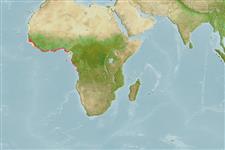
Native range | All suitable habitat | Point map | Year 2050
This map was computer-generated and has not yet been reviewed.
Ethmalosa fimbriata   AquaMaps   Data sources: GBIF OBIS
Загрузить свой Фото и Видео
изображения | Изображение на Google
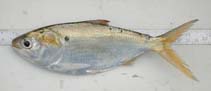
Image of Ethmalosa fimbriata (Bonga shad)
Ethmalosa fimbriata
Изображение сделано Durand, J.-D.


Senegal country information

Common names: Awatt, Chalo, Cobo
Occurrence: native
Salinity: freshwater
Abundance: | Ref:
Importance: commercial | Ref: FAO, 1994
Aquaculture: | Ref:
Regulations: | Ref:
Uses: live export: yes;
Comments: Type locality of the neotype of Ethmalosa fimbriata: 'St. Louis, Senegal' (Ref. 102833); type locality of Meletta senegalensis: 'Sénégal' (Ref. 104876). Known from coast of Atlantic Ocean (Ref. 3068, 43836, 43850), Senegal River (Ref. 5356, 41488, 42792, 43853, 101136, 102833, 118136, 118206), Sine-Saloum estuary (Ref. 5476, 28587, 42792, 45752, 118136, 118206) and Casamance River (Ref. 5476, 27162, 33587, 42792, 118136, 118206). Also Ref. 187, 3054.
National Checklist:
Country Information: https://www.cia.gov/library/publications/resources/the-world-factbook/geos/sg.html
National Fisheries Authority: http://www.refer.sn/sngal_ct/eco/oeps/
Occurrences: Occurrences Point map
Main Ref: Albaret, J.-J., 1987
National Database:

Common names from other countries

Классификация / Names народные названия | синонимы | Catalog of Fishes(род, виды) | ITIS | CoL | WoRMS | Cloffa

> Clupeiformes (Herrings) > Dorosomatidae (Gizzard shads and sardinellas)
Etymology: Ethmalosa: Greek, ethmos, -ou = sieve, also the ethmoides bone + Latin, alausa = a fish cited by Ausonius and Latin, halec = pickle, dealing with the Greek word hals = salt; it is also the old Saxon name for shad = "alli" ; 1591 (Ref. 45335).

Environment: milieu / climate zone / пределы глубины / distribution range экология

морской; пресноводный; солоноватоводный pelagic-neritic; катадромный (Ref. 51243); пределы глубины 0 - 50 m (Ref. 54436), usually 0 - 50 m (Ref. 54436). Tropical; 25°N - 8°S, 17°W - 14°E (Ref. 54436)

распространение страны | регионы FAO | Ecosystems | места находок | карта точек | интродукции | Faunafri

Atlantic Ocean: Eastern central Atlantic Ocean, from Dakhla in Western Sahara southward to Lobito Bay in Angola (Ref. 188, 5286, 81269, 81631), occasionally entering freshwater (Ref. 3509). Reports from Cape Verde Islands are based on an erroneous type locality for Clupea fimbriata by Bowdich (1825), which was later rectified as probably Gambia (Ref. 188, 5286, 94080).

Length at first maturity / Size / Вес / Возраст

половая зрелость: Lm 17.0  range ? - 18.5 cm
Max length : 46.0 cm TL самец/пол неопределен; (Ref. 1989); common length : 25.0 cm TL самец/пол неопределен; (Ref. 187); наибольший вес (опубликованные данные): 1.0 kg (Ref. 1989)

Краткое описание определительные ключи | морфология | морфометрия

колючие лучи спинного плавника (общее число) : 0; членистые (мягкие) лучи спинного плавника (общее число) : 16 - 19; колючие лучи анального плавника: 0; членистые (мягкие) лучи анального плавника: 19 - 25; позвонки: 40 - 44. Diagnosis: Body fairly deep, compressed, scutes present along belly; upper jaw with distinct notch, into which tip of lower jaw fits; lower gillrakers long, fine and numerous, about 3 times as long as gill filaments, upper gillrakers bent sharply upward, V-shaped; pelvic fin rays with 1 unbranched and 7 branched rays; caudal fin tips long and pointed (Ref. 188). A faint dark spot behind gill cover, sometimes followed by others; dorsal fin tip black; caudal fin deep chrome yellow; golden tints on body (Ref. 188, 81269). Ethmalosa fimbriata resembles Sardinella aurita, Sardinella rouxi and especially Sardinella maderensis, but these are more slender, have a rounded upper jaw which is not notched and the upper gillrakers are not bent upward like an elbow (Ref. 188).
Body shape (shape guide): fusiform / normal; Cross section: compressed.

биология     глоссарий (например epibenthic)

Ethmalosa fimbriata is found in fairly shallow coastal waters, lagoons and estuaries, and sometimes also in lower courses of coastal rivers, even more than 300 km up rivers (Ref. 187, 188, 81269, 81631). It feeds principally on phytoplankton, chiefly diatoms, filtered by the very fine gillraker sieve (Ref. 187, 188, 3166). It breeds throughout the year in waters of salinities 3.5-38 ppt, but with peaks in at least some areas; spawns in the sea, in estuaries and in rivers (Ref. 188). The largest fisheries are in Senegal, Sierra Leone, Ivory Coast, Nigeria and Cameroon, mainly in the dry season (Ref. 188).

Life cycle and mating behavior половая зрелость | размножение | нерест | икра | Fecundity | личинки

Breeds all year in waters of salinities 3.5 to 38 ppt, but with peaks in at least some areas, becoming progressively later to south. Spawns in the sea, in estuaries and in rivers.

Основная ссылка Upload your references | ссылки | координатор | соавторы

Whitehead, P.J.P., 1985. FAO Species Catalogue. Vol. 7. Clupeoid fishes of the world (suborder Clupeoidei). An annotated and illustrated catalogue of the herrings, sardines, pilchards, sprats, shads, anchovies and wolf-herrings. FAO Fish. Synop. 125(7/1):1-303. Rome: FAO. (Ref. 188)

Статус Красного Списка МСОП (Ref. 130435: Version 2025-1)

  Не вызывающий беспокойства (LC) ; Date assessed: 30 April 2019

CITES

Not Evaluated

CMS (Ref. 116361)

Not Evaluated

Угроза для людей

  Harmless


Использование человеком

рыболовство: важный объект промысла; аквакультура (рыбоводство): экспериментальный
FAO - рыболовство: landings, Видовой профиль; Publication: search | FIRMS - Stock assessments | FishSource | Sea Around Us

дополнительная информация

Trophic ecology
Food items (preys)
состав пищи
потребление пищи
Food rations
хищники
экология
экология
Home ranges
Population dynamics
Growth parameters
Max. ages / sizes
Length-weight rel.
Length-length rel.
Размерный состав
Mass conversion
пополнение
численность
Life cycle
размножение
половая зрелость
Maturity/Gills rel.
Fecundity
нерест
Spawning aggregations
икра
Развитие икры
личинки
динамика численности личинок
распространение
страны
регионы FAO
Ecosystems
места находок
интродукции
BRUVS - Videos
Anatomy
жаберная область
Brain
Otolith
Physiology
Body composition
Nutrients
Oxygen consumption
Swimming type
Swimming speed
Visual pigments
Fish sound
Diseases & Parasites
Toxicity (LC50s)
генетика
Геном
генетика
Heterozygosity
наследуемость
Human related
Aquaculture systems
особенности рыбоводства
степень растяжения
Ciguatera cases
Stamps, coins, misc.
Outreach
соавторы
ссылки
ссылки

инструменты

Специальные отчеты

Скачать в формате XML

ресурсы в Интернет

AFORO (otoliths) | Aquatic Commons | BHL | Cloffa | Websites from users | Проверить FishWatcher | CISTI | Catalog of Fishes: род, виды | DiscoverLife | ECOTOX | FAO - рыболовство: landings, Видовой профиль; Publication: search | Faunafri | Fishipedia | Fishtrace | GloBI | Google Books | Google Scholar | Google | IGFA World Record | OneZoom | Open Tree of Life | Otolith Atlas of Taiwan Fishes | PubMed | Reef Life Survey | Socotra Atlas | TreeBase | Tree of Life | Wikipedia: Вперёд, поиск | World Records Freshwater Fishing | Zoological Record

Estimates based on models

Preferred temperature (ссылка 123201): 20.2 - 27.9, mean 26.4 °C (based on 180 cells).
Phylogenetic diversity index (ссылка 82804):  PD50 = 1.0000   [Uniqueness, from 0.5 = low to 2.0 = high].
Bayesian length-weight: a=0.00891 (0.00780 - 0.01018), b=3.06 (3.02 - 3.10), in cm total length, based on LWR estimates for this species (Ref. 93245).
Trophic level (ссылка 69278):  2.5   ±0.25 se; based on food items.
устойчивость к внешним воздействиям (ссылка 120179):  высокий, минимальное время удвоения популяции до 15 месяцев (K=0.25-0.36; tm=1; Fec=16,000).
Prior r = 0.23, 95% CL = 0.15 - 0.34, Based on 1 full stock assessment.
Fishing Vulnerability (Ref. 59153):  Low vulnerability (21 of 100). 🛈
Climate Vulnerability (Ref. 125649):  High vulnerability (60 of 100). 🛈
Категория цены (Ref. 80766):   High.
Nutrients (Ref. 124155):  Calcium = 181 [96, 321] mg/100g; Iron = 1.91 [1.04, 3.19] mg/100g; Protein = 19 [17, 21] %; Omega3 = 0.374 [0.211, 0.670] g/100g; Selenium = 65.7 [32.1, 137.4] μg/100g; VitaminA = 8.42 [3.24, 21.22] μg/100g; Zinc = 1.75 [1.23, 2.59] mg/100g (wet weight); based on nutrient studies.