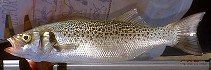
Dicentrarchus punctatus, Spotted seabass : fisheries, gamefish

You can sponsor this page

Dicentrarchus punctatus (Bloch, 1792)

Spotted seabass
Waarneming toevoegen in Fish Watcher
Native range | All suitable habitat | Point map | Year 2050
This map was computer-generated and has not yet been reviewed.
Dicentrarchus punctatus   AquaMaps   Data sources: GBIF OBIS
Uploaden van uw Foto's en video's
Afbeeldingen | Google afbeelding
Image of Dicentrarchus punctatus (Spotted seabass)
Dicentrarchus punctatus
Afbeelding van JJPhoto


Senegal country information

Common names: Dian doulla, Douroï, Silengkeu
Occurrence: native
Salinity: brackish
Abundance: | Ref:
Importance: | Ref:
Aquaculture: | Ref:
Regulations: | Ref:
Uses: live export: yes;
Comments: Occurs in the Sine-Saloum (Ref. 28587, 57391), Senegal and Casamance rivers (Ref. 28587).
National Checklist:
Country Information: https://www.cia.gov/library/publications/resources/the-world-factbook/geos/sg.html
National Fisheries Authority: http://www.refer.sn/sngal_ct/eco/oeps/
Occurrences: Occurrences Point map
Main Ref: Hureau, J.-C., 1991
National Database:

Common names from other countries

Classificatie / Namen Lokale namen | Synoniemen | Catalog of Fishes(Genus, Soort(en)) | ITIS | CoL | WoRMS | Cloffa

> Eupercaria/misc (Various families in series Eupercaria) > Moronidae (Temperate basses)
Etymology: Dicentrarchus: Greek, di = two + Greek, kentron = sting + Greek, archos = anus (Ref. 45335).
More on author: Bloch.

Environment: milieu / Klimaatzone / Diepte / distribution range Ecologie

marien; brak water pelagic-neritic; diepte 30 - ? m (Ref. 5990). Subtropical; 51°N - 10°N

Verspreiding Landen | FAO regio's | Ecosystemen | Voorkomen | Verspreidingskaart | Introducties | Faunafri

Eastern Atlantic: English Channel (occasional) southward along the coasts of Europe and Morocco to Senegal and the Canary Islands; also southern Mediterranean and the Gulf of Suez.

Lengte bij maturiteit / Grootte / Gewicht / Leeftijd

Maturiteit: Lm 21.6  range ? - ? cm
Max length : 70.0 cm TL mannelijk / geslacht onbekend; (Ref. 57391); common length : 30.0 cm TL mannelijk / geslacht onbekend; (Ref. 3397)

Korte beschrijving Determinatiesleutels | Morfologie | Morfometrie

Dorsale stekels (totaal) : 9 - 10; Dorsale zachte stralen (totaal) : 12 - 14; Anale stekels: 3; Anale zachte stralen: 10 - 12. Diagnosis: elongate fish with 2 separate dorsal fins and a rather deep caudal peduncle; vomerine teeth patch anchor-shaped, with the posterior teeth extending to the midline of palate; scales on interorbital space ctenoid; opercle with 2 flat spines; lower preopercular margin with large, forward-pointing spines; caudal fin moderately forked; scales small (Ref. 57391). Coloration: silvery grey, back bluish in life; juveniles and adults with small dark markings scattered over back and sides; a very distinct black spot on opercle (Ref. 57391).
Body shape (shape guide): fusiform / normal.

Biologie     Verklarende woordenlijst (bv. epibenthic)

Coastal species (Ref. 4197), found in coastal marine and brackish waters (Ref. 57391). Occurs on various kinds of bottoms, including sand, muddy sand and rocks; occasionally occurring in rivers (Ref. 6916, 57391). Also capable of living in hypersaline habitats (Sine Saloum in Senegal)(Ref. 57391). Feeds mainly on shrimps and mollusks, also fishes (Ref. 5990).

Levenscyclus en paargedrag Maturiteit | Voortplanting | Paaien | Eieren | Fecunditeit | Larven

Hoofdreferentie Upload uw referenties | Referenties | Coördinator : Heemstra, Phillip C. | Medewerkers

Smith, C.L., 1990. Moronidae. p. 692-694. In J.C. Quero, J.C. Hureau, C. Karrer, A. Post and L. Saldanha (eds.) Check-list of the fishes of the eastern tropical Atlantic (CLOFETA). JNICT, Lisbon; SEI, Paris; and UNESCO, Paris. Vol. 2. (Ref. 6916)

Status op de Rode Lijst van het IUCN (Ref. 130435: Version 2025-1)

  Niet bedreigd (LC) ; Date assessed: 14 July 2014

CITES

Not Evaluated

CMS (Ref. 116361)

Not Evaluated

Gevaar voor de mens

  Harmless


Gebruik door de mens

Visserij: van minder commercieel belang; sportvis: ja
FAO - visserij: aanvoer; Publication: search | FishSource | Sea Around Us

Meer informatie

Trofische ecologie
Food items (preys)
Dieetsamenstelling
Voedselconsumptie
Food rations
Predatoren
Ecologie
Ecologie
Home ranges
Population dynamics
Groeiparameters
Max. ages / sizes
Length-weight rel.
Length-length rel.
Lengtefrequenties
Massaconversie
Rekrutering
Abundantie
Life cycle
Voortplanting
Maturiteit
Maturity/Gills rel.
Fecunditeit
Paaien
Spawning aggregations
Eieren
Ontwikkeling van de eieren
Larven
Larvale populatiedynamiek
Verspreiding
Landen
FAO regio's
Ecosystemen
Voorkomen
Introducties
BRUVS - Videos
Anatomy
Kieuwoppervlak
Brain
Otolith
Physiology
Body composition
Nutrients
Zuurstofverbruik
Zwemtype
Zwemsnelheid
Visual pigments
Fish sound
Diseases & Parasites
Toxicity (LC50s)
Genetica
genoom
Genetica
Heterozygosity
Erfelijkheid
Human related
Aquaculture systems
Aquacultuurprofielen
Kweeklijnen
Ciguatera cases
Stamps, coins, misc.
Outreach
Medewerkers
Referenties
Referenties

Tools

Speciale rapporten

Download XML

Internetbronnen

Estimates based on models

Preferred temperature (Ref. 123201): 13.3 - 20.7, mean 17.3 °C (based on 39 cells).
Fylogenetische diversiteitsindex (Ref. 82804):  PD50 = 0.7656   [Uniqueness, from 0.5 = low to 2.0 = high].
Bayesian length-weight: a=0.00813 (0.00636 - 0.01039), b=3.03 (2.96 - 3.10), in cm total length, based on LWR estimates for this species (Ref. 93245).
Trofisch niveau (Ref. 69278):  3.9   ±0.65 se; based on food items.
Weerstandsvermogen (Ref. 120179):  Gemiddeld, minimale populatieverdubbelingstijd 1,4-4,4 jaar (K=0.07-0.16).
Prior r = 0.25, 95% CL = 0.16 - 0.37, Based on 1 full stock assessment.
Fishing Vulnerability (Ref. 59153):  Moderate vulnerability (36 of 100). 🛈
Climate Vulnerability (Ref. 125649):  High to very high vulnerability (74 of 100). 🛈
Prijsklasse (Ref. 80766):   Medium.
Nutrients (Ref. 124155):  Calcium = 35.4 [3.9, 188.9] mg/100g; Iron = 0.815 [0.282, 2.003] mg/100g; Protein = 20.5 [19.2, 21.9] %; Omega3 = 0.345 [0.187, 0.624] g/100g; Selenium = 10.5 [3.3, 29.4] μg/100g; VitaminA = 9.83 [2.35, 42.99] μg/100g; Zinc = 0.716 [0.328, 1.624] mg/100g (wet weight); based on nutrient studies.