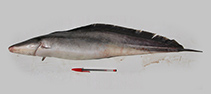
Gymnarchus niloticus, Aba : fisheries

You can sponsor this page

Gymnarchus niloticus Cuvier, 1829

Aba
Upload your photos and videos
Immagini | Stamps, coins, misc. | Google image
Image of Gymnarchus niloticus (Aba)
Gymnarchus niloticus
Picture by KMFRI


Senegal country information

Common names: Alluuxuune, Beesoo, Galakh
Occurrence: native
Salinity: freshwater
Abundance: | Ref:
Importance: | Ref:
Aquaculture: | Ref:
Regulations: | Ref:
Uses: no uses
Comments: Occurs in the Senegal River (Ref. 28587).
National Checklist:
Country Information: https://www.cia.gov/library/publications/resources/the-world-factbook/geos/sg.html
National Fisheries Authority: http://www.refer.sn/sngal_ct/eco/oeps/
Occurrences: Occurrences Point map
Main Ref: Adams-Sow, A. (ed.), 1996
National Database:

Common names from other countries

Classification / Names Nomi Comuni | Sinonimi | Catalog of Fishes(Genere, Specie) | ITIS | CoL | WoRMS | Cloffa

> Osteoglossiformes (Bony tongues) > Gymnarchidae (Abas)
Etymology: Gymnarchus: Greek, gymnos = naked + Greek, archos = anus (Ref. 45335).
More on author: Cuvier.

Environment: milieu / climate zone / distribuzione batimetrica / distribution range Ecologia

; acqua dolce demersale; pH range: 6.5 - 8.0; dH range: 10 - 25; potamodromo (Ref. 51243). Tropical; 23°C - 28°C (Ref. 13614); 18°N - 2°N, 16°W - 36°E

Distribuzione Stati | Aree FAO | Ecosystems | Presenze | Mappa dei ritrovamenti | Introduzioni | Faunafri

Africa: basins of the rivers Senegal, Gambia, Volta, Niger and Chad in West Africa (Ref. 3530, 81275). Also in the Nile River basin (Ref. 3530, 28714) and Lake Turkana (Ref. 3530, 52331).

Size / Peso / Age

Maturità: Lm ?  range ? - ? cm
Max length : 167 cm SL maschio/sesso non determinato; (Ref. 2915); peso massimo pubblicato: 18.5 kg (Ref. 2915)

Short description Chiavi di identificazione | Morfologia | Morfometria

Spine dorsali (totale) : 0; Raggi dorsali molli (totale) : 183 - 230. Diagnosis: body very elongate (Ref. 28714, 81275), anguilliform (Ref. 81275), its depth 7.2-10.6 times in SL, and covered with tiny scales (Ref. 2915, 81275). Lateral line complete (Ref. 81275). Dorsal fin soft-rayed, extending almost over the entire length of back (Ref. 81275), stopping short of a naked tail (Ref. 28714). Pelvic, anal and caudal fins absent (Ref. 28714, 81275), body ending in a thin/sharp point (Ref. 2915, 81275). Pectoral fins reduced (Ref. 81275), 1.9-5.0 times in head length (Ref. 2915, 81275). Head naked, its length 5.6-6.9 times in SL; snout prominent (Ref. 2915, 81275). Mouth large and terminal; teeth strong, pointed or notched, aligned in a single row in both jaws, 12-16 in upper, 22-28 in lower jaw; premaxillae, as well as vomer and palatines, coalesced; maxillae, vomer and palatines toothless; eye very small, without a free margin (covered by skin); only the left gonad is developed and functional (Ref. 81275). Coloration: dark grey to almost black, darker posteriorly; belly whitish (Ref. 81275).
Body shape (shape guide): elongated; Cross section: circular.

Biologia     Glossario (es. epibenthic)

Obligate air-breathing (Ref. 126274); Obligate air-breathing (Ref. 118411, 126274). Inhabits marginal vegetation and swamps constructing a flask-shaped nest in vegetation during the floods, which it is reputed to defend with vigour (Ref. 28714). Following flooding of the Gambia River banks, large elliptical floating nests are build in densely vegetated swamps at depths of about 1-1.5 m, in which about 1000 ‘amber-like’ eggs are laid; larvae hatch after 5 days (Ref. 10609). Feeds on crustaceans, insects and fish (Ref. 28714). No pelvic, anal or caudal fins (Ref. 28714). Possesses an electric organ that extends along almost the entire trunk to the tip of the tail (Ref. 10840). Also equipped with ampullary receptors and two types of tuberous receptors for electroreception (Ref. 10841). Showed increased electric organ discharge (EOD) rate by 50-60 Hz between 21 and 31°C (Ref. 10837).

Life cycle and mating behavior Maturità | Riproduzione | Deposizione | Uova | Fecundity | Larve

Breeds in well-vegetated, marginal areas of swamps and rivers, where a large, floating nest, about 1 m in diameter, is constructed, in which the eggs are laid and later guarded by one of the parents (Ref. 27583). Distinct pairing (Ref. 205).

Main reference Upload your references | Bibliografia | Coordinatore | Collaboratori

Bigorne, R., 1990. Gymnarchidae. p. 185-186. In C. Lévêque, D. Paugy and G.G. Teugels (eds.) Faune des poissons d'eaux et saumâtres d'Afrique de l'Ouest. tome 1. Faune Trop. 28. Musée Royal de l'Afrique Centrale, Tervuren, Belgique and ORSTOM, Paris. (Ref. 2911)

IUCN Red List Status (Ref. 130435: Version 2025-1)

  Least Concern (LC) ; Date assessed: 12 May 2019

CITES

Not Evaluated

CMS (Ref. 116361)

Not Evaluated

Threat to humans

  Harmless


Human uses

Pesca: commerciale
FAO - Aquaculture systems: production; pesca: landings; Publication: search | FishSource |

Informazioni ulteriori

Trophic ecology
Food items (preys)
Alimentazione
Consumo di cibo
Food rations
Predatori
Ecologia
Ecologia
Home ranges
Population dynamics
Growth parameters
Max. ages / sizes
Length-weight rel.
Length-length rel.
Length-frequencies
Mass conversion
Reclutamento
Abbondanza
Life cycle
Riproduzione
Maturità
Maturity/Gills rel.
Fecundity
Deposizione
Spawning aggregations
Uova
Egg development
Larve
Dinamica popolazioni larvali
Distribuzione
Stati
Aree FAO
Ecosystems
Presenze
Introduzioni
BRUVS - Videos
Anatomy
Area branchiale
Brain
Otolith
Physiology
Body composition
Nutrients
Oxygen consumption
Swimming type
Swimming speed
Visual pigments
Fish sound
Diseases & Parasites
Toxicity (LC50s)
Genetica
Genome
Genetica
Heterozygosity
Ereditarietà
Human related
Aquaculture systems
Profili di acquacoltura
Varietà
Ciguatera cases
Stamps, coins, misc.
Outreach
Collaboratori
Taxonomy
Nomi Comuni
Sinonimi
Morfologia
Morfometria
Immagini
Bibliografia
Bibliografia

Strumenti

Special reports

Download XML

Fonti Internet

AFORO (otoliths) | Aquatic Commons | BHL | Cloffa | Websites from users | Check FishWatcher | CISTI | Catalog of Fishes: Genere, Specie | DiscoverLife | ECOTOX | FAO - Aquaculture systems: production; pesca: landings; Publication: search | Faunafri | Fishipedia | Fishtrace | GloBI | Google Books | Google Scholar | Google | IGFA World Record | OneZoom | Open Tree of Life | Otolith Atlas of Taiwan Fishes | Acquari pubblici | PubMed | Reef Life Survey | Socotra Atlas | TreeBase | Tree of Life | Wikipedia: Go, ricerca | World Records Freshwater Fishing | Zoobank | Zoological Record

Estimates based on models

Phylogenetic diversity index (Fonte Biblio. 82804):  PD50 = 1.5000   [Uniqueness, from 0.5 = low to 2.0 = high].
Bayesian length-weight: a=0.00427 (0.00162 - 0.01126), b=3.09 (2.87 - 3.31), in cm total length, based on LWR estimates for this (Sub)family-body shape (Ref. 93245).
Trophic level (Fonte Biblio. 69278):  3.7   ±0.58 se; based on food items.
Generation time: 6.5 ( na - na) years. Estimated as median ln(3)/K based on 1 growth studies.
Resilienza (Fonte Biblio. 120179):  Basso, tempo minimo di raddoppiamento della popolazione 4.5 - 14 anni (K=0.12-0.17).
Fishing Vulnerability (Ref. 59153):  High vulnerability (63 of 100). 🛈
Price category (Ref. 80766):   Unknown.
Nutrients (Ref. 124155):  Calcium = 62.6 [33.3, 136.7] mg/100g; Iron = 1.01 [0.56, 2.07] mg/100g; Protein = 17.4 [15.5, 19.1] %; Omega3 = 0.27 [0.11, 0.68] g/100g; Selenium = 118 [43, 271] μg/100g; VitaminA = 17 [6, 45] μg/100g; Zinc = 1.05 [0.73, 1.57] mg/100g (wet weight);