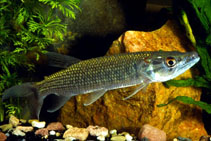
Common names from other countries
>
Characiformes (Characins) >
Hepsetidae (African pikes)
Etymology: Hepsetus: Greek, epsetas, -e, -on = boiled, but there is the following sentence: "oí epsetoi" = certain fishes, and also could be related to "psetta" = grouper (Ref. 45335); odoe: The specific name is possibly derived from the Greek 'odon' which means tooth (Brown 1954) (Ref. 88135).
More on author: Bloch.
Environment: milieu / climate zone / distribuzione batimetrica / distribution range
Ecologia
; acqua dolce demersale; pH range: 6.0 - 7.5; dH range: ? - 18; potamodromo (Ref. 51243). Tropical; 26°C - 28°C (Ref. 2060)
Africa: easternmost part of West Africa, from the Sassandra River, Ivory Coast, in the west to the Shari River, Central African Republic, in the east; and southwards up to the Kribi River in Cameroon (Ref. 88135). Reports from outside this area refer to other species of Hepsetus (Ref. 88135, 93279, 93907, 108775).
Length at first maturity / Size / Peso / Age
Maturità: Lm 14.0 range ? - ? cm
Max length : 44.2 cm SL maschio/sesso non determinato; (Ref. 83624)
Spine dorsali (totale) : 0; Raggi dorsali molli (totale) : 9; Spine anali: 0; Raggi anali molli: 12; Vertebre: 45 - 49. Diagnosis: This species is distinguished from all other Hepsetus species by the following unique combination of characters: number of lateral line scales low, 43–51; nostril-lower jaw distance short, 36.6–42.1% of head length; number of gill rakers high, 17–23; number of scales between dorsal fin and lateral line 7.5-9.5; number of scales between adipose fin and lateral line 4.5-6.5; head width broad, 32.8–42.3% of head length; and internasal distance high, 21.9–28.3% of head length (Ref. 88135).
Body shape (shape guide): elongated.
This species seems to prefer upper river courses or small rivers where Hydrocynus species are absent or scarce (Ref. 81278).
Builds a free-floating bubblenest.
Decru, E., E. Vreven and J. Snoeks, 2012. A revision of the West African Hepsetus (Characiformes: Hepsetidae) with a description of Hepsetus akawo sp. nov. and a redescription of Hepsetus odoe (Bloch, 1794). J. Nat. Hist. 46(1-2):1-23. (Ref. 88135)
IUCN Red List Status (Ref. 130435: Version 2025-1)
Threat to humans
Harmless
Human uses
Pesca: pesca di sussistenza; Acquario: Commerciale
Strumenti
Special reports
Download XML
Fonti Internet
Estimates based on models
Phylogenetic diversity index (Fonte Biblio.
82804): PD
50 = 0.5312 [Uniqueness, from 0.5 = low to 2.0 = high].
Bayesian length-weight: a=0.00550 (0.00412 - 0.00732), b=3.13 (3.05 - 3.21), in cm total length, based on LWR estimates for this species (Ref.
93245).
Trophic level (Fonte Biblio.
69278): 4.1 ±0.71 se; based on food items.
Generation time: 3.8 ( na - na) years. Estimated as median ln(3)/K based on 1
growth studies.
Resilienza (Fonte Biblio.
120179): Medio, tempo minimo di raddoppiamento della popolazione 1.4 - 4.4 anni (K=0.27-0.59; tmax=5; Fec < 10,000).
Fishing Vulnerability (Ref.
59153): Moderate vulnerability (36 of 100).
🛈
Nutrients (Ref.
124155): Calcium = 164 [63, 392] mg/100g; Iron = 2.04 [1.02, 4.59] mg/100g; Protein = 18.9 [16.8, 21.2] %; Omega3 = 0.362 [0.132, 0.962] g/100g; Selenium = 120 [47, 340] μg/100g; VitaminA = 14.6 [5.4, 40.0] μg/100g; Zinc = 1.47 [0.99, 2.21] mg/100g (wet weight);