This website uses cookies to enhance your browsing experience and ensure the functionality of our site. For more detailed information about the types of cookies we use and how we protect your privacy, please visit our Privacy Information page.
×
Cookie Settings
This website uses different types of cookies to enhance your experience. Please select your preferences below:
Performance
These cookies help us understand how visitors interact with our website by collecting and reporting information anonymously. For example, we use Google Analytics to generate web statistics, which helps us improve our website's performance and user experience. These cookies may track information such as the pages visited, time spent on the site, and any errors encountered.
Teleostei (teleosts) > Eupercaria/misc (Various families in series Eupercaria) > Gerreidae (Mojarras)
Etymology: Gerres:Latin, gerres = a kind of anchovies; cited by Plinius. Eponymy: This is a toponym referring to the River Niger; the river (or its mouth, in the case of marine species) being the type locality. (Ref. 128868), visit book page. More on author: Günther.
Environment: milieu / climate zone / depth range / distribution range Ecology
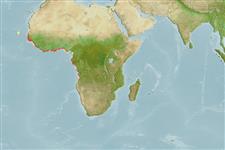
Marine; brackish; benthopelagic; depth range ? - 60 m (Ref. 57394). Tropical; 18°N - 17°S, 29°W - 14°E
Eastern Atlantic: west African coast, from Guinea to Congo (Ref. 57394). Also reported from Senegal (Ref. 4323, 28587, 33587), Gambia (Ref. 5476), Guinea-Bissau (Ref. 26999) and as far south as Angola (Ref. 3166).
Length at first maturity / Size / Weight / Age
Maturity: Lm8.8, range 7 - ? cm Max length : 20.0 cm TL male/unsexed; (Ref. 57394); common length : 15.0 cm TL male/unsexed; (Ref. 2683)
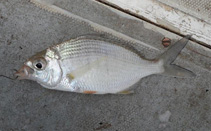
Dorsalspines (total): 9; Dorsalsoft rays (total): 10; Analspines: 3; Analsoft rays: 8. Diagnosis: body oblong and compressed; snout pointed, shorter than eye diameter; mouth strongly protrusible; nostrils contiguous, situated at midpoint between eye and snout tip; dorsal fin deeply notched; pectoral fins long, reaching to, or extending beyond anal-fin origin; large cycloid scales; scales of the interocular space not reaching anterior border of eyes; spinous part of dorsal fin greyish, without a black spot at tip (Ref. 57394).
Coloration: back olivaceous-brown, sides silvery, with longitudinal dark bands; young individuals with narrow, dark vertical bars on sides; spinous part of dorsal fin distally greyish, but without a distinct black spot at tip; juveniles with 2 longitudinal series of dark spots on dorsal fin (Ref. 57394). Body shape (shape guide): fusiform / normal; Cross section: compressed.
Occurs on littoral mud and sand bottoms to about 60 m depth (Ref. 57394). Often enters estuaries and coastal lagoons (Ref. 7375) during reproduction (Ref. 57394). Feeds on fish, shrimps, mollusks, plankton and detritus (Ref. 28587).
Roux, C., 1986. Gerridae. p. 325-326. In J. Daget, J.-P. Gosse and D.F.E. Thys van den Audenaerde (eds.) Check-list of the freshwater fishes of Africa (CLOFFA). ISNB, Brussels; MRAC, Tervuren; and ORSTOM, Paris. Vol. 2. (Ref. 4323)
IUCN Red List Status (Ref. 130435: Version 2025-2)