Euthynnus alletteratus, Little tunny : fisheries, gamefish

You can sponsor this page

Euthynnus alletteratus (Rafinesque, 1810)

Little tunny
Waarneming toevoegen in Fish Watcher
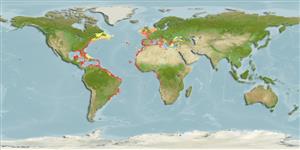
Native range | All suitable habitat | Point map | Year 2050
This map was computer-generated and has not yet been reviewed.
Euthynnus alletteratus   AquaMaps   Data sources: GBIF OBIS
Uploaden van uw Foto's en video's
Afbeeldingen | video's | Postzegels, munten, diversen. | Google afbeelding
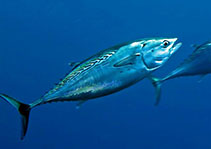
Image of Euthynnus alletteratus (Little tunny)
Euthynnus alletteratus
Afbeelding van Cox, C.D.


Spain territory information

Common names: Bacoreta, Bacoreta
Occurrence: native
Salinity: marine
Abundance: | Ref:
Importance: | Ref:
Aquaculture: | Ref:
Regulations: | Ref:
Uses: no uses
Comments:
National Checklist:
Territory Information: https://www.cia.gov/library/publications/resources/the-world-factbook/geos/sp.html
National Fisheries Authority:
Occurrences: Occurrences Point map
Main Ref: Collette, B.B. and C.E. Nauen, 1983
National Database: ICTIMED

Common names from other countries

Classificatie / Namen Lokale namen | Synoniemen | Catalog of Fishes(Genus, Soort(en)) | ITIS | CoL | WoRMS | Cloffa

> Scombriformes (Mackerels) > Scombridae (Mackerels, tunas, bonitos) > Scombrinae
Etymology: Euthynnus: Greek, eu = good + Greek, thynnos = tunna (Ref. 45335).
More on author: Rafinesque.

Milieu: milieu / Klimaatzone / Diepte / verspreidingsgebied Ecologie

marien; brak water pelagic-oceanic; oceanodroom (Ref. 71039); diepte 1 - 150 m (Ref. 28173). Tropical; 56°N - 30°S, 92°W - 42°E

Verspreiding Gebieden | FAO regio's | Ecosystemen | Voorkomen | Verspreidingskaart | Introducties | Faunafri

Atlantic Ocean: in tropical and subtropical waters, including the Mediterranean, Black Sea, Caribbean Sea and Gulf of Mexico. Highly migratory species

Lengte bij maturiteit / Grootte / Gewicht / Leeftijd

Maturiteit: Lm 41.8  range ? - 60 cm
Max length : 122 cm TL mannelijk / geslacht onbekend; (Ref. 26340); common length : 80.0 cm TL mannelijk / geslacht onbekend; (Ref. 5217); max. gepubliceerd gewicht: 16.5 kg (Ref. 40637); max. gerapporteerde leeftijd: 10 Jaren (Ref. 28173)

Korte beschrijving Determinatiesleutels | Morfologie | Morfometrie

Dorsale stekels (totaal) : 15 - 16; Dorsale zachte stralen (totaal) : 11 - 13; Anale stekels: 0; Anale zachte stralen: 11 - 15; Wervels: 39. Anterior spines of first dorsal fin much higher than the those mid-way, giving the fin a strongly concave outline. Interpelvic process small and bifid. Body naked except for corselet and lateral line. Swim bladder absent. Incipient protuberances on 33rd and 34th vertebrae. Back with broken oblique stripes (Ref. 168). Caudal peduncle with 7-8 finlets. Dark stripes on the back and with 3-7 dark spots between pelvic and pectoral fins (Ref. 35388).
Body shape (shape guide): fusiform / normal; Cross section: oval.

Biologie     Verklarende woordenlijst (bv. epibenthic)

Found in neritic waters close inshore (Ref. 13628). This schooling species is an opportunistic predator which feeds on virtually everything within its range, i.e. crustaceans, fishes (mainly clupeoid), squids, heteropods and tunicates. Eggs and larvae are pelagic (Ref. 6769). Specialized traps (madragues) are used in Tunisia and Morocco. Diving bird flocks may indicate large schools (Ref. 9710). Utilized fresh, dried-salted, smoked, canned and frozen (Ref. 9987). A popular game fish (Ref. 9710).

Levenscyclus en paargedrag Maturiteit | Voortplanting | Paaien | Eieren | Fecunditeit | Larven

Eggs are shed in several batches when the water is warmest.

Hoofdreferentie Upload uw referenties | Referenties | Coördinator : Collette, Bruce B. | Medewerkers

Collette, B.B. and C.E. Nauen, 1983. FAO Species Catalogue. Vol. 2. Scombrids of the world. An annotated and illustrated catalogue of tunas, mackerels, bonitos and related species known to date. Rome: FAO. FAO Fish. Synop. 125(2):137 p. (Ref. 168)

Status op de Rode Lijst van het IUCN (Ref. 130435: Version 2025-2 (Global))

  Niet bedreigd (LC) ; Date assessed: 01 March 2022

CITES

Not Evaluated

CMS (Ref. 116361)

Not Evaluated

Gevaar voor de mens

  Reports of ciguatera poisoning (Ref. 30303)


Gebruik door de mens

Visserij: commercieel; sportvis: ja
FAO - visserij: aanvoer; Publication: search | FIRMS - Stock assessments | FishSource | Sea Around Us

Meer informatie

Trofische ecologie
Voedsel (prooien)
Dieetsamenstelling
Voedselconsumptie
Voedselrantsoenen
Predatoren
Ecologie
Ecologie
Home ranges
Populatiedynamica
Groeiparameters
Max. leeftijden / maten
Lengte-gewicht rel.
Lengte-lengte rel.
Lengtefrequenties
Massaconversie
Rekrutering
Abundantie
Verspreiding
Gebieden
FAO regio's
Ecosystemen
Voorkomen
Introducties
BRUVS - Video's
Anatomie
Kieuwoppervlak
Hersenen
Otoliet
Fysiologie
Lichaamssamenstelling
Voedingsstoffen
Zuurstofverbruik
Type zwemmen
Zwemsnelheid
Visuele pigmenten
Vis geluid
Ziekten en parasieten
Toxiciteit (LC50)
Genetica
genoom
Genetica
Heterozygositeit
Erfelijkheid
Menselijk gerelateerd
Aquacultuursystemen
Aquacultuurprofielen
Kweeklijnen
Ciguatera gevallen
Postzegels, munten, diversen.
Outreach
Medewerkers
Referenties
Referenties

Tools

Speciale rapporten

Download XML

Internetbronnen

Schattingen op basis van modellen

Gewenste temperatuur (Ref. 123201): 11.5 - 27.8, mean 23.3 °C (based on 1094 cells).
Fylogenetische diversiteitsindex (Ref. 82804):  PD50 = 0.6250   [Uniqueness, from 0.5 = low to 2.0 = high].
Bayesian length-weight: a=0.01000 (0.00867 - 0.01153), b=3.06 (3.02 - 3.10), in cm total length, based on LWR estimates for this species (Ref. 93245).
Trofisch niveau (Ref. 69278):  4.5   ±0.0 se; based on diet studies.
Weerstandsvermogen (Ref. 120179):  Gemiddeld, minimale populatieverdubbelingstijd 1,4-4,4 jaar (K=0.13-0.22; tm=2; tmax=8; Fec=71,000).
Prior r = 0.57, 95% CL = 0.37 - 0.85, Based on 5 data-limited stock assessments.
Kwetsbaarheid van de visserij (Ref. 59153):  Moderate vulnerability (41 of 100). 🛈
Kwetsbaarheid voor het klimaat (Ref. 125649):  Moderate vulnerability (40 of 100). 🛈
Prijsklasse (Ref. 80766):   Medium.
Voedingsstoffen (Ref. 124155):  Calcium = 15.6 [6.9, 118.0] mg/100g; Iron = 1.86 [0.70, 4.94] mg/100g; Protein = 23.1 [21.1, 24.8] %; Omega3 = 0.228 [0.133, 0.398] g/100g; Selenium = 58.4 [30.9, 111.8] μg/100g; VitaminA = 24.3 [5.5, 105.8] μg/100g; Zinc = 0.487 [0.245, 1.888] mg/100g (wet weight); based on nutrient studies.