This website uses cookies to enhance your browsing experience and ensure the functionality of our site. For more detailed information about the types of cookies we use and how we protect your privacy, please visit our Privacy Information page.
×
Cookie Settings
This website uses different types of cookies to enhance your experience. Please select your preferences below:
Teleostei (teleosts) > Carangaria/misc (Various families in series Carangaria) > Polynemidae (Threadfins)
Etymology: Galeoides:Greek, galeos = a shark + suffix oides = similar to (Ref. 45335). More on author: Bloch.
Environment: milieu / climate zone / depth range / distribution range Ecology
Marine; brackish; demersal; depth range 10 - 70 m (Ref. 10799). Subtropical; 37°N - 27°S, 19°W - 16°E (Ref. 57343)
Eastern Atlantic: West African coasts, from Canary Islands and Morocco to Angola (Ref. 57402). Sporadically known from Algeria and Namibia (Ref. 57343). Record from Mauritius is likely to be erroneous.
Length at first maturity / Size / Weight / Age
Maturity: Lm11.6 range ? - ? cm Max length : 50.0 cm TL male/unsexed; (Ref. 5377); common length : 30.0 cm TL male/unsexed; (Ref. 3659)
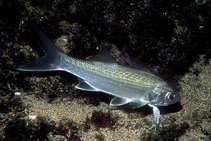
Dorsalspines (total): 9; Dorsalsoft rays (total): 13 - 14. Diagnosis: 9-10 short detached pectoral filaments, not exceeding length of upper pectoral fin; body moderately elongate and compressed, its height comprised 2.9-3.4 times in standard length; snout very short, blunt and prominent; mouth inferior; posterior edge of maxillary only slightly expanded, barely reaching past eye; 2 widely separated dorsal fins, 1st with 8 spines, 2nd with 1 flexible spine and 13-14 soft rays; 2nd
dorsal fin and anal fin bases barely equal; pectoral fin inserted low on body; scales ctenoid; head and unpaired fins partly covered with small scales (Ref. 57402).
Coloration: body uniformly silvery, upper part greyish and belly white; a large rounded black spot, about equal to eye diameter, generally visible under lateral line, behind opercle (Ref. 57402). Body shape (shape guide): fusiform / normal.
Occurs over sandy (Ref. 2683) and muddy bottoms in shallow waters (Ref. 4340), frequently in brackish habitats (Ref. 4340, 57402) and estuaries, but not in freshwaters (Ref. 57402). Feeds on benthic invertebrates (Ref. 5377). Sold fresh, dried salted or smoked (Ref. 36127).
Life cycle and mating behavior Maturity | Reproduction | Spawning | Eggs | Fecundity | Larvae
Daget, J. and J.C. Njock, 1986. Polynemidae. p. 352-354. In J. Daget, J.-P. Gosse and D.F.E. Thys van den Audenaerde (eds.) Check-list of the freshwater fishes of Africa (CLOFFA). ISNB, Brussels; MRAC, Tervuren; and ORSTOM, Paris. Vol. 2. (Ref. 4340)
IUCN Red List Status (Ref. 130435: Version 2025-2)