Common names from other countries
>
Carangiformes (Jacks) >
Istiophoridae (Billfishes)
Etymology: Tetrapturus: Greek, tetra = four + Greek, pteron, fin, wing (Ref. 45335).
Eponymy: Albert Pflueger Sr. (d: 1962) was a taxidermist based in Miami who invented a new method of mounting fish specimens, especially large ‘sport’ specimens like tarpon and sailfish. (Ref. 128868), visit book page.
More on authors: Robins, de & Sylva.
Miljö: miljö / Klimatzon / djupintervall / distributionsområde
Ekologi
marina pelagic-oceanic; havsvandrande (Ref. 71039); djupintervall 0 - 200 m (Ref. 43), usually 100 - ? m (Ref. 4770). Subtropical; 44°N - 33°S, 98°W - 17°E (Ref. 43)
Atlantic Ocean: widely distributed in offshore waters, much more densely so in the western than in the eastern Atlantic. Highly migratory species.
Storlek / Vikt / Ålder
Könsmognad: Lm ? range ? - ? cm
Max length : 254 cm FL hane/ej könsbestämd; (Ref. 40637); common length : 165 cm OT hane/ej könsbestämd; (Ref. 43); publicerad maxvikt: 58.0 kg (Ref. 40637)
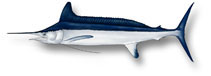
Taggstrålar i ryggfenan (totalt) : 0; Mjukstrålar i ryggfenan (totalt) : 50 - 57; Taggstrålar i analfenan: 0; Mjukstrålar i analfenan: 18 - 21; Ryggkotor: 24. Blue-black above, silvery white splattered with brown on the sides, silvery white below; dorsal fins dark blue; pectorals blackish brown, occasionally with tinges of greyish white; pelvic fins blue-black with a black fin membrane; 1st anal fin dark blue with silvery white at base; 2nd anal fin blackish brown.
Body shape (shape guide): elongated.
Oceanic species, chiefly found in offshore waters, usually above the thermocline. Feed mainly on pelagic fishes and squids (Ref. 4770). Females probably spawn once a year (Ref. 4770). Marketed frozen.
Livscykel och parningsbeteende
Könsmognad | Reproduktion | Lek | Ägg | Fekunditet | Larver
Maturation seems to occur at the same time rather than in the same season both in the northern and southern hemisphere, which could be suggestive of homogeneity of the population of this species. Females probably spawn once a year (Ref. 4770).
Nakamura, I., 1985. FAO species catalogue. Vol. 5. Billfishes of the world. An annotated and illustrated catalogue of marlins, sailfishes, spearfishes and swordfishes known to date. FAO Fish. Synop. 125(5):65p. Rome: FAO. (Ref. 43)
Status på IUCN:s rödlista (Ref. 130435: Version 2025-2)
Hot mot människor
Harmless
Mänskliga användningsområden
Fiskeri: mindre kommeriell; sportfisk: ja
Verktyg
Särskilda rapporter
Ladda ner XML
Internet-källor
Uppskattningar baserade på modeller
Önskad temperatur (Ref.
123201): 14.1 - 23.7, mean 18.2 °C (based on 140 cells).
Index för fylogenetisk mångfald (Ref.
82804): PD
50 = 0.5630 [Uniqueness, from 0.5 = low to 2.0 = high].
Bayesian length-weight: a=0.00447 (0.00195 - 0.01025), b=3.14 (2.94 - 3.34), in cm total length, based on LWR estimates for this (Sub)family-body shape (Ref.
93245).
Trofisk nivå (Ref.
69278): 4.4 ±0.4 se; based on diet studies.
Resiliens (Ref.
120179): Mellan, lägsta populationsfördubblingstid 1,4-4,4 år (Assuming tm=2-4).
Sårbarhet i fisket (Ref.
59153): Very high vulnerability (90 of 100).
🛈
Sårbarhet för klimatet (Ref.
125649): High to very high vulnerability (65 of 100).
🛈
Näringsämnen (Ref.
124155): Calcium = 37.9 [17.3, 66.4] mg/100g; Iron = 1.05 [0.60, 1.83] mg/100g; Protein = 19.7 [18.5, 20.8] %; Omega3 = 0.231 [0.124, 0.428] g/100g; Selenium = 44.6 [22.8, 89.1] μg/100g; VitaminA = 5.4 [1.7, 17.5] μg/100g; Zinc = 0.368 [0.250, 0.552] mg/100g (wet weight);