Common names from other countries
Elasmobranchii (hajar och rockor) (sharks and rays) >
Carcharhiniformes (Ground sharks) >
Carcharhinidae (Requiem sharks)
Etymology: Carcharhinus: karcharos (Gr.), sharp or jagged; rhinus, an ancient name for sharks, from rhine (Gr.), rasp, both words alluding to a shark's jagged, rasp-like skin (See ETYFish); leucas: From leukos (Gr.), white, referring to its body color, usually grayish with white underside [authorship often attributed to Müller & Henle, who published Valenciennes’ description] (See ETYFish).
Miljö: miljö / Klimatzon / djupintervall / distributionsområde
Ekologi
marina; sötvatten; brackvatten revassocierade; amfidrom (Ref. 51243); djupintervall 1 - 164 m (Ref. 106604), usually 1 - 30 m (Ref. 55183). Subtropical; 42°N - 39°S, 180°W - 180°E (Ref. 55182)
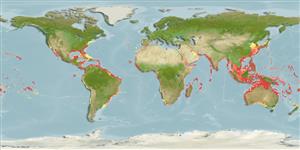
Cosmopolitan in tropical and subtropical waters (Ref. 81283): widespread in warm oceans, rivers and lakes (Ref. 4716). Western Atlantic: Massachusetts, USA to Argentina (Ref. 58839); eastern Atlantic: Morocco, Senegal to Angola (Ref. 81283, 81623); Indo-Pacific: Kenya and South Africa to India, then, Viet Nam to Australia; southern Baja California, Mexico to Ecuador and possibly occurring in Peru. Africa: in freshwater found in rivers of West Africa from Gambia River to Ogowe River (Ref. 81283) and in the Cuanza in Angola (Ref. 120641).
Sympatric with Carcharhinus amboinensis, Glyphis gangeticus.
Längd vid första mognad / Storlek / Vikt / Ålder
Könsmognad: Lm 201.0, range 180 - 230 cm
Max length : 360 cm TL hane/ej könsbestämd; (Ref. 85726); 400.0 cm TL (female); common length : 260 cm TL hane/ej könsbestämd; (Ref. 9253); publicerad maxvikt: 316.5 kg (Ref. 40637); rapporterad maxålder: 32 år (Ref. 42004)
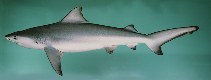
Taggstrålar i ryggfenan (totalt) : 0; Taggstrålar i analfenan: 0. Diagnosis: Carcharhinus leucas is a massive shark with a short, broad and blunt snout, small eyes and triangular saw-edged upper teeth, and lack of interdorsal ridge, characters which are sufficient to distinguish this species (Ref. 26938).
Body shape (shape guide): fusiform / normal.
A coastal and freshwater shark inhabiting shallow waters especially in bays, estuaries, rivers, and lakes (Ref. 244). It readily penetrates far up rivers and hypersaline bays and littoral lagoons (Ref. 9997, 44894, 81283). Capable of covering great distances (up to 180 kilometers in 24 hours), moving between fresh and brackish water at random (Ref. 44894). Adults often found near estuaries and freshwater inflows to the sea; young enter rivers and may be found hundreds of km from the sea (Ref. 4967, 44894, 58304). Feeds on bony fishes, other sharks, rays, mantis shrimps, crabs, squid, sea snails, sea urchins, mammalian carrion, sea turtles, and occasionally garbage (Ref. 244, 5578, 44894). Viviparous (Ref. 50449). Gives birth to litters of up to 13 young (Ref. 26938, 44894). Size at birth is 56-81 cm TL (Ref. 81623). Sexual maturity is attained after 10-15 years (at a length between 160-200 centimeters) (Ref. 44894). Though not commercially important, this species is a good food fish (Ref. 12484). Utilized fresh, fresh-frozen or smoked for human consumption, fins for soup, hide for leather, liver for oil, and carcass for fishmeal (Ref. 244). Very hardy and lives well in captivity (Ref. 244). This large shark is potentially dangerous to man (Ref. 81283), probably the most dangerous species of tropical shark (Ref. 244), and it is repeatedly implicated in attacks on humans (Ref. 4967, 44894); attacks in fresh water are rare (Ref. 44894).
Viviparpous, with a yolk-sac placenta, 1-13 young in a litter. Size at birth about 60 cm TL (Ref. 9997). In the western North Atlantic off Florida and the Gulf of Mexico, and off South Africa, young are born in late spring or early summer. Off Nicaragua, females may have young throughout the year, with a peak in spring and early summer. Estimated gestation period is 10 to 11 months (Ref. 244). Distinct pairing with embrace (Ref. 205). Females often have courtship scars, but males are rarely seen with fighting scars (Ref. 244).
Compagno, L.J.V., 1984. FAO Species Catalogue. Vol. 4. Sharks of the world. An annotated and illustrated catalogue of shark species known to date. Part 2 - Carcharhiniformes. FAO Fish. Synop. 125(4/2):251-655. Rome: FAO. (Ref. 244)
Status på IUCN:s rödlista (Ref. 130435: Version 2025-2)
Hot mot människor
Traumatogenic (Ref. 4690)
Mänskliga användningsområden
Fiskeri: kommersiell; sportfisk: ja
Verktyg
Särskilda rapporter
Ladda ner XML
Internet-källor
Uppskattningar baserade på modeller
Önskad temperatur (Ref.
123201): 23.2 - 29, mean 27.5 °C (based on 2930 cells).
Index för fylogenetisk mångfald (Ref.
82804): PD
50 = 0.5000 [Uniqueness, from 0.5 = low to 2.0 = high].
Bayesian length-weight: a=0.00501 (0.00405 - 0.00620), b=3.06 (3.02 - 3.10), in cm total length, based on LWR estimates for this species (Ref.
93245).
Trofisk nivå (Ref.
69278): 4.3 ±0.5 se; based on diet studies.
Resiliens (Ref.
120179): Mycket låg, lägsta populationsfördubblingstid mer än 14 år (K=0.04-0.15; tm=6-21; tmax=32; Fec=1-13).
Sårbarhet i fisket (Ref.
59153): Very high vulnerability (82 of 100).
🛈
Näringsämnen (Ref.
124155): Calcium = 2.56 [0.48, 14.67] mg/100g; Iron = 0.304 [0.074, 0.932] mg/100g; Protein = 23 [20, 25] %; Omega3 = 0.151 [0.052, 0.397] g/100g; Selenium = 17.1 [5.0, 54.8] μg/100g; VitaminA = 28 [7, 105] μg/100g; Zinc = 0.431 [0.202, 0.866] mg/100g (wet weight);