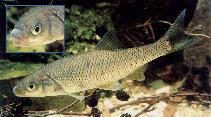
Common names from other countries
Classification / Names
ชื่อสามัญ | ชื่อพ้อง | Catalog of Fishes(สกุล, ชนิด) | ITIS | CoL | WoRMS | Cloffa
Environment: milieu / climate zone / ระดับความลึก / distribution range
นิเวศวิทยา
; น้ำจืด; กร่อย กลุ่มสัตว์หน้าดิน,กลุ่มสัตว์พื้นท้องน้ำ; pH range: 6.0 - 8.0; สัตว์น้ำจืดที่มีการอพยพอย่างแท้จริงภายในแหล่งน้ำจืดเท่านั้น (Ref. 51243); ระดับความลึก 1 - ? m. Temperate; 4°C - 22°C (Ref. 41616); 72°N - 41°N, 10°W - 155°E
Europe and Asia: North, Baltic, White and Barents Sea basins; Caspian basin, in Volga and Ural drainages; Black Sea basin, from Danube to Dniepr drainages; Atlantic basin, in Seine drainage; Mediterranean basin from Rhône to Arch drainages (France). Only very localized in Danube main river in Romania, in Scandinavia north of 69°N and most of cenral Finland. Populations from Siberia and East Asia usually referred to Leuciscus leuciscus are distinct species, Leuciscus baicalensis and Leuciscus dzungaricus (Ref. 59043). Has become widespread in Europe and gained access to Ireland as a bait fish. At least one country reports adverse ecological impact after introduction (Ref. 1739).
Length at first maturity / ขนาด / น้ำหนัก / Age
วัยเจริญพันธุ์: Lm 17.9 range ? - ? cm
Max length : 40.0 cm TL เพศผู้/กระเทย; (Ref. 30578); common length : 15.0 cm TL เพศผู้/กระเทย; (Ref. 556); น้ำหนักสูงสุดที่มีการรายงาน: 1.0 kg (Ref. 30578); อายุสูงสุดที่ได้รายงาน: 16 ปี (Ref. 41616)
เงี่ยงครีบหลัง (รวม) : 2 - 3; ก้านครีบอ่อนที่หาง (รวม) : 7 - 9; เงี่ยงครีบก้น: 3; ก้านครีบอ่อนที่ก้น: 8 - 9; สัตว์มีกระดูกสันหลัง: 42 - 46. Diagnosed from congeners in Europe by the following characters: subinferior or subterminal mouth; subequal jaw, upper jaw slightly longer; upper lip tip about level with center of eye; not projecting snout; articulation of lower jaw distinctly behind anterior margin of eye; horizontal branch of preoperculum shorter than vertical branch; and 40-50 + 1-2 scales on lateral line (Ref. 59043). Rarely longer than 30 cm TL; normally 47-52 scales in lateral line; anal fin concave; caudal fin forked with 19 rays (Ref. 41616).
Body shape (shape guide): fusiform / normal; Cross section: oval.
Gregarious fish which swims near the surface (Ref. 30578). Inhabits moderate to fast-flowing large streams to large rivers with rock or gravel bottom. Adults aggregate in dense swarms in winter in the lower reaches of rivers or backwaters and often migrate to spawning streams in autumn and overwinter there. Juveniles spend winter in cavities along the shores. Early juveniles occur in very shallow shoreline habitats and when they grow, they leave the shores for faster-flowing waters. Feeding larvae thrive along shores. Prey on small invertebrates. Spawns in fast-flowing water on shallow gravel beds, often in small tributaries (Ref. 59043). Breeds in March and April (Ref. 30578). Pale yellow eggs are found attached to gravel and stones in shallow, flowing water (Ref. 41678).
Regularly undertake migration of some tens of km to spawning sites, which are often situated in tributaries. Males form large aggregations, each male defending a small territory. Females lay sticky eggs into excavaitons made in gravel (Ref. 59043).
Kottelat, M. and J. Freyhof, 2007. Handbook of European freshwater fishes. Publications Kottelat, Cornol and Freyhof, Berlin. 646 pp. (Ref. 59043)
IUCN Red List Status (Ref. 130435: Version 2025-1)
Threat to humans
Potential pest (Ref. 13686)
Human uses
การประมง: ไม่มีผลประโยชน์; การตกปลาเป็นกีฬา: ใช่; เหยื่อ: usually
เครื่องมือ
Special reports
Download XML
แหล่งที่มาจากอินเตอร์เน็ต
Estimates based on models
Phylogenetic diversity index (อ้างอิง
82804): PD
50 = 0.5000 [Uniqueness, from 0.5 = low to 2.0 = high].
Bayesian length-weight: a=0.00631 (0.00545 - 0.00731), b=3.16 (3.13 - 3.19), in cm total length, based on LWR estimates for this species (Ref.
93245).
ระดับชั้นอาหาร (อ้างอิง
69278): 2.9 ±0.1 se; based on diet studies.
ความสามารถในการกลับคืนสู่ปกติ (อ้างอิง
120179): ขนาดกลาง, เวลาต่ำสุดที่จะทำให้ประชากรเพิ่มขึ้นเป็น 2 เท่าใช้เวลา 1.4 - 4.4 ปี (K=0.18-0.25; tm=3-4; tmax=10).
Fishing Vulnerability (Ref.
59153): Moderate to high vulnerability (48 of 100).
🛈
Nutrients (Ref.
124155): Calcium = 113 [51, 231] mg/100g; Iron = 0.783 [0.453, 1.420] mg/100g; Protein = 19.1 [17.5, 20.8] %; Omega3 = 0.601 [0.267, 1.255] g/100g; Selenium = 8.31 [4.09, 16.84] μg/100g; VitaminA = 25.7 [8.6, 75.4] μg/100g; Zinc = 1.02 [0.69, 1.49] mg/100g (wet weight);