Clupeonella cultriventris, Black and Caspian Sea sprat : fisheries

You can sponsor this page

Clupeonella cultriventris (Nordmann, 1840)

Black and Caspian Sea sprat
Ajouter votre observation dans Fish Watcher
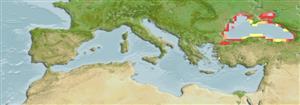
Native range | All suitable habitat | Point map | Year 2050
This map was computer-generated and has not yet been reviewed.
Clupeonella cultriventris   AquaMaps   Data sources: GBIF OBIS
Envoyez vos Photos et vidéos
Images | Images Google
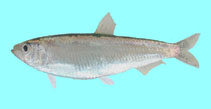
Image of Clupeonella cultriventris (Black and Caspian Sea sprat)
Clupeonella cultriventris
Photo de Otel, V.


Turkmenistan territory information

Common names: [No common name]
Occurrence: native
Salinity: freshwater
Abundance: | Ref:
Importance: commercial | Ref: FAO, 1994
Aquaculture: | Ref:
Regulations: | Ref:
Uses: no uses
Comments:
National Checklist:
Territory Information: https://www.cia.gov/library/publications/resources/the-world-factbook/geos/tx.html
National Fisheries Authority:
Occurrences: Occurrences Point map
Main Ref: Whitehead, P.J.P., 1984
National Database:

Common names from other countries

Classification / Noms Noms communs | Synonymes | Catalog of Fishes(Genre, Espèce) | ITIS | CoL | WoRMS | Cloffa

> Clupeiformes (Herrings) > Ehiravidae (River sprats)
Etymology: Clupeonella: Latin, clupea = sardine, derived from Clupeus = shield; diminutive (Ref. 45335)cultriventris: "cultiventris" is taken from the Latin word, culter, meaning to cultivate. The ventral area of this fish is in the shape of a coulter, a vertical iron cutting blade fixed in front of a ploughshare (Ref. 72389).

Environnement : milieu / zone climatique / profondeur / gamme de distribution Écologie

marin; eau douce; saumâtre pelagic-neritic; anadrome (Ref. 51243); profondeur 10 - 13 m (Ref. 10535). Temperate; 60°N - 36°N, 27°E - 56°E

Distribution Territoires | Zones FAO | Écosystèmes | Occurrences | Carte par point | Introductions | Faunafri

Eurasia: Black Sea (northwestern parts), Sea of Azov and Caspian Sea, also most of the affluent rivers of the area, reaching as far as 60 km inland. Also, Lake Palaeostomi (Bulgaria) and in Bay of Feodosiya (Romania), also Lake Apolyont (Turkey) (Ref. 188). Previously, two subspecies were recognized by some: Clupeonella cultriventris cultriventris (Nordmann, 1840) from the Black Sea and the Sea of Azov and Clupeonella cultriventris caspia (Svetovidov, 1941) from the Caspian Sea (Ref. 26334, 39702).

Taille / Poids / Âge

Maturité: Lm ?  range ? - ? cm
Max length : 14.5 cm TL mâle / non sexé; (Ref. 72389); common length : 10.0 cm SL mâle / non sexé; (Ref. 188); âge max. reporté: 5 années (Ref. 10535)

Description synthétique Clés d'identification | Morphologie | Morphométrie

Épines dorsales (Total) : 0; Rayons mous dorsaux (Total) : 13 - 21; Épines anales: 0; Rayons mous anaux: 12 - 23. Head short and wide; belly sharply keeled, with 24 to 29 scutes; pectoral fin tips pointed; last 2 anal fin rays enlarged; pterotic bulla absent; no notch at the center of the upper jaw. Based on pelvic and pectoral fin length, Svetovidov (1952 and 1963) recognized 2 subspecies: C. cultriventris cultriventris with longer pectoral and pelvic fins compared to that of C. cultriventris caspia.
Body shape (shape guide): fusiform / normal; Cross section: compressed.

Biologie     Glossaire (ex. epibenthic)

Essentially a brackish water species but tolerating salinities up to 34 ppt and with semi-anadromous and purely freshwater forms in rivers and lakes. Forms schools. Migratory between winter or autumn feeding and summer spawning grounds. Feeds on zooplankton (Ref. 188); crustaceans such as copepods and cladocerans (Ref. 59043). Breeds in early summer in the Sea of Azov with a peak in May, and from about May in the lower reaches of rivers (e.g. Dneiper and Dneister) (Ref. 188). Eggs are pelagic (Ref. 59043).

Cycle de vie et comportement reproducteur Maturité | Reproduction | Frai | Œufs | Fécondité | Larves

Référence principale Téléchargez vos références | Références | Coordinateur | Collaborateurs

Whitehead, P.J.P., 1985. FAO Species Catalogue. Vol. 7. Clupeoid fishes of the world (suborder Clupeoidei). An annotated and illustrated catalogue of the herrings, sardines, pilchards, sprats, shads, anchovies and wolf-herrings. FAO Fish. Synop. 125(7/1):1-303. Rome: FAO. (Ref. 188)

Statut dans la liste rouge de l'IUCN (Ref. 130435: Version 2025-2 (Global))

  Préoccupation mineure (LC) ; Date assessed: 20 April 2022

CITES

Not Evaluated

CMS (Ref. 116361)

Not Evaluated

Menace pour l'homme

  Harmless


Utilisations par l'homme

Pêcheries: hautement commercial
FAO - pêcheries: débarquements, Résumé espèce; Publication: search | FishSource | Sea Around Us

Plus d'informations

Écologie trophique
Aliments (proies)
Composition du régime alimentaire
Consommation alimentaire
Rations alimentaires
Prédateurs
Écologie
Écologie
Home ranges
Dynamique des populations
Paramètres de croissance
Âges / tailles maximales
Longueur-poids rel.
Rel. longueur-longueur.
Fréquences de longueurs
Conversion de masse
Recrutement
Abondance
Cycle de vie
Reproduction
Maturité
Maturité/épines rel.
Fécondité
Frai
Agrégats de frai
Œufs
Développement de l'œuf
Larves
Dynamique des populations larvaires
Anatomie
Surface branchiale
Cerveau
Otolithe
Physiologie
Composition corporelle
Nutriments
Consommation d'oxygène
Type de natation
Vitesse de nage
Pigments visuels
Son de poisson
Maladies et parasites
Toxicité (CL50)
Génétique
génôme
Génétique
Hétérozygotie
Héritabilité
Liées à l'homme
Systèmes d'aquaculture
Profils d'aquaculture
Souches
Cas de ciguatera
Timbres, pièces de monnaie, divers
Sensibilisation
Collaborateurs
Références
Références

Outils

Articles particuliers

Télécharger en XML

Sources Internet

AFORO (otoliths) | Alien/Invasive Species database | Aquatic Commons | BHL | Cloffa | Websites from users | FishWatcher | CISTI | Catalog of Fishes: Genre, Espèce | DiscoverLife | ECOTOX | FAO - pêcheries: débarquements, Résumé espèce; Publication: search | Faunafri | Fishipedia | Fishtrace | GloBI | Google Books | Google Scholar | Google | IGFA World Record | Bases de données nationales | OneZoom | Open Tree of Life | Otolith Atlas of Taiwan Fishes | PubMed | Reef Life Survey | Socotra Atlas | TreeBase | Arbre de Vie | Wikipedia: aller à, chercher | World Records Freshwater Fishing | Zoological Record

Estimations basées sur des modèles

Température préférée (Réf. 123201): 13.5 - 16.5, mean 14.8 °C (based on 130 cells).
Indice de diversité phylogénétique (Réf. 82804):  PD50 = 0.5078   [Uniqueness, from 0.5 = low to 2.0 = high].
Bayesian length-weight: a=0.00759 (0.00359 - 0.01605), b=3.06 (2.87 - 3.25), in cm total length, based on LWR estimates for this species & (Sub)family-body (Ref. 93245).
Niveau trophique (Réf. 69278):  3.0   ±0.0 se; based on diet studies.
Résilience (Réf. 120179):  Milieu, temps minimum de doublement de population : 1,4 à 4,4 années (K=0.2-1.1(?); tm=2-3; tmax=5; Fec=5,220-20,110).
Vulnérabilité de la pêche (Ref. 59153):  Moderate vulnerability (35 of 100). 🛈
Vulnérabilité climatique (Ref. 125649):  High vulnerability (60 of 100). 🛈
Catégorie de prix (Ref. 80766):   High.
Nutriments (Ref. 124155):  Calcium = 39.7 [14.4, 148.7] mg/100g; Iron = 0.303 [0.112, 1.137] mg/100g; Protein = 18.6 [16.8, 20.6] %; Omega3 = 0.937 [0.472, 1.929] g/100g; Selenium = 2.05 [0.71, 7.26] μg/100g; VitaminA = 46 [15, 144] μg/100g; Zinc = 0.597 [0.351, 1.704] mg/100g (wet weight); based on nutrient studies.