Trachinus draco, Greater weever : fisheries, gamefish, aquarium

You can sponsor this page

Trachinus draco Linnaeus, 1758

Greater weever
Add your observation in Fish Watcher
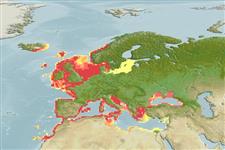
Native range | All suitable habitat | Point map | Year 2050
This map was computer-generated and has not yet been reviewed.
Trachinus draco   AquaMaps   Data sources: GBIF OBIS
Upload your photos and videos
Imágenes | Videos | Google image
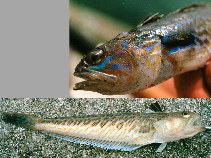
Image of Trachinus draco (Greater weever)
Trachinus draco
Picture by Østergaard, T.


United Kingdom country information

Common names: Môr-wiber fawr
Occurrence: native
Salinity: marine
Abundance: | Ref:
Importance: | Ref:
Aquaculture: | Ref:
Regulations: | Ref:
Uses: no uses
Comments:
National Checklist:
Country Information: https://www.cia.gov/library/publications/resources/the-world-factbook/geos/uk.html
National Fisheries Authority:
Occurrences: Occurrences Point map
Main Ref: Tortonese, E., 1986
National Database:

Common names from other countries

Classification / Names Nombres comunes | Sinónimos | Catalog of Fishes(Género, Especie) | ITIS | CoL | WoRMS | Cloffa

> Perciformes/Percoidei (Perchs) > Trachinidae (Weeverfishes)
Etymology: Trachinus: Greek, trachys, -eia, -ys = rough (Ref. 45335).
More on author: Linnaeus.

Environment: milieu / climate zone / rango de profundidad / distribution range Ecología

marino demersal; rango de profundidad 1 - 150 m (Ref. 6790), usually 1 - 30 m (Ref. 35388). Temperate; 66°N - 27°N, 19°W - 42°E

Distribución Países | Áreas FAO | Ecosistemas | Ocurrencias, apariciones | Mapa de puntos | Introducciones | Faunafri

Eastern Atlantic: Norway to Morocco, Madeira and Canary Islands, including the Mediterranean and the Black Sea (Ref. 6790). Reported from Mauritania (Ref. 55783).

Length at first maturity / Tamaño / Peso / Age

Madurez: Lm 12.0  range ? - ? cm
Max length : 53.0 cm TL macho / no sexado; (Ref. 40637); common length : 25.0 cm SL macho / no sexado; (Ref. 3397); peso máximo publicado: 1.9 kg (Ref. 40637)

Short description Claves de identificación | Morfología | Morfometría

Body elongate, length more than 6 times height. Greenish in upper parts, yellowish-white oblique stripes. Small 2-3 spines in front of each eye (Ref. 35388).
Body shape (shape guide): elongated.

Biología     Glosario (por ej. epibenthic)

On sandy, muddy or gravelly bottoms, from a few meters to about 150 m. Rest on the bottom, often buried with eyes and tip of first dorsal fin exposed (Ref. 9988). At night they swim around freely, even pelagically (Ref. 35388). Feed on small invertebrates and fishes; chiefly nocturnal. Oviparous, eggs and larval stages pelagic (Ref. 4675). There are dark markings along the scales; the anterior dorsal fin is black and contains venomous spines. Utilized fresh and frozen; can be pan-fried, broiled, boiled and baked (Ref. 9988). Spawning takes place in June and August, pelagic eggs are 1 mm (Ref. 35388). Also Ref. 57406.

Life cycle and mating behavior Madurez | Reproducción | Puesta | Huevos | Fecundidad | Larva

Oviparous, eggs and larvae are pelagic (Ref. 4675).

Main reference Upload your references | Referencias | Coordinador | Colaboradores

Roux, C., 1990. Trachinidae. p. 893-895. In J.C. Quero, J.C. Hureau, C. Karrer, A. Post and L. Saldanha (eds.) Check-list of the fishes of the eastern tropical Atlantic (CLOFETA). JNICT, Lisbon; SEI, Paris; and UNESCO, Paris. Vol. 2. (Ref. 6790)

IUCN Red List Status (Ref. 130435: Version 2025-1)

  Least Concern (LC) ; Date assessed: 14 July 2014

CITES

Not Evaluated

CMS (Ref. 116361)

Not Evaluated

Threat to humans

  Venomous (Ref. 4690)


Human uses

Pesquerías: escaso valor comercial; pesca deportiva: si; Acuario: Acuarios públicos
FAO - pesquerías: landings; Publication: search | FishSource | Sea Around Us

Más información

Ecología Trófica
Food items (preys)
Composición de la dieta
consumo de alimento
Food rations
Despredadores
Ecología
Ecología
Home ranges
Life cycle
Reproducción
Madurez
Maturity/Gills rel.
Fecundidad
Puesta
Spawning aggregations
Huevos
Egg development
Larva
Dinámica larvaria
Distribución
Países
Áreas FAO
Ecosistemas
Ocurrencias, apariciones
Introducciones
BRUVS - Videos
Anatomy
Superficie branquial
Brain
Otolith
Physiology
Body composition
Nutrients
Consumo del oxígeno
Tipo de natación
Velocidad de natación
Visual pigments
Fish sound
Diseases & Parasites
Toxicity (LC50s)
Genética
Genome
Genética
Heterozygosity
heritabilidad
Human related
Aquaculture systems
Perfiles de acuicultura
Razas
Ciguatera cases
Stamps, coins, misc.
Outreach
Colaboradores
Referencias
Referencias

Herramientas

Special reports

Download XML

Fuentes de Internet

Estimates based on models

Preferred temperature (Referencia 123201): 8.7 - 18.7, mean 10.9 °C (based on 780 cells).
Phylogenetic diversity index (Referencia 82804):  PD50 = 0.5059   [Uniqueness, from 0.5 = low to 2.0 = high].
Bayesian length-weight: a=0.00562 (0.00460 - 0.00688), b=3.04 (2.98 - 3.10), in cm total length, based on LWR estimates for this species (Ref. 93245).
Nivel trófico (Referencia 69278):  3.9   ±0.6 se; based on diet studies.
Resiliencia (Referencia 120179):  Medio, población duplicada en un tiempo mínimo de 1.4-4.4 años (K=0.08-0.5; Assuming tm=2-4).
Fishing Vulnerability (Ref. 59153):  Moderate to high vulnerability (55 of 100). 🛈
Climate Vulnerability (Ref. 125649):  Moderate vulnerability (38 of 100). 🛈
Price category (Ref. 80766):   Low.
Nutrients (Ref. 124155):  Calcium = 29.9 [20.3, 57.9] mg/100g; Iron = 0.36 [0.23, 0.58] mg/100g; Protein = 18.7 [17.9, 19.4] %; Omega3 = 0.643 [0.399, 1.025] g/100g; Selenium = 13.2 [7.3, 25.9] μg/100g; VitaminA = 23.8 [7.7, 74.1] μg/100g; Zinc = 0.445 [0.328, 0.607] mg/100g (wet weight); based on nutrient studies.