Common names from other countries
Holocéfalos (quimeras) (chimaeras) >
Chimaeriformes (Chimaeras) >
Chimaeridae (Shortnose chimaeras or ratfishes)
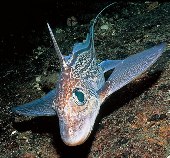
Etymology: Chimaera: Named for the mythological creature composed of parts of multiple animals, referring to their odd mix of characteristics (See ETYFish); monstrosa: Latin for strange or grotesque, referring to its strange appearance, as if composed of parts of multiple animals (See ETYFish).
More on author: Linnaeus.
Environment: milieu / climate zone / rango de profundidad / distribution range
Ecología
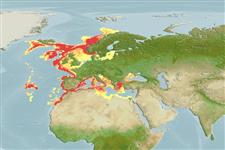
marino batidemersal; oceanodromo (Ref. 51243); rango de profundidad 40 - 1400 m (Ref. 104125), usually 300 - 500 m (Ref. 4443). Deep-water; 75°N - 27°N, 32°W - 35°E
Eastern Atlantic: northern Norway and Iceland, Skagerrak and Kattegat south to Morocco including western Mediterranean (some isolated records from eastern part), Azores and Madeira Islands. Records from South Africa are questionable. Reported from Oshima, Japan (FMNH 89161) (Ref. 27954).
Length at first maturity / Tamaño / Peso / Age
Madurez: Lm 45.9 range ? - ? cm
Max length : 150 cm TL macho / no sexado; (Ref. 35388); peso máximo publicado: 2.5 kg (Ref. 4645)
Short description
Claves de identificación | Morfología | Morfometría
Bathydemersal to benthopelagic generally between 300 and 500 m depth. Found in the upper continental slope. Usually found in deeper waters in southern latitudes, while making a summer inshore migration up to 40-100 m in the northern areas. Sluggish, usually occurring in small groups. Feeds mainly on bottom-living invertebrates. The single dorsal spine is sharp and pointed, and although only mildly venomous can inflict a painful wound. Oviparous. Males have a clasper on the forehead that is probably used to hold on to the female during copulation. Egg capsules are about 17 cm long; young look alike adults and hatch when 10 cm long. Common by-catch when trawling for shrimps in the North Sea or Skaggerak.
Oviparous; egg-capsules slender, club-shaped with narrow lateral membranes and a horny filament at the long pointed end, 17 cm long and 3 cm wide; deposited mainly in spring and summer. The embryos developing in about 9-12 months and hatch at 10 cm length.
Krefft, G., 1990. Chimaeridae. p. 111-113. In J.C. Quero, J.C. Hureau, C. Karrer, A. Post and L. Saldanha (eds.) Check-list of the fishes of the eastern tropical Atlantic (CLOFETA). JNICT, Lisbon; SEI, Paris; and UNESCO, Paris. Vol. 1. (Ref. 4443)
IUCN Red List Status (Ref. 130435: Version 2025-1)
Threat to humans
Traumatogenic (Ref. 4690)
Human uses
Pesquerías: escaso valor comercial
Herramientas
Special reports
Download XML
Fuentes de Internet
Estimates based on models
Preferred temperature (Referencia
123201): 3.7 - 14.1, mean 7.9 °C (based on 179 cells).
Phylogenetic diversity index (Referencia
82804): PD
50 = 0.5000 [Uniqueness, from 0.5 = low to 2.0 = high].
Bayesian length-weight: a=0.00257 (0.00156 - 0.00424), b=3.01 (2.87 - 3.15), in cm total length, based on LWR estimates for this species & (Sub)family-body (Ref.
93245).
Nivel trófico (Referencia
69278): 3.5 ±0.0 se; based on diet studies.
Generation time: 16.4 ( na - na) years. Estimated as median ln(3)/K based on 2
growth studies.
Resiliencia (Referencia
120179): Bajo, población duplicada en un tiempo mínimo de 4.5-14 años (Assuming Fec <100;).
Fishing Vulnerability (Ref.
59153): High to very high vulnerability (68 of 100).
🛈
Climate Vulnerability (Ref.
125649): Moderate vulnerability (38 of 100).
🛈
Nutrients (Ref.
124155): Calcium = 7.33 [2.04, 25.54] mg/100g; Iron = 0.33 [0.11, 0.85] mg/100g; Protein = 14.7 [9.9, 18.5] %; Omega3 = 0.239 [0.093, 0.622] g/100g; Selenium = 22 [6, 73] μg/100g; VitaminA = 5.79 [1.22, 27.56] μg/100g; Zinc = 0.326 [0.169, 0.636] mg/100g (wet weight);