Raja microocellata, Small-eyed ray : fisheries, gamefish

You can sponsor this page

Raja microocellata Montagu, 1818

Small-eyed ray
Adicionar sua observação em Fish Watcher
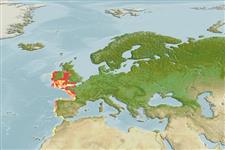
Native range | All suitable habitat | Point map | Year 2050
This map was computer-generated and has not yet been reviewed.
Raja microocellata   AquaMaps   Data sources: GBIF OBIS
Carregue seu(sua) Fotos e vídeos
Fotos | Imagem do Google
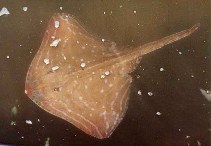
Image of Raja microocellata (Small-eyed ray)
Raja microocellata
Foto de Meyer, T.


United Kingdom country information

Common names: Morgath lygaid-bach, Owl ray, Painted ray
Occurrence: native
Salinity: marine
Abundance: fairly common (chances are about 50%) | Ref: Ellis, J.R., A. Cruz-Martinez, B.D. Rackham and S.I. Rodgers, 2005
Importance: | Ref:
Aquaculture: | Ref:
Regulations: | Ref:
Uses: no uses
Comments: Common in the Bristol Channel, where catch rates attained 40 ind/hr. Occasionally caught in the English and St George’s Channels, with maximum recorded depth of 112 m. Juveniles were most common in the Bristol Channel and especially in Carmarthen Bay (Ref. 82399).
National Checklist:
Country Information: https://www.cia.gov/library/publications/resources/the-world-factbook/geos/uk.html
National Fisheries Authority:
Occurrences: Occurrences Point map
Main Ref: Stehmann, M. and D.L. Bürkel, 1984
National Database:

Common names from other countries

Classificação / Nomes Nomes comuns | Sinônimos | Catalog of Fishes(Gênero, Espécies) | ITIS | CoL | WoRMS | Cloffa

Elasmobranchii (tubarões e raias) (sharks and rays) > Rajiformes (Skates and rays) > Rajidae (Skates)
Etymology: Raja: Latin, raja, -ae = a sting ray (Raja sp.) (Ref. 45335).

Environment: milieu / Zona climática / intervalo de profundidade / distribution range Ecologia

marinhas demersal; intervalo de profundidade ? - 100 m (Ref. 4426). Temperate; 55°N - 24°N, 16°W - 1°W

Distribuição Países | Áreas da FAO | Ecossistemas | Ocorrências | Mapa de pontos | Introduções | Faunafri

Eastern Atlantic: southwestern England and Ireland to Rio de Oro in Western Sahara; absent from the North Sea and the Mediterranean.

Comprimento de primeira maturação / Tamanho / Peso / Idade

Maturidade: Lm 74.0, range 73 - ? cm
Max length : 87.0 cm TL macho/indeterminado; (Ref. 6014); peso máx. publicado: 4.5 kg (Ref. 4699)

Descrição suscinta Chaves de identificação | Morfologia | Morfometria

Espinhos dorsais (total) : 0; Espinhos anais: 0. Eyes conspicuously small; dorsal fins close-set, no thorns between; upper surface predominantly spinulose, underside almost smooth in young, but head and centre of disc prickly in larger specimens; orbital thorns separate, a regular row of about 50 thorns from nape to first dorsal fin; upper surface greyish, olive to light brown with light blotches and long bands, underside white (Ref. 3167).
Body shape (shape guide): other; Cross section: flattened.

Biologia     Glossário (p.ex. epibenthic)

Found on sandy bottoms, from inshore waters to about 100 m in tidal areas (Ref. 3167). Feed on fishes (Ref. 3167). Oviparous. Distinct pairing with embrace. Young may tend to follow large objects, such as their mother (Ref. 205). Eggs are oblong capsules with stiff pointed horns at the corners deposited in sandy or muddy flats (Ref. 205). Egg capsules are 6.6-10.0 cm long and 4.1-6.3 cm wide (Ref. 41250). About 54-61 eggs are laid by an individual in a year (Ref. 41250).

Ciclo de vida ou comportamento de acasalamento Maturidade | Reprodução | Desova | Ovos | Fecundidade | Larvas

Oviparous (Ref. 3167). Paired eggs are laid. Embryos feed solely on yolk (Ref. 50449). Distinct pairing with embrace. Young may tend to follow large objects, such as their mother (Ref. 205).

Referência principal Carregar suas referências | Referências | Coordenador : McEachran, John | Colaboradores

McEachran, J.D. and K.A. Dunn, 1998. Phylogenetic analysis of skates, a morphologically conservative clade of elasmobranchs (Chondrichthyes: Rajidae). Copeia 1998(2):271-290. (Ref. 27314)

Status na Lista Vermelha da UICN (Ref. 130435: Version 2025-1)

  Quase ameaçada (NT) ; Date assessed: 13 February 2006

CITES

Not Evaluated

CMS (Ref. 116361)

Not Evaluated

Ameaça para os humanos

  Harmless


Uso pelos humanos

Pescarias: pouco comercial; peixe esportivo: sim
FAO - pescarias: desembarques; Publication: search | FishSource | Sea Around Us

Mais informação

Ecologia Trófica
Food items (preys)
Composição da dieta
Consumo alimentar
Food rations
Predadores
Ecologia
Ecologia
Home ranges
Population dynamics
Parâmetros de crescimento
Max. ages / sizes
Length-weight rel.
Length-length rel.
Frequências de comprimento
Conversão de massa
Recrutamento
Abundância
Life cycle
Reprodução
Maturidade
Maturity/Gills rel.
Fecundidade
Desova
Spawning aggregations
Ovos
Desenvolvimento dos ovos
Larvas
Dinâmica larval
Distribuição
Países
Áreas da FAO
Ecossistemas
Ocorrências
Introduções
BRUVS - Videos
Anatomy
Área branquial
Brain
Otolith
Physiology
Body composition
Nutrients
Consumo de oxigênio
Tipo de natação
Velocidade de natação
Visual pigments
Fish sound
Diseases & Parasites
Toxicity (LC50s)
Genética
genoma
Genética
Heterozygosity
Hereditariedade
Human related
Aquaculture systems
Perfis para aquacultura
Estirpes
Ciguatera cases
Stamps, coins, misc.
Outreach
Colaboradores
Referências
Referências

Ferramentas

Relatórios especiais

Baixar XML

Fontes da internet

AFORO (otoliths) | Aquatic Commons | BHL | Cloffa | Websites from users | Checar Observador de Peixes (FishWatcher) | CISTI | Catalog of Fishes: Gênero, Espécies | DiscoverLife | ECOTOX | FAO - pescarias: desembarques; Publication: search | Faunafri | Fishipedia | Fishtrace | GloBI | Google Books | Google Scholar | Google | IGFA World Record | Bases de dados nacionais | OneZoom | Open Tree of Life | Otolith Atlas of Taiwan Fishes | PubMed | Reef Life Survey | Socotra Atlas | TreeBase | Árvore da vida | Wikipedia: Ir para, procura | World Records Freshwater Fishing | Registro zoológico

Estimates based on models

Preferred temperature (Ref. 123201): 10.4 - 15.4, mean 12 °C (based on 138 cells).
Índice de diversidade filogenética (Ref. 82804):  PD50 = 0.5000   [Uniqueness, from 0.5 = low to 2.0 = high].
Bayesian length-weight: a=0.00468 (0.00295 - 0.00741), b=3.30 (3.17 - 3.43), in cm total length, based on LWR estimates for this species & Genus-body shape (Ref. 93245).
Nível Trófico (Ref. 69278):  3.9   ±0.2 se; based on diet studies.
Resiliência (Ref. 120179):  Baixo, tempo mínimo de duplicação da população 4,5 - 14 anos (Fec= 54-61).
Fishing Vulnerability (Ref. 59153):  Moderate to high vulnerability (55 of 100). 🛈
Climate Vulnerability (Ref. 125649):  Very high vulnerability (88 of 100). 🛈
Categoria de preço (Ref. 80766):   Medium.
Nutrients (Ref. 124155):  Calcium = 6.33 [0.91, 111.73] mg/100g; Iron = 0.25 [0.02, 2.91] mg/100g; Protein = 17 [14, 19] %; Omega3 = 0.847 [0.342, 2.086] g/100g; Selenium = 10.4 [2.2, 54.2] μg/100g; VitaminA = 6.1 [0.5, 70.5] μg/100g; Zinc = 0.354 [0.024, 3.858] mg/100g (wet weight); based on nutrient studies.