Isurus oxyrinchus, Shortfin mako : fisheries, gamefish

You can sponsor this page

Isurus oxyrinchus Rafinesque, 1810

Shortfin mako
Thêm quan sát của bạn vào Fish Watcher
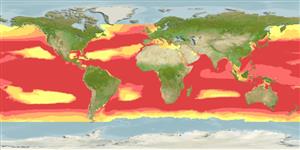
Native range | All suitable habitat | Point map | Year 2050
This map was computer-generated and has not yet been reviewed.
Isurus oxyrinchus   AquaMaps   Data sources: GBIF OBIS
Tải lên của bạn hình ảnh Và Video
Các tranh (Ảnh) | Video | Tem, tiền xu, v.v. | Google image


Tanzania territory information

Common names: Papa nyamarasi, Papa nyamzani, Papa sumbwi
Occurrence: native
Salinity: marine
Abundance: | Ref:
Importance: | Ref:
Aquaculture: | Ref:
Regulations: | Ref:
Uses: no uses
Comments:
National Checklist:
Territory Information: https://www.cia.gov/library/publications/resources/the-world-factbook/geos/tz.html
National Fisheries Authority: http://www.isp.msu.edu/AFRICANSTUDIES/PLEA/TAFIRI.HTM
Occurrences: Occurrences Point map
Main Ref: Compagno, L.J.V., 1984
National Database:

Common names from other countries

Phân loại / Tên Tên thường gặp | Các synonym ( Các tên trùng) | Catalog of Fishes(Giống, Các loài) | ITIS | CoL | WoRMS | Cloffa

Lớp phụ Cá sụn (cá mập và cá đuối) (sharks and rays) > Lamniformes (Mackerel sharks) > Lamnidae (Mackerel sharks or white shark)
Etymology: Isurus: isos (Gr.), equal; oura (Gr.), tail, referring to caudal-fin lobes of I. oxyrinchus being equal in length (except that they are not; the upper is clearly longer) (See ETYFish)oxyrinchus: oxys (Gr.), sharp or pointed; rynchus (L.), snout, referring to its pointed snout (See ETYFish).
More on author: Rafinesque.

Môi trường: môi trường / vùng khí hậu / Mức độ sâu / phạm vi phân phối Sinh thái học

biển pelagic-oceanic; Ở đại duơng, biển (Ref. 87829); mức độ sâu 0 - 888 m (Ref. 106604), usually 100 - 150 m (Ref. 36731). Subtropical; 16°C - ? (Ref. 9988); 65°N - 54°S, 180°W - 180°E

Sự phân bố Lãnh thổ | Các khu vực của FAO | Các hệ sinh thái | Những lần xuất hiện | Bản đồ điểm | Những chỉ dẫn | Faunafri

Cosmopolitan in temperate and tropical seas (Ref. 6871, 11230). Western Atlantic: Gulf of Maine to southern Brazil and Argentina (Ref. 58839), including the Gulf of Mexico and Caribbean. Eastern Atlantic: Norway to South Africa, including the Mediterranean. Indo-Pacific: East Africa to Hawaii, north to Primorskiy Kray (Russian Federation), south to Australia and New Zealand. Eastern Pacific: south of Aleutian Islands and from southern California, USA to Chile.

Chiều dài lúc trưởng thành đầu tiên / Bộ gần gũi / Khối lượng (Trọng lượng) / Tuổi

Chín muồi sinh dục: Lm 278.3, range 275 - 285 cm
Max length : 445 cm TL con đực/không giới tính; (Ref. 106604); common length : 270 cm TL con đực/không giới tính; (Ref. 5217); Khối lượng cực đại được công bố: 505.8 kg (Ref. 4699); Tuổi cực đại được báo cáo: 32 các năm (Ref. 86588)

Mô tả ngắn gọn Khóa để định loại | Hình thái học | Sinh trắc học

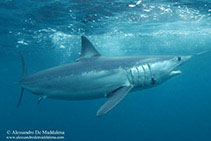
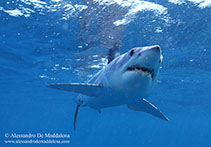
Các tia vây lưng cứng (tổng cộng) : 0; Tia cứng vây hậu môn: 0. A large, spindle-shaped shark with large black eyes, a sharp snout, and large, narrow, hooked teeth with smooth edges (Ref. 5578). Caudal fin lunate, lower lobe strongly developed (Ref. 13574). Dark blue above, white below (Ref. 6581). Tiny second dorsal and anal fins (Ref. 26938).
Body shape (shape guide): fusiform / normal.

Sinh học     Tự điển (thí dụ epibenthic)

Oceanic, but sometimes found close inshore (Ref. 6871, 11230, 58302). Usually in surface waters (Ref. 30573), down to about 150 m (Ref. 26938, 11230). Coastal, epipelagic at 1->500 m (Ref. 58302). Isotope analysis has shown that shortfin mako is the highest level fish predator in oceanic waters off eastern Australia (Ref. 86961). Adults feed on bony fishes, other sharks (Ref. 5578), cephalopods; larger individuals may feed on larger prey such as billfish and small cetaceans (Ref. 6871, 58048). Ovoviviparous, embryos feeding on yolk sac and other ova produced by the mother (Ref. 43278, 50449). With 4-16 young of about 60-70 cm long (Ref. 35388, 26346). Gestation period lasts 15-18 months, spawning cycle is every 3 years. Some authors (Refs. 1661, 28081, 31395) have erroneously assumed that two age rings are deposited per year by this species, thus underestimating longevity, age at maturity, and resilience . These data have been removed and replaced by recent, verified estimates (Refs. 86586, 86587, 86588). Tagging in New Zealand indicates seasonal migrations (Ref. 26346). The presence of genetic differentiation in mitochondrial DNA across global populations (Ref. 36416) suggests dispersal may be male-biased, and that females may have natal site-fidelity. Shortfin mako has been shown to have a marked sexually segregated population structure (Ref. 86954). Shortfin mako is probably the fastest of all sharks and can leap out of the water when hooked (Ref. 6871). Potentially dangerous and responsible for unprovoked attacks on swimmers and boats (Ref. 13574). Utilized fresh, dried or salted, smoked and frozen; eaten broiled and baked (Ref. 9988). Valued for its fine quality meat as well as its fins and skin (Ref. 247). Oil is extracted for vitamins and fins for shark-fin soup (Ref. 13574). Jaws and teeth are also sold as ornaments and trophies (Ref. 9988). by Kabasakal & de Maddalena, 2011 reported a historical record of a larger specimen, caught in the Mediterranean Sea off Turkey, about 585 cm (TL estimated from photographs) (Ref. 106604). Maximum depth from Ref. 125614.

Vòng đời và hành vi giao phối Chín muồi sinh dục | Sự tái sinh sản | Đẻ trứng | Các trứng | Sự sinh sản | Ấu trùng

Exhibit ovoviparity (aplacental viviparity), with embryos feeding on other ova produced by the mother (oophagy) after the yolk sac is absorbed (Ref. 50449). With up to 18 young in a litter (Ref. 26346). Gives birth to litters of 4-25 (usually 10-18) pups after a gestation period of 15-18 months; reproduces every 3 years (Ref.58048). Size at birth between 60 and 70 cm (Ref. 247). Distinct pairing with embrace (Ref. 205).

Tài liệu tham khảo chính Tải lên tài liệu tham khảo của bạn | Các tài liệu tham khảo | Người điều phối : Compagno, Leonard J.V. | Người cộng tác

Compagno, L.J.V., 1984. FAO Species Catalogue. Vol. 4. Sharks of the world. An annotated and illustrated catalogue of shark species known to date. Part 1 - Hexanchiformes to Lamniformes. FAO Fish. Synop. 125(4/1):1-249. Rome, FAO. (Ref. 247)

Tình trạng Sách đỏ IUCN (Ref. 130435: Version 2025-2 (Global))

  Endangered (EN) (A2bd); Date assessed: 05 November 2018

CITES


Mối đe dọa đối với con người

  Traumatogenic (Ref. 247)


Sử dụng của con người

Các nghề cá: buôn bán nhỏ; cá để chơi: đúng
FAO - Các nghề cá: hạ cánh, hồ sơ loài; Publication: search | FIRMS - Stock assessments | FishSource | Biển chung quanh ta

Thêm thông tin

Vòng đời
Sự tái sinh sản
Chín muồi sinh dục
Độ trưởng thành/Mang liên quan
Sự sinh sản
Đẻ trứng
Tập hợp sinh sản
Các trứng
Sự phát triển của trứng
Ấu trùng
Sự biến động ấu trùng
Giải phẫu
Vùng mang
Não
sỏi tai
Sinh lý học
Thành phần cơ thể
Chất dinh dưỡng
Thành phần ô-xy
Kiểu bơi
Tốc độ bơi
Sắc tố thị giác
Tiếng cá
Bệnh tật & Ký sinh trùng
Độc tính (LC50)
Di truyền
Bộ gen
Di truyền
Sự dị hợp tử
Di sản
Liên quan đến con người
Hệ thống nuôi trồng thủy sản
Các tổng quan nuôi trồng thủy sản
Các giống
Các trường hợp ngộ độc Ciguatera
Tem, tiền xu, v.v.
Tiếp cận
Người cộng tác
Các tài liệu tham khảo

Các công cụ

Báo cáo đặc biệt

Tải xuống XML

Các nguồn internet

Ước tính dựa trên mô hình

Nhiệt độ ưa thích (Tài liệu tham khảo 123201): 9.7 - 24.4, mean 17.4 °C (based on 598 cells).
Chỉ số đa dạng phát sinh loài (Tài liệu tham khảo 82804):  PD50 = 0.7813   [Uniqueness, from 0.5 = low to 2.0 = high].
Bayesian length-weight: a=0.00646 (0.00386 - 0.01080), b=3.02 (2.87 - 3.17), in cm total length, based on LWR estimates for this species & (Sub)family-body (Ref. 93245).
Mức dinh dưỡng (Tài liệu tham khảo 69278):  4.5   ±0.0 se; based on diet studies.
Thích nghi nhanh (Tài liệu tham khảo 120179):  thấp, thời gian nhân đôi của chủng quần tối thiểu là 4.5 - 14 năm (rm=0.051; tm=8-20; tmax=32; Fec=4).
Prior r = 0.14, 95% CL = 0.09 - 0.21, Based on 3 full stock assessments.
Sự dễ bị tổn thương của nghề đánh cá (Ref. 59153):  Very high vulnerability (79 of 100). 🛈
Sự dễ bị tổn thương của khí hậu (Ref. 125649):  High vulnerability (62 of 100). 🛈
Loại giá (Ref. 80766):   Medium.
Chất dinh dưỡng (Ref. 124155):  Calcium = 7.24 [2.04, 36.21] mg/100g; Iron = 0.713 [0.180, 2.070] mg/100g; Protein = 20.7 [18.3, 22.9] %; Omega3 = 0.383 [0.157, 0.916] g/100g; Selenium = 35.5 [11.1, 99.0] μg/100g; VitaminA = 6.35 [2.11, 19.61] μg/100g; Zinc = 0.32 [0.16, 0.59] mg/100g (wet weight); based on nutrient studies.