Common names from other countries
Teleostei (teleosts) >
Anguilliformes (Eels and morays) >
Congridae (Conger and garden eels) > Congrinae
Etymology: Conger: Latin, conger = conger (Ref. 45335).
More on author: Mitchill.
Environment: milieu / climate zone / depth range / distribution range
Ecology
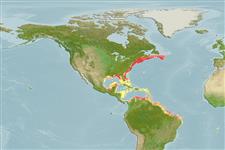
Marine; demersal; oceanodromous (Ref. 51243); depth range 1 - 477 m (Ref. 5951), usually 75 - 150 m (Ref. 5951). Subtropical; 46°N - 16°S, 97°W - 5°W
Western Atlantic: Cape Cod in Massachusetts to northeastern Florida in USA and northern Gulf of Mexico. Reported in eastern Atlantic: St. Helena (Ref. 5288). Northwest Atlantic: Canada (Ref. 5951).
Size / Weight / Age
Maturity: Lm ? range ? - ? cm
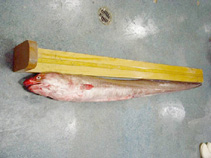
Max length : 230 cm TL male/unsexed; (Ref. 7251); common length : 100.0 cm TL male/unsexed; (Ref. 3715); max. published weight: 40.0 kg (Ref. 7251)
Occurs from shallow inshore waters to depths of 477 m and up to 260 m in the Gulf of Maine (Ref. 7135). Benthic (Ref. 5951). Nocturnal predators (Ref. 93252). Feeds mainly on fishes, but also on shrimps and small shellfish. Commonly caught by anglers along piers, docks and jetties in middle Atlantic states.
Life cycle and mating behavior
Maturity | Reproduction | Spawning | Eggs | Fecundity | Larvae
Robins, C.R. and G.C. Ray, 1986. A field guide to Atlantic coast fishes of North America. Houghton Mifflin Company, Boston, U.S.A. 354 p. (Ref. 7251)
IUCN Red List Status (Ref. 130435: Version 2025-2)
Threat to humans
Harmless
Human uses
Fisheries: minor commercial; gamefish: yes
Tools
Special reports
Download XML
Internet sources