This website uses cookies to enhance your browsing experience and ensure the functionality of our site. For more detailed information about the types of cookies we use and how we protect your privacy, please visit our Privacy Information page.
×
Cookie Settings
This website uses different types of cookies to enhance your experience. Please select your preferences below:
Teleostei (teleosts) > Carangiformes (Jacks) > Carangidae (Jacks and pompanos) > Caranginae
Etymology: Trachurus:Greek, trachys, -eia, -ys = rough + Greek, oura = tail (Ref. 45335). Eponymy: Roy A Latham (1881–1979) of Orient, Long Island, New York, USA, was a farmer and amateur self-eductaed naturalist who collected from a very early age and continued into his late nineties! Over the years he filled the two floors and multiple rooms of [...] (Ref. 128868), visit book page. More on author: Nichols.
Environment: milieu / climate zone / depth range / distribution range Ecology
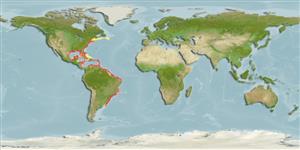
Marine; reef-associated; depth range 30 - 200 m (Ref. 5951). Subtropical; 45°N - 37°S
Western Atlantic: Canada (Ref. 5951) to Maine, USA and northern Gulf of Mexico to northern Argentina; apparently rare in the West Indies.
Length at first maturity / Size / Weight / Age
Maturity: Lm12.0 range ? - ? cm Max length : 40.0 cm TL male/unsexed; (Ref. 7251); common length : 30.0 cm TL male/unsexed; (Ref. 5217); max. published weight: 500.00 g (Ref. 5217)
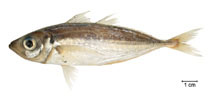
Dorsalspines (total): 8; Dorsalsoft rays (total): 32; Analspines: 3; Analsoft rays: 28. Body elongate and slightly compressed; posterior edge of upper jaw reaching to below anterior margin of eye; eye large with a well developed adipose eyelid; shallow furrow on upper margin of shoulder girdle; body except for small part behind pectoral fin covered with small cycloid scales; body dark blue dorsally, silver-white ventrally; black blotch on posterior margin of opercle; tip of snout dusky; anterior margin and tip of first dorsal fin dusky, other parts pale; second dorsal fin pale; caudal fin dusky, pectoral and pelvic fins pale (Ref. 13608). Body shape (shape guide): fusiform / normal.
Adults are benthopelagic over continental shelves (Ref. 5217). Rare in oceanic insular areas (Ref. 5217). Juveniles associate with the jellyfish Chrysaora lactea in Southwestern Atlantic. Preyed on by juvenile comb grouper (Mycteroperca acutirostris) when protection given by the jellyfish fails (Ref. 52493). Adults are found often in schools. They feed on small invertebrates. Marketed fresh locally and considered a good food fish (Ref. 9626). In southern Brazil, stocks are found in 147 m deep water (Ref. 47377).