Archosargus probatocephalus, Sheepshead : fisheries, gamefish, aquarium

You can sponsor this page

Archosargus probatocephalus (Walbaum, 1792)

Sheepshead
Add your observation in Fish Watcher
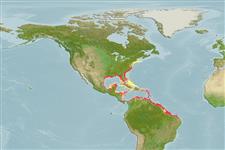
Native range | All suitable habitat | Point map | Year 2050
This map was computer-generated and has not yet been reviewed.
Archosargus probatocephalus   AquaMaps   Data sources: GBIF OBIS
Upload your photos and videos
Immagini | Videos | Google image
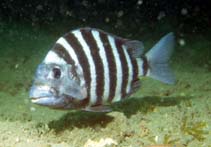
Image of Archosargus probatocephalus (Sheepshead)
Archosargus probatocephalus
Picture by Wirtz, P.


United States (contiguous states) country information

Common names: Convictt fish, Sheephead, Sheepshead
Occurrence: native
Salinity: brackish
Abundance: | Ref:
Importance: commercial | Ref:
Aquaculture: | Ref:
Regulations: | Ref:
Uses: gamefish: yes;
Comments: Also Ref. 9988.
National Checklist:
Country Information: https://www.cia.gov/library/publications/resources/the-world-factbook/geos/us.html
National Fisheries Authority: http://www.nmfs.gov
Occurrences: Occurrences Point map
Main Ref: Robins, C.R. and G.C. Ray, 1986
National Database:

Common names from other countries

Classification / Names Nomi Comuni | Sinonimi | Catalog of Fishes(Genere, Specie) | ITIS | CoL | WoRMS | Cloffa

> Eupercaria/misc (Various families in series Eupercaria) > Sparidae (Porgies)
Etymology: Archosargus: Greek, archo = anus + Latin , sargus = sea bream (Ref. 45335).
More on author: Walbaum.

Environment: milieu / climate zone / distribuzione batimetrica / distribution range Ecologia

marino; salmastro associati a barriera corallina; distribuzione batimetrica 15 - ? m (Ref. 9988). Subtropical; 49°N - 6°S, 100°W - 36°W (Ref. 55299)

Distribuzione Stati | Aree FAO | Ecosystems | Presenze | Mappa dei ritrovamenti | Introduzioni | Faunafri

Western Atlantic: Nova Scotia, Canada and northern Gulf of Mexico to Brazil. Absent in Bermuda, the Bahamas, the West Indies and Grenada (Ref. 7251, 26938).

Size / Peso / Age

Maturità: Lm ?  range ? - ? cm
Max length : 91.0 cm TL maschio/sesso non determinato; (Ref. 7251); common length : 35.0 cm TL maschio/sesso non determinato; (Ref. 3815); peso massimo pubblicato: 9.6 kg (Ref. 4699)

Biologia     Glossario (es. epibenthic)

Inhabits bays and estuaries. Freely enters brackish waters; sometimes enters freshwaters (Ref. 26938). Commonly found around pilings. Caught by anglers from jetties or rocky shores (Ref. 9988). Feeds mainly on mollusks and crustaceans. An excellent food fish. Marketed fresh and frozen; eaten broiled, microwaved and baked (Ref. 9988).

Life cycle and mating behavior Maturità | Riproduzione | Deposizione | Uova | Fecundity | Larve

Main reference Upload your references | Bibliografia | Coordinatore | Collaboratori

Robins, C.R. and G.C. Ray, 1986. A field guide to Atlantic coast fishes of North America. Houghton Mifflin Company, Boston, U.S.A. 354 p. (Ref. 7251)

IUCN Red List Status (Ref. 130435: Version 2025-1)

  Least Concern (LC) ; Date assessed: 31 March 2011

CITES

Not Evaluated

CMS (Ref. 116361)

Not Evaluated

Threat to humans

  Harmless


Human uses

Pesca: commerciale; Pesce da pesca sportiva: si; Acquario: Acquari pubblici
FAO - pesca: landings; Publication: search | FishSource | Sea Around Us

Informazioni ulteriori

Trophic ecology
Food items (preys)
Alimentazione
Consumo di cibo
Food rations
Predatori
Ecologia
Ecologia
Home ranges
Life cycle
Riproduzione
Maturità
Maturity/Gills rel.
Fecundity
Deposizione
Spawning aggregations
Uova
Egg development
Larve
Dinamica popolazioni larvali
Distribuzione
Stati
Aree FAO
Ecosystems
Presenze
Introduzioni
BRUVS - Videos
Anatomy
Area branchiale
Brain
Otolith
Physiology
Body composition
Nutrients
Oxygen consumption
Swimming type
Swimming speed
Visual pigments
Fish sound
Diseases & Parasites
Toxicity (LC50s)
Genetica
Genome
Genetica
Heterozygosity
Ereditarietà
Human related
Aquaculture systems
Profili di acquacoltura
Varietà
Ciguatera cases
Stamps, coins, misc.
Outreach
Collaboratori
Bibliografia
Bibliografia

Strumenti

Special reports

Download XML

Fonti Internet

Estimates based on models

Preferred temperature (Fonte Biblio. 123201): 22.9 - 28, mean 25.9 °C (based on 192 cells).
Phylogenetic diversity index (Fonte Biblio. 82804):  PD50 = 0.6250   [Uniqueness, from 0.5 = low to 2.0 = high].
Bayesian length-weight: a=0.02188 (0.01831 - 0.02614), b=2.98 (2.93 - 3.03), in cm total length, based on LWR estimates for this species (Ref. 93245).
Trophic level (Fonte Biblio. 69278):  3.5   ±0.53 se; based on food items.
Resilienza (Fonte Biblio. 120179):  Medio, tempo minimo di raddoppiamento della popolazione 1.4 - 4.4 anni (K=0.4; tmax=20).
Fishing Vulnerability (Ref. 59153):  Moderate vulnerability (36 of 100). 🛈
Climate Vulnerability (Ref. 125649):  High to very high vulnerability (69 of 100). 🛈
Price category (Ref. 80766):   Low.
Nutrients (Ref. 124155):  Calcium = 24.1 [9.8, 46.1] mg/100g; Iron = 0.562 [0.283, 1.069] mg/100g; Protein = 21 [20, 22] %; Omega3 = 0.215 [0.123, 0.398] g/100g; Selenium = 16.3 [7.4, 32.4] μg/100g; VitaminA = 22.3 [6.2, 82.3] μg/100g; Zinc = 0.703 [0.460, 1.099] mg/100g (wet weight);