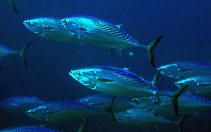
Euthynnus affinis, Kawakawa : fisheries, gamefish

You can sponsor this page

Euthynnus affinis (Cantor, 1849)

Kawakawa
Añada su observación en Fish Watcher
Native range | All suitable habitat | Point map | Year 2050
This map was computer-generated and has not yet been reviewed.
Euthynnus affinis   AquaMaps   Data sources: GBIF OBIS
Sube tu fotos y Vídeos
Imágenes | Vídeos | Google image
Image of Euthynnus affinis (Kawakawa)
Euthynnus affinis
Foto de Field, R.


Eritrea territory information

Common names: [No common name]
Occurrence: native
Salinity: marine
Abundance: | Ref:
Importance: | Ref:
Aquaculture: | Ref:
Regulations: | Ref:
Uses: no uses
Comments:
National Checklist:
Territory Information: https://www.cia.gov/library/publications/resources/the-world-factbook/geos/er.html
National Fisheries Authority:
Occurrences: Occurrences Point map
Main Ref: Collette, B.B. and C.E. Nauen, 1983
National Database:

Common names from other countries

Clasificación / Nombres Nombres comunes | Sinónimos | Catalog of Fishes(Género, Especie) | ITIS | CoL | WoRMS | Cloffa

> Scombriformes (Mackerels) > Scombridae (Mackerels, tunas, bonitos) > Scombrinae
Etymology: Euthynnus: Greek, eu = good + Greek, thynnos = tunna (Ref. 45335).

Entorno: milieu / zona climática / rango de profundidad / gama de distribución Ecología

marino pelagic-neritic; oceanodromo (Ref. 71039); rango de profundidad 0 - 200 m (Ref. 54439). Tropical; 18°C - 29°C (Ref. 168); 35°N - 38°S, 19°E - 137°W (Ref. 54439)

Distribución Territorios | Áreas FAO | Ecosistemas | Ocurrencias, apariciones | Mapa de puntos | Introducciones | Faunafri

Indo-West Pacific: in warm waters including oceanic islands and archipelagos. A few stray specimens have been collected in the Eastern Central Pacific. Highly migratory.

Longitud en la primera madurez / Tamaño / Peso / Edad

Madurez: Lm 42.3, range 40 - 65 cm
Max length : 100.0 cm FL macho / no sexado; (Ref. 168); common length : 60.0 cm FL macho / no sexado; (Ref. 168); peso máximo publicado: 14.0 kg (Ref. 30874); edad máxima reportada: 6 años (Ref. 121508)

Descripción breve Claves de identificación | Morfología | Morfometría

Espinas dorsales (total) : 10 - 15; Radios blandos dorsales (total) : 11 - 15; Espinas anales: 0; Radios blandos anales: 11 - 15; Vértebra: 39. This species is distinguished by the following characters: medium-sized fish with a robust, elongate and fusiform body; teeth small and conical, in a single series; total gill rakers on first gill arch 29-34; D1 XI-XIV with both dorsal fins separated by only a narrow interspace (not wider than eye), anterior spines of first fin much higher than those midway, giving fin a strongly concave outline; D2 much lower than first and followed by 8-10 finlets; anal fin followed by 6-8 finlets; pectoral fins short, never reaching interspace between dorsal fins; 2 flaps (interpelvic process) between pelvic fins; very slender caudal peduncle with a prominent lateral keel between 2 small keels at base of caudal fin; body naked except for corselet and lateral line. Colour of back dark blue with a complicated striped pattern which does not extend forward beyond middle of first dorsal fin; lower sides and belly silvery white; several characteristic dark spots between pelvic and pectoral fins (but may not always be present) (Ref. 9684, 90102).


Body shape (shape guide): fusiform / normal; Cross section: oval.

Biología     Glosario (por ej. epibenthic)

Occurs in open waters but always remains close to the shoreline. The young may enter bays and harbors. Forms multi-species schools by size with other scombrid species comprising from 100 to over 5,000 individuals. A highly opportunistic predator feeding indiscriminately on small fishes, especially on clupeoids and atherinids; also on squids, crustaceans and zooplankton. Caught in multispecies fisheries, mainly by surface trolling; also with gill nets. Generally marketed canned and frozen; also utilized dried, salted, smoked and fresh (Ref. 9684).

Ciclo vital y comportamiento de apareamiento Madurez | Reproducción | Puesta | Huevos | Fecundidad | Larva

Referencia principal Suba sus referencias | Referencias | Coordinador : Collette, Bruce B. | Colaboradores

Collette, B.B. and C.E. Nauen, 1983. FAO Species Catalogue. Vol. 2. Scombrids of the world. An annotated and illustrated catalogue of tunas, mackerels, bonitos and related species known to date. Rome: FAO. FAO Fish. Synop. 125(2):137 p. (Ref. 168)

Situación en la Lista Roja de la UICN (Ref. 130435: Version 2025-2 (Global))

  Least Concern (LC) ; Date assessed: 01 March 2022

CITES

Not Evaluated

CMS (Ref. 116361)

Not Evaluated

Amenaza para el ser humano

  Reports of ciguatera poisoning (Ref. 30911)


Usos humanos

Pesquerías: muy comercial; pesca deportiva: si
FAO - pesquerías: desembarques, perfil de la especie; Publication: search | FIRMS - Stock assessments | FishSource | Sea Around Us

Más información

Ecología Trófica
Alimentos (presas)
Composición de la dieta
consumo de alimento
Raciones de comida
Despredadores
Ecología
Ecología
Home ranges
Dinámica de la población
Coeficiente del crecimiento para
Edades / tallas máximas
Longitud-peso rel.
Longitud-longitud rel.
Longitud-frecuencias
Conversión de masas
Reclutamiento
Abundancia
Ciclo de vida
Reproducción
Madurez
Madurez/Gills rel.
Fecundidad
Puesta
Agregaciones de desove
Huevos
Desarrollo de los huevos
Larva
Dinámica larvaria
Anatomía
Superficie branquial
Cerebro
Otolito
Genética
Genoma
Genética
Heterocigosidad
heritabilidad
Relacionados con el ser humano
Sistemas de acuicultura
Perfiles de acuicultura
Razas
Ciguatera cases
Sellos, monedas, varios
Divulgación
Colaboradores
Referencias
Referencias

Herramientas

Informes especiales

Descargar XML

Fuentes de Internet

Estimaciones basadas en modelos

Temperatura preferida (Referencia 123201): 20.7 - 28.5, mean 26.9 °C (based on 1384 cells).
Índice de diversidad filogenética (Referencia 82804):  PD50 = 0.6250   [Uniqueness, from 0.5 = low to 2.0 = high].
Bayesian length-weight: a=0.00977 (0.00846 - 0.01129), b=3.05 (3.01 - 3.09), in cm total length, based on LWR estimates for this species (Ref. 93245).
Nivel trófico (Referencia 69278):  4.5   ±0.0 se; based on diet studies.
Generation time: 1.6 (1.2 - 2.5) years. Estimated as median ln(3)/K based on 11 growth studies.
Resiliencia (Referencia 120179):  Medio, población duplicada en un tiempo mínimo de 1.4-4.4 años (K=0.60; tm>2; tmax=6).
Prior r = 0.88, 95% CL = 0.58 - 1.32, Based on 5 full stock assessments.
Vulnerabilidad pesquera (Ref. 59153):  Moderate vulnerability (36 of 100). 🛈
Vulnerabilidad climática (Ref. 125649):  High to very high vulnerability (75 of 100). 🛈
Categoría de precios (Ref. 80766):   Medium.
Nutrientes (Ref. 124155):  Calcium = 20.9 [9.6, 171.3] mg/100g; Iron = 2.28 [0.88, 5.97] mg/100g; Protein = 23.1 [21.1, 24.7] %; Omega3 = 0.235 [0.129, 0.428] g/100g; Selenium = 70.6 [35.4, 143.5] μg/100g; VitaminA = 20.2 [5.4, 77.8] μg/100g; Zinc = 0.408 [0.211, 1.643] mg/100g (wet weight); based on nutrient studies.