


Myliobatis hamlyni Ogilby, 1911
Purple eagle ray
Upload your photos and videos
Pictures | Google image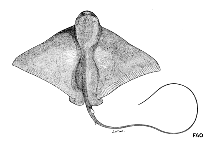 Myliobatis hamlyni
Picture by FAO
Pictures | Google image
Picture by FAO
Classification / Names Common names | Synonyms | Catalog of Fishes(genus, species) | ITIS | CoL | WoRMS | Cloffa
Elasmobranchii (sharks and rays) > Myliobatiformes (Stingrays) > Myliobatidae (Eagle and manta rays)
Etymology: Myliobatis: Greek, mylo = mill + Greek, + Greek, batis,-idos = a ray (Raja sp.) (Ref. 45335).
Eponymy: Dr Ronald Hamlyn-Harris (1874–1953) was an English-born entomologist. [...] (Ref. 128868), visit book page.
More on author: Ogilby.
Etymology: Myliobatis: Greek, mylo = mill + Greek, + Greek, batis,-idos = a ray (Raja sp.) (Ref. 45335).
Eponymy: Dr Ronald Hamlyn-Harris (1874–1953) was an English-born entomologist. [...] (Ref. 128868), visit book page.
More on author: Ogilby.
Environment: milieu / climate zone / depth range / distribution range Ecology
Marine; benthopelagic; depth range 200 - ? m (Ref. 6871). Deep-water; 17°S - 26°S
Distribution Territories | FAO areas | Ecosystems | Occurrences | Point map | Introductions | Faunafri
Indo-West Pacific: patchy distribution, Austalia, Indonesia, the Philippines, Taiwan and Japan.
Length at first maturity / Size / Weight / Age
Short description Identification keys | Morphology | Morphometrics
Vertebrae: 114 - 119. This medium-sized Myliobatis species (attaining at least 114.2 cm DW) is distinguished by the following set of characters: dorsal surface uniformly purplish brown to greenish brown, without dark spots or blotches; tail with a distinct, low ventral skin fold; stinging spine(s) are relatively long (longest spine 13.1-15.9% DW); adult males with interorbital space moderately concave; anterior margins of pectoral fin is straight to slightly convex; cranial fontanelle (visible in dorsal view without dissection) is relatively wide with slightly convex lateral margins; claspers of adult males 5.5-5.7% DW; predorsal length 63.6-68.6% DW; each jaw with 7 rows of teeth, with a broad median row flanked by three smaller rows on each side; pectoral-fin radials 85-92 (excluding rostral propterygial radials anterior of eyes); total vertebral centra (including synarcual) 114-119; males mature at about 65.0 cm DW (Ref. 132213).
Cross section: flattened.
Cross section: flattened.
Common inshore and offshore, demersal in intertidal habitats to depths of at least 220 m (Ref. 58048); also in coral reefs (Ref. 58534). Diet unknown, but presumably consists primarily of bivalves and other bottom-dwelling invertebrates. Caught occasionally by inshore, demersal longline fisheries. Utilized for its meat and cartilage (Ref. 58048). Ovoviviparous (Ref. 50449).
Life cycle and mating behavior Maturity | Reproduction | Spawning | Eggs | Fecundity | Larvae
Exhibit ovoviparity (aplacental viviparity), with embryos feeding initially on yolk, then receiving additional nourishment from the mother by indirect absorption of uterine fluid enriched with mucus, fat or protein through specialised structures (Ref. 50449).
Main reference
Upload your references | References | Coordinator : McEachran, John | Collaborators
White, W.T., J. Kawauchi, S. Corrigan, E. Rochel and G.J.P. Naylor, 2015. Redescription of the eagle rays Myliobatis hamlyni Ogilby, 1911 and M. tobijei Bleeker, 1854 (Myliobatiformes: Myliobatidae) from the east Indo-West Pacific. Zootaxa 3948(3):521-548. (Ref. 132213)
IUCN Red List Status (Ref. 130435: Version 2025-2 (Global))
Near Threatened (NT) ; Date assessed: 17 February 2015
CITES
Not Evaluated
Threat to humans
Harmless
Human uses
Fisheries: commercial
FAO - Publication: search | FishSource |
More information
Trophic ecology
Food items (preys)
Diet composition
Food consumption
Food rations
Predators
Food items (preys)
Diet composition
Food consumption
Food rations
Predators
Ecology
Ecology
Ecology
Population dynamics
Growth parameters
Max. ages / sizes
Length-weight rel.
Length-length rel.
Length-frequencies
Mass conversion
Recruitment
Abundance
Growth parameters
Max. ages / sizes
Length-weight rel.
Length-length rel.
Length-frequencies
Mass conversion
Recruitment
Abundance
Life cycle
Reproduction
Maturity
Maturity/Gills rel.
Fecundity
Spawning
Spawning aggregations
Eggs
Egg development
Larvae
Larval dynamics
Reproduction
Maturity
Maturity/Gills rel.
Fecundity
Spawning
Spawning aggregations
Eggs
Egg development
Larvae
Larval dynamics
Anatomy
Gill area
Brain
Otolith
Gill area
Brain
Otolith
Physiology
Body composition
Nutrients
Oxygen consumption
Swimming type
Swimming speed
Visual pigments
Fish sound
Diseases & Parasites
Toxicity (LC50s)
Body composition
Nutrients
Oxygen consumption
Swimming type
Swimming speed
Visual pigments
Fish sound
Diseases & Parasites
Toxicity (LC50s)
Genetics
Genome
Genetics
Heterozygosity
Heritability
Genetic Diversity
Genome
Genetics
Heterozygosity
Heritability
Genetic Diversity
Human related
Aquaculture systems
Aquaculture profiles
Strains
Ciguatera cases
Stamps, coins, misc.
Aquaculture systems
Aquaculture profiles
Strains
Ciguatera cases
Stamps, coins, misc.
Tools
E-book | Field guide | Identification keys | Length-frequency wizard | Life-history tool | Point map |
Catch-MSY |
Special reports
Download XML
Internet sources
AFORO (otoliths) | Aquatic Commons | BHL | Cloffa | Websites from users | Check FishWatcher | CISTI | Catalog of Fishes: genus, species | DiscoverLife | ECOTOX | FAO - Publication: search | Faunafri | Fishipedia | Fishtrace | GloBI | Google Books | Google Scholar | Google | IGFA World Record | National databases | OneZoom | Open Tree of Life | Otolith Atlas of Taiwan Fishes | PubMed | Reef Life Survey | Socotra Atlas | TreeBase | Tree of Life | Wikipedia: Go, Search | World Records Freshwater Fishing | Zoobank | Zoological Record
Estimates based on models
Phylogenetic diversity index (Ref. 82804): PD50 = 0.5002 [Uniqueness, from 0.5 = low to 2.0 = high].
Bayesian length-weight: a=0.00389 (0.00124 - 0.01219), b=3.08 (2.83 - 3.33), in cm total length, based on LWR estimates for this (Sub)family-body shape (Ref. 93245).
Trophic level (Ref. 69278): 3.4 ±0.4 se; based on size and trophs of closest relatives
Resilience (Ref. 120179): Low, minimum population doubling time 4.5 - 14 years (Fec assumed to be <100).