


Rhinobatos jimbaranensis Last, White & Fahmi, 2006
Jimbaran shovelnose ray
Upload your photos and videos
Google image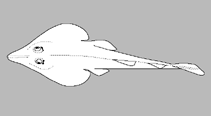 No image available for this species;
drawing shows typical species in Rhinobatidae.
Google image
drawing shows typical species in Rhinobatidae.
Classification / Names Common names | Synonyms | Catalog of Fishes(genus, species) | ITIS | CoL | WoRMS | Cloffa
Elasmobranchii (sharks and rays) > Rhinopristiformes (Shovelnose rays) > Rhinobatidae (Guitarfishes)
Etymology: Rhinobatos: Greek, rhinos = nose + Greek, batis, -idos = a ray (Raja sp.) (Ref. 45335); jimbaranensis: Named for its type locality, the Jimbaran Bay.
More on authors: Last, White & Fahmi.
Etymology: Rhinobatos: Greek, rhinos = nose + Greek, batis, -idos = a ray (Raja sp.) (Ref. 45335); jimbaranensis: Named for its type locality, the Jimbaran Bay.
More on authors: Last, White & Fahmi.
Environment: milieu / climate zone / depth range / distribution range Ecology
Marine; benthopelagic. Tropical
Distribution Territories | FAO areas | Ecosystems | Occurrences | Point map | Introductions | Faunafri
Eastern Indian Ocean: endemic to central Indonesia (Ref. 114953).
Length at first maturity / Size / Weight / Age
Maturity: Lm 76.5 range ? - ? cm
Max length : 89.2 cm TL male/unsexed; (Ref. 74367); 99.4 cm TL (female)
Max length : 89.2 cm TL male/unsexed; (Ref. 74367); 99.4 cm TL (female)
Short description Identification keys | Morphology | Morphometrics
This species is defined by the following set of adult characters: disc wedge-shaped, width 32-33% TL, length more than 1.3 (1.35-1.39) times width; snout moderately elongate, length 3.4-3.6 times interspiracular distance, 5-5.5 times interorbital width; orbit medium-sized, 1.5-1.6 times spiracle length; nostrils weakly oblique, length 1.3-1.4 times internarial distance; preoral length 7.7-8.1 times internarial distance; anterior nasal flaps penetrating slightly into internarial space, however, well separated at their insertion; posterior nasal flaps broad; spiracular folds 2, outermost fold only slightly taller than inner fold; ridges of rostral cartilage almost parallel, converging slightly anteriorly but not constricted medially; anterior cartilage sickle shaped, pointed posteriorly; distance between fifth gill slits 3.1-3.4 times in ventral head length; prebranchial sensory pore patch obvious, extending to first gill slit; postscapular sensory canal obscure, without exposed lateral pores, not grooved; thorn patches on supraorbit, scapular region, and dorsal midline rudimentary, inconspicuous; inner margin of pelvic-fin slightly shorter than its base; interdorsal distance more than 2.5 (2.8-3.1) times first dorsal-fin base; dorsal caudal margin about 2.1 times preventral margin; upper jaw with 62-77 tooth rows; post-synarcual centra 176-180; nasal lamellae more than 50 (51-55); dorsal fin not distinctly bicolored; white spots absent on dorsal disc (Ref. 72461).
Body shape (shape guide): elongated.
Body shape (shape guide): elongated.
Demersal inshore on inner insular shelf. Mainly feeds on small crustaceans (Ref. 114953). The smallest pregnant female observed from this species was 74.7 cm TL; with pregnant females having 6-11 embryos, birth size unknown, but embryos well developed at 13 cm TL (Ref. 72461). Males mature at 77-80 cm TL. Females produces litters of 6-11 pups (Ref. 114953).
Life cycle and mating behavior Maturity | Reproduction | Spawning | Eggs | Fecundity | Larvae
Main reference
Upload your references | References | Coordinator : McEachran, John | Collaborators
Last, P.R., W.T. White and Fahmi, 2006. Rhinobatos jimbaranensis and R. penggali, two new shovelnose rays (Batoidea: Rhinobatidae) from eastern Indonesia. Cybium 30(3):261-271. (Ref. 72461)
IUCN Red List Status (Ref. 130435: Version 2025-2 (Global))
Critically Endangered (CR) (A2d); Date assessed: 19 May 2020
Threat to humans
Harmless
Human uses
FAO - Publication: search | FishSource |
More information
Trophic ecology
Food items (preys)
Diet composition
Food consumption
Food rations
Predators
Food items (preys)
Diet composition
Food consumption
Food rations
Predators
Ecology
Ecology
Ecology
Population dynamics
Growth parameters
Max. ages / sizes
Length-weight rel.
Length-length rel.
Length-frequencies
Mass conversion
Recruitment
Abundance
Growth parameters
Max. ages / sizes
Length-weight rel.
Length-length rel.
Length-frequencies
Mass conversion
Recruitment
Abundance
Anatomy
Gill area
Brain
Otolith
Gill area
Brain
Otolith
Physiology
Body composition
Nutrients
Oxygen consumption
Swimming type
Swimming speed
Visual pigments
Fish sound
Diseases & Parasites
Toxicity (LC50s)
Body composition
Nutrients
Oxygen consumption
Swimming type
Swimming speed
Visual pigments
Fish sound
Diseases & Parasites
Toxicity (LC50s)
Genetics
Genome
Genetics
Heterozygosity
Heritability
Genetic Diversity
Genome
Genetics
Heterozygosity
Heritability
Genetic Diversity
Human related
Aquaculture systems
Aquaculture profiles
Strains
Ciguatera cases
Stamps, coins, misc.
Aquaculture systems
Aquaculture profiles
Strains
Ciguatera cases
Stamps, coins, misc.
Tools
Special reports
Download XML
Internet sources
AFORO (otoliths) | Aquatic Commons | BHL | Cloffa | Websites from users | Check FishWatcher | CISTI | Catalog of Fishes: genus, species | DiscoverLife | ECOTOX | FAO - Publication: search | Faunafri | Fishipedia | Fishtrace | GloBI | Google Books | Google Scholar | Google | IGFA World Record | OneZoom | Open Tree of Life | Otolith Atlas of Taiwan Fishes | PubMed | Reef Life Survey | Socotra Atlas | TreeBase | Tree of Life | Wikipedia: Go, Search | World Records Freshwater Fishing | Zoobank | Zoological Record
Estimates based on models
Phylogenetic diversity index (Ref. 82804): PD50 = 0.5000 [Uniqueness, from 0.5 = low to 2.0 = high].
Bayesian length-weight: a=0.00295 (0.00150 - 0.00581), b=3.13 (2.96 - 3.30), in cm total length, based on LWR estimates for this (Sub)family-body shape (Ref. 93245).
Trophic level (Ref. 69278): 3.8 ±0.4 se; based on size and trophs of closest relatives
Resilience (Ref. 120179): Low, minimum population doubling time 4.5 - 14 years (Preliminary low fecundity).