


Plectranthias elaine Heemstra & Randall, 2009
Add your observation in Fish Watcher
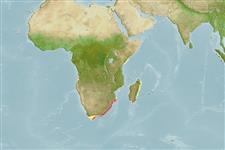
| Native range | All suitable habitat | Point map | Year 2050 |
|
| This map was computer-generated and has not yet been reviewed. |
| Plectranthias elaine AquaMaps Data sources: GBIF OBIS |
Upload your photos and videos
Google image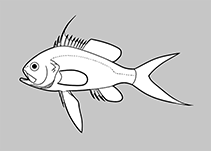 No image available for this species;
drawing shows typical species in Anthiadidae.
Google image
drawing shows typical species in Anthiadidae.
Classification / Names Common names | Synonyms | Catalog of Fishes(genus, species) | ITIS | CoL | WoRMS | Cloffa
Teleostei (teleosts) > Perciformes/Serranoidei (Groupers) > Anthiadidae (Fairy basslets or Streamer basses)
Etymology: Plectranthias: Bleeker (1873) disagrees with the generic placement of Plectropoma anthioides by Günther. He, therefore, erected Plectranthias to accommodate Pl. anthioides. The name is presumably the combination of the first part of Plectropoma (plectrum), and anthias. Plectrum = Plektron = πλῆκτρον (Greek, plektron = anyhting to strike with, spur + Greek, anthias = a fish, Ref. 45335); elaine: Named for Elaine Heemstra.
Eponymy: Elaine Margaret Heemstra née Lawrence formerly Grant is Scientific Illustrator Emeritus at the South Africa Institute for Aquatic Biodiversity. [...] (Ref. 128868), visit book page.
More on authors: Heemstra & Randall.
Etymology: Plectranthias: Bleeker (1873) disagrees with the generic placement of Plectropoma anthioides by Günther. He, therefore, erected Plectranthias to accommodate Pl. anthioides. The name is presumably the combination of the first part of Plectropoma (plectrum), and anthias. Plectrum = Plektron = πλῆκτρον (Greek, plektron = anyhting to strike with, spur + Greek, anthias = a fish, Ref. 45335); elaine: Named for Elaine Heemstra.
Eponymy: Elaine Margaret Heemstra née Lawrence formerly Grant is Scientific Illustrator Emeritus at the South Africa Institute for Aquatic Biodiversity. [...] (Ref. 128868), visit book page.
More on authors: Heemstra & Randall.
Environment: milieu / climate zone / depth range / distribution range Ecology
Marine; pelagic-neritic; depth range 68 - 114 m (Ref. 81822). Temperate
Distribution Territories | FAO areas | Ecosystems | Occurrences | Point map | Introductions | Faunafri
Western Indian Ocean: South Africa.
Size / Weight / Age
Short description Identification keys | Morphology | Morphometrics
Dorsal spines (total): 10; Dorsal soft rays (total): 15; Anal spines: 3; Anal soft rays: 7. This species has the following characters: color when fresh, dull red on head and body, shading to pale yellow ventrally, bases of median and pectoral fins irregular pale yellow or with white blotches; spinous dorsal fin is pale bluish white, as if daubed with thick paint; upper lip pale, with several red or white vertical bars; iris reddish orange, with short thin radiating blue-grey streaks. D X, 15, the fin margin moderately notched before soft-rayed part, with 3rd spine longest (24-30% SL), 1.8 in head length, short cirrus behind tips of spines 3, 4 and 5; A III,7, with 2nd spine longest, 2nd and 3rd anal-fin rays elongated; pectoral fins 14 rays, all branched except upper and lowermost 2 or 3 rays, fin reaching vertical at 3rd (4th) anal-fin ray; caudal fin slightly emarginate, principal rays 17, branched rays 15, 3 uppermost principal rays slightly produced; pelvic fins not reaching anus. Oval body with depth 2.1-2.5), head length 2.2-2.4, peduncle depth 7.2 (& 7.6) in SL; orbit diameter greater than snout length, 3.8 (3.4), snout length 4.8 (4.4-5.0), bony interorbital width 7.4 (9.8) in head length. Completer lateral-line with 31 (28, 30) tubed scales, 2 rows of large scales between middle dorsal fin spines and lateral-line and 3 scales from dorsal SL; orbit diameter 3.6-3.9, snout length, 4.1-4.8, bony interorbital width 8.0-8.5, all in head length. Lateral line incomplete, ending below middle of soft dorsal fin, with 16-20 tubed scales; 1 row of large scales between 5th dorsal-fin spine and lateral-line; circum-peduncular scales 12; scales on top of head extend to rear nostrils; operculum scaly, with 5-7 oblique series of large scales on cheek and a series along interopercle; snout suborbitals and lower jaw naked. Maxilla reaches past vertical at rear edge of eye; a row of 7-11 small ctenoid scales along (below) dorsal ledge of maxilla. Preopercle edge with 14-20 coarse serrae posteriorly; no antrorse spine on lower edge; subopercle and interopercle with 7-9 coarse serrae. Gill-rakers 4-5 / 9-11. Two supraneural bones, /0+0/2/1+1/1/1/ (Ref. 81822).
Body shape (shape guide): elongated.
Body shape (shape guide): elongated.
Life cycle and mating behavior Maturity | Reproduction | Spawning | Eggs | Fecundity | Larvae
Main reference
Upload your references | References | Coordinator | Collaborators
Heemstra, P.C. and J.E. Randall, 2009. A review of the anthiine fish genus Plectranthias (Perciformes: Serranidae) of the Western Indian Ocean, with description of a new species, and a key to the species. Smithiana Bull. 10:3-17. (Ref. 81822)
IUCN Red List Status (Ref. 130435: Version 2025-2 (Global))
Data deficient (DD) ; Date assessed: 19 July 2017
CITES
Not Evaluated
Threat to humans
Harmless
Human uses
Fisheries: of no interest
FAO - Publication: search | FishSource |
More information
Trophic ecology
Food items (preys)
Diet composition
Food consumption
Food rations
Predators
Food items (preys)
Diet composition
Food consumption
Food rations
Predators
Ecology
Ecology
Ecology
Population dynamics
Growth parameters
Max. ages / sizes
Length-weight rel.
Length-length rel.
Length-frequencies
Mass conversion
Recruitment
Abundance
Growth parameters
Max. ages / sizes
Length-weight rel.
Length-length rel.
Length-frequencies
Mass conversion
Recruitment
Abundance
Life cycle
Reproduction
Maturity
Maturity/Gills rel.
Fecundity
Spawning
Spawning aggregations
Eggs
Egg development
Larvae
Larval dynamics
Reproduction
Maturity
Maturity/Gills rel.
Fecundity
Spawning
Spawning aggregations
Eggs
Egg development
Larvae
Larval dynamics
Anatomy
Gill area
Brain
Otolith
Gill area
Brain
Otolith
Physiology
Body composition
Nutrients
Oxygen consumption
Swimming type
Swimming speed
Visual pigments
Fish sound
Diseases & Parasites
Toxicity (LC50s)
Body composition
Nutrients
Oxygen consumption
Swimming type
Swimming speed
Visual pigments
Fish sound
Diseases & Parasites
Toxicity (LC50s)
Genetics
Genome
Genetics
Heterozygosity
Heritability
Genetic Diversity
Genome
Genetics
Heterozygosity
Heritability
Genetic Diversity
Human related
Aquaculture systems
Aquaculture profiles
Strains
Ciguatera cases
Stamps, coins, misc.
Aquaculture systems
Aquaculture profiles
Strains
Ciguatera cases
Stamps, coins, misc.
Tools
Special reports
Download XML
Internet sources
AFORO (otoliths) | Aquatic Commons | BHL | Cloffa | Websites from users | Check FishWatcher | CISTI | Catalog of Fishes: genus, species | DiscoverLife | ECOTOX | FAO - Publication: search | Faunafri | Fishipedia | Fishtrace | GloBI | Google Books | Google Scholar | Google | IGFA World Record | OneZoom | Open Tree of Life | Otolith Atlas of Taiwan Fishes | PubMed | Reef Life Survey | Socotra Atlas | TreeBase | Tree of Life | Wikipedia: Go, Search | World Records Freshwater Fishing | Zoobank | Zoological Record
Estimates based on models
Preferred temperature (Ref. 123201): 13 - 23.1, mean 20.7 °C (based on 9 cells).
Phylogenetic diversity index (Ref. 82804): PD50 = 0.5000 [Uniqueness, from 0.5 = low to 2.0 = high].
Bayesian length-weight: a=0.00389 (0.00180 - 0.00842), b=3.12 (2.94 - 3.30), in cm total length, based on all LWR estimates for this body shape (Ref. 93245).
Trophic level (Ref. 69278): 3.5 ±0.6 se; based on size and trophs of closest relatives
Resilience (Ref. 120179): High, minimum population doubling time less than 15 months (Preliminary K or Fecundity.).