


Rhinogobius baborinisanensis Chen & Yeh, 2024
Upload your photos and videos
Google image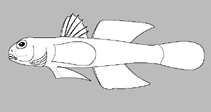 No image available for this species;
drawing shows typical species in Gobiidae.
Google image
drawing shows typical species in Gobiidae.
Classification / Names Common names | Synonyms | Catalog of Fishes(genus, species) | ITIS | CoL | WoRMS | Cloffa
Teleostei (teleosts) > Gobiiformes (Gobies) > Gobiidae (Gobies) > Gobionellinae
Etymology: Rhinogobius: Greek, rhinos = nose + Latin, gobius = gudgeon (Ref. 45335); baborinisanensis: Named for its type locality of tributaries of river drainage—Dar-An River running northward originating from 'Babo Rinisan' mountain ridge which as a classical name for 'Dar-Shue-Shan'” mountain ridge, a branch of Shue-Shan mountain ridge, northern Taiwan.
Etymology: Rhinogobius: Greek, rhinos = nose + Latin, gobius = gudgeon (Ref. 45335); baborinisanensis: Named for its type locality of tributaries of river drainage—Dar-An River running northward originating from 'Babo Rinisan' mountain ridge which as a classical name for 'Dar-Shue-Shan'” mountain ridge, a branch of Shue-Shan mountain ridge, northern Taiwan.
Environment: milieu / climate zone / depth range / distribution range Ecology
Freshwater; benthopelagic. Subtropical
Distribution Territories | FAO areas | Ecosystems | Occurrences | Point map | Introductions | Faunafri
Asia: Taiwan.
Size / Weight / Age
Short description Identification keys | Morphology | Morphometrics
Dorsal spines (total): 7; Dorsal soft rays (total): 8 - 9; Anal spines: 1; Anal soft rays: 7 - 8; Vertebrae: 27. This species is distinguished from its congeners by the following set of characters: D2 modally I,8; A I,7; pectoral fin rays modally 17; longitudinal scale series 32-33 (modally 33); perdorsal scales usually 13-14; vertebrae 27; male with rear edge of mouth merely extending to or slightly beyond vertical of anterior margin of pupil. Colouration: lateral body of male with 6-8 longitudinal rows of deep orange to orange red spots about 1/2-1/3 of pupil diameter, its cheek and opercle with 24-28 orange to reddish orange spots; with a larger cheek spot about 1/2 of pupil diameter; branchiostegal membrane of male gray with some yellowish green tone with larger 12-15 orange spots, while in female, the number of spots is less than 5; male with a middle, conspicuous grayish black mark mainly in front of second spine of first dorsal fin and its basal region with 7-9 orange or brown spots; pectoral fin base of male with two rows (totally 7-10 spots) of orange to red orange spots which 3-4 larger orange spots on anterior row (Ref, 133058).
Cross section: oval.
Cross section: oval.
Life cycle and mating behavior Maturity | Reproduction | Spawning | Eggs | Fecundity | Larvae
Main reference
Upload your references | References | Coordinator | Collaborators
Chen, I-S and M.-F. Yeh, 2024. Two new freshwater gobiid species of Rhinogobius Gill, 1859 (Teleostei: Gobiidae) from Taiwan. Zootaxa 5550(1):333-353. (Ref. 133058)
CITES
Not Evaluated
Threat to humans
Harmless
Human uses
Fisheries: of no interest
FAO - Publication: search | FishSource |
More information
Trophic ecology
Food items (preys)
Diet composition
Food consumption
Food rations
Predators
Food items (preys)
Diet composition
Food consumption
Food rations
Predators
Ecology
Ecology
Ecology
Population dynamics
Growth parameters
Max. ages / sizes
Length-weight rel.
Length-length rel.
Length-frequencies
Mass conversion
Recruitment
Abundance
Growth parameters
Max. ages / sizes
Length-weight rel.
Length-length rel.
Length-frequencies
Mass conversion
Recruitment
Abundance
Life cycle
Reproduction
Maturity
Maturity/Gills rel.
Fecundity
Spawning
Spawning aggregations
Eggs
Egg development
Larvae
Larval dynamics
Reproduction
Maturity
Maturity/Gills rel.
Fecundity
Spawning
Spawning aggregations
Eggs
Egg development
Larvae
Larval dynamics
Anatomy
Gill area
Brain
Otolith
Gill area
Brain
Otolith
Physiology
Body composition
Nutrients
Oxygen consumption
Swimming type
Swimming speed
Visual pigments
Fish sound
Diseases & Parasites
Toxicity (LC50s)
Body composition
Nutrients
Oxygen consumption
Swimming type
Swimming speed
Visual pigments
Fish sound
Diseases & Parasites
Toxicity (LC50s)
Genetics
Genome
Genetics
Heterozygosity
Heritability
Genetic Diversity
Genome
Genetics
Heterozygosity
Heritability
Genetic Diversity
Human related
Aquaculture systems
Aquaculture profiles
Strains
Ciguatera cases
Stamps, coins, misc.
Aquaculture systems
Aquaculture profiles
Strains
Ciguatera cases
Stamps, coins, misc.
Tools
Special reports
Download XML
Internet sources
AFORO (otoliths) | Aquatic Commons | BHL | Cloffa | Websites from users | Check FishWatcher | CISTI | Catalog of Fishes: genus, species | DiscoverLife | ECOTOX | FAO - Publication: search | Faunafri | Fishipedia | Fishtrace | GloBI | Google Books | Google Scholar | Google | IGFA World Record | National databases | OneZoom | Open Tree of Life | Otolith Atlas of Taiwan Fishes | PubMed | Reef Life Survey | Socotra Atlas | TreeBase | Tree of Life | Wikipedia: Go, Search | World Records Freshwater Fishing | Zoobank | Zoological Record
Estimates based on models
Phylogenetic diversity index (Ref. 82804): PD50 = 0.5000 [Uniqueness, from 0.5 = low to 2.0 = high].
Bayesian length-weight: a=0.00813 (0.00356 - 0.01856), b=3.08 (2.91 - 3.25), in cm total length, based on LWR estimates for this Genus-body shape (Ref. 93245).
Trophic level (Ref. 69278): 3.2 ±0.4 se; based on size and trophs of closest relatives
Resilience (Ref. 120179): High, minimum population doubling time less than 15 months (Preliminary K or Fecundity.).