-

- About this page
- Languages
- User feedbacks
- Citation
- Uploads
- Related species
-



Upload your photos and videos
Google image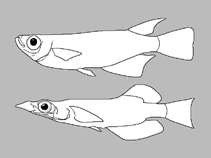 No image available for this species;
drawing shows typical species in Adrianichthyidae.
Google image
drawing shows typical species in Adrianichthyidae.
Classification / Names Common names | Synonyms | Catalog of Fishes(genus, species) | ITIS | CoL | WoRMS | Cloffa
Teleostei (teleosts) > Beloniformes (Needle fishes) > Adrianichthyidae (Ricefishes) > Oryziinae
Etymology: Oryzias: Greek, oryza = rice; because of the habitat used by this fish (Ref. 45335); loxolepis: Name from Ancient Greek ‘loxos’, meaning ‘oblique’ and ‘lepis’ meaning ‘scales’, referring to the diagonally aligned scales of this species.
Etymology: Oryzias: Greek, oryza = rice; because of the habitat used by this fish (Ref. 45335); loxolepis: Name from Ancient Greek ‘loxos’, meaning ‘oblique’ and ‘lepis’ meaning ‘scales’, referring to the diagonally aligned scales of this species.
Environment: milieu / climate zone / depth range / distribution range Ecology
Freshwater; benthopelagic; depth range 0 - 2 m (Ref. 133090). Tropical
Distribution Territories | FAO areas | Ecosystems | Occurrences | Point map | Introductions | Faunafri
Asia: Indonesia.
Size / Weight / Age
Maturity: Lm ? range ? - ? cm
Max length : 4.0 cm SL male/unsexed; (Ref. 133090); 3.5 cm SL (female)
Max length : 4.0 cm SL male/unsexed; (Ref. 133090); 3.5 cm SL (female)
Short description Identification keys | Morphology | Morphometrics
Dorsal soft rays (total): 9 - 12; Anal soft rays: 22 - 27; Vertebrae: 27 - 29. This species is distinguished by the following characters: similar to Oryzias marmoratus by having dark brown blotches on a grayish-brown trunk, differs from O. marmoratus by having 11 abdominal vertebrae, 12 or 13 transverse scales, a shorter caudal peduncle, terminal mouth, reduced nuchal concavity, scales diagonally aligned aslant to midlateral stripe, and male with round-shaped dorsal fin without yellow margin; differs from O. profundicola (sympatric congener in Lake Towuti), in having a longer snout in both sexes, males with larger head and eyes, and a black margined dorsal fin, and females with shallower body depth at the anal- and dorsal-fin origins; D 9-12, A 22-27; head length 24.4-27.2% SL (male 24.4-26.2%, female 24.6-27.2%); eye diameter 10.8-12.5% SL; snout length 7.9-9.3% SL; body depth at point of anal-fin origin 26.1-30.7% SL (male 27.5-30.7%, female 26.1-28.5%); body depth at point of dorsal-fin origin 24.1–28.4%SL (male 25.0-28.4%m female 24.1-26.8%); caudal peduncle length 8.0-11.2% SL (Ref. 133090).
Cross section: oval.
Cross section: oval.
ll specimens were collected and observed at daytime and this species occurs on gently sloping, shallow shores (1.5 m depth) with large boulders and submerged woods over sand and gravel. It often schools with O. profundicola and O. marmoratus and associated with Paratherina spp., Glossogobius sp., G. favipinnis, G. intermedius, Mugilogobius rexi, M. latifrons, and Nomorhamphus megarrhamphus (Ref. 133090).
Life cycle and mating behavior Maturity | Reproduction | Spawning | Eggs | Fecundity | Larvae
Main reference
Upload your references | References | Coordinator : Seegers, Lothar | Collaborators
Kobayashi, H., D.F. Mokodongan, M. Horoiwa, S. Fujimoto, R, Tanaka, K.W.A. Masengi and K. Yamahira, 2023. A new lacustrine ricefsh from central Sulawesi, with a redescription of Oryzias marmoratus (Teleostei: Adrianichthyidae). Ichthyol. Res. 70(4):490-514. (Ref. 133090)
CITES
Not Evaluated
Threat to humans
Harmless
Human uses
Fisheries: of no interest
FAO - Publication: search | FishSource |
More information
Trophic ecology
Food items (preys)
Diet composition
Food consumption
Food rations
Predators
Food items (preys)
Diet composition
Food consumption
Food rations
Predators
Ecology
Ecology
Ecology
Population dynamics
Growth parameters
Max. ages / sizes
Length-weight rel.
Length-length rel.
Length-frequencies
Mass conversion
Recruitment
Abundance
Growth parameters
Max. ages / sizes
Length-weight rel.
Length-length rel.
Length-frequencies
Mass conversion
Recruitment
Abundance
Life cycle
Reproduction
Maturity
Maturity/Gills rel.
Fecundity
Spawning
Spawning aggregations
Eggs
Egg development
Larvae
Larval dynamics
Reproduction
Maturity
Maturity/Gills rel.
Fecundity
Spawning
Spawning aggregations
Eggs
Egg development
Larvae
Larval dynamics
Anatomy
Gill area
Brain
Otolith
Gill area
Brain
Otolith
Physiology
Body composition
Nutrients
Oxygen consumption
Swimming type
Swimming speed
Visual pigments
Fish sound
Diseases & Parasites
Toxicity (LC50s)
Body composition
Nutrients
Oxygen consumption
Swimming type
Swimming speed
Visual pigments
Fish sound
Diseases & Parasites
Toxicity (LC50s)
Genetics
Genome
Genetics
Heterozygosity
Heritability
Genetic Diversity
Genome
Genetics
Heterozygosity
Heritability
Genetic Diversity
Human related
Aquaculture systems
Aquaculture profiles
Strains
Ciguatera cases
Stamps, coins, misc.
Aquaculture systems
Aquaculture profiles
Strains
Ciguatera cases
Stamps, coins, misc.
Tools
Special reports
Download XML
Internet sources
AFORO (otoliths) | Aquatic Commons | BHL | Cloffa | Websites from users | Check FishWatcher | CISTI | Catalog of Fishes: genus, species | DiscoverLife | ECOTOX | FAO - Publication: search | Faunafri | Fishipedia | Fishtrace | GloBI | Google Books | Google Scholar | Google | IGFA World Record | OneZoom | Open Tree of Life | Otolith Atlas of Taiwan Fishes | PubMed | Reef Life Survey | Socotra Atlas | TreeBase | Tree of Life | Wikipedia: Go, Search | World Records Freshwater Fishing | Zoobank | Zoological Record