Classification / Names
Common names | Synonyms | Catalog of Fishes(genus, species) | ITIS | CoL | WoRMS | Cloffa
Teleostei (teleosts) >
Gobiesociformes (Clingfishes) >
Gobiesocidae (Clingfishes and singleslits) > Gobiesocinae
Etymology: Acyrtus: Greek, a = without + Greek, kyrtos, -e, -on = bent + Greek, ops = shape (Ref. 45335); simon: Named for Thiony Emanuel Simon, an ichthyologist; noun in apposition.
Environment: milieu / climate zone / depth range / distribution range
Ecology
Marine; benthopelagic; depth range ? - 15 m (Ref. 132134). Tropical
Southwest Atlantic: Brazil.
Size / Weight / Age
Maturity: Lm ? range ? - ? cm
Max length : 3.2 cm SL male/unsexed; (Ref. 132134)
Short description
Identification keys | Morphology | Morphometrics
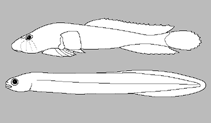
Dorsal soft rays (total): 8 - 9; Anal soft rays: 6 - 8; Vertebrae: 27 - 31. This species is distinguished from its congeners by the following characters: head deep, depth 19-21% SL; large pelvic disc 36-39% SL, its width 30-36% SL; eye diameter large 32-40% HL; pectoral-fin rays 21-23; shallow caudal peduncle 8-10% SL, its length 10-17% SL; anus-disc distance short 6-12% SL; anus-anal fin distance long 11-15% SL; snout length long 20-33% HL; interorbital space narrow 18-29% HL (Ref. 132134).
Cross section: oval.
Occurs from an intertidal habitat down to reefs at 15 m depth. It is commonly found taking shelter in cavities used by Diadema antillarum during the day, often sharing the protection from predators offered by spines with the Vitória-Trindade Chain (VTC) endemic Hypleurochilus brasil, Apogon americanus and a number of others hosts (Ref. 132134).
Life cycle and mating behavior
Maturity | Reproduction | Spawning | Eggs | Fecundity | Larvae
Quintão, T.L., J.L. Gasparini, J.-C. Joyeux, L.A. Rocha and H.T. Pinheiro, 2022. Recent dispersal and diversification within the clingfish genus Acyrtus (Actinopterygii: Gobiesocidae), with the description of a new western Atlantic species. Neotrop. Ichthyol. 20(3):e210137. (Ref. 132134)
IUCN Red List Status (Ref. 130435: Version 2025-1)
Threat to humans
Harmless
Human uses
Tools
Special reports
Download XML
Internet sources
Estimates based on models
Phylogenetic diversity index (Ref.
82804): PD
50 = 0.5312 [Uniqueness, from 0.5 = low to 2.0 = high].
Trophic level (Ref.
69278): 3.1 ±0.3 se; based on size and trophs of closest relatives
Resilience (Ref.
120179): High, minimum population doubling time less than 15 months (Preliminary K or Fecundity.).
Fishing Vulnerability (Ref.
59153): Low vulnerability (10 of 100).
🛈