>
Pleuronectiformes (Flatfishes) >
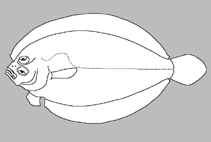
Bothidae (Lefteye flounders)
Etymology: Arnoglossus: Greek, aros, -oy = lamb + Greek, glossa = tongue (Ref. 45335).
Eponymy: Philip Armstrong – about whom we know nothing other than the etymology’s statement that the holotype was caught at Bridport, northern Tasmania “…by Mr Philip Armstrong, in whose honour the species is named.” (Ref. 128868), visit book page.
Environment: milieu / climate zone / profondeur / distribution range
Écologie
marin démersal. Temperate
Eastern Indian Ocean: Tasmania, Australia.
Taille / Poids / Âge
Maturité: Lm ? range ? - ? cm
Max length : 16.9 cm SL mâle / non sexé; (Ref. 13746)
Life cycle and mating behavior
Maturité | Reproduction | Frai | Œufs | Fécondité | Larves
Amaoka, K., M. Arai and M. Gomon, 1997. A new species of Arnoglossus (Pleuronectiformes: Bothidae) from the southwestern coast of Australia. Ichthyol. Res. 44(2):131-136. (Ref. 13746)
Statut dans la liste rouge de l'IUCN (Ref. 130435: Version 2025-1)
Menace pour l'homme
Harmless
Utilisations par l'homme
Outils
Articles particuliers
Télécharger en XML
Sources Internet
Estimates based on models
Phylogenetic diversity index (Réf.
82804): PD
50 = 0.5000 [Uniqueness, from 0.5 = low to 2.0 = high].
Bayesian length-weight: a=0.00912 (0.00408 - 0.02036), b=3.04 (2.85 - 3.23), in cm total length, based on LWR estimates for this (Sub)family-body shape (Ref.
93245).
Niveau trophique (Réf.
69278): 3.6 ±0.4 se; based on size and trophs of closest relatives
Résilience (Réf.
120179): Milieu, temps minimum de doublement de population : 1,4 à 4,4 années (Preliminary K or Fecundity.).
Fishing Vulnerability (Ref.
59153): Low vulnerability (11 of 100).
🛈