>
Eupercaria/misc (Various families in series Eupercaria) >
Labridae (Wrasses) > Bodianinae
Etymology: Bodianus: Bodianus after Bodiano or Pudiano, from the Portuguese pudor, meaning modesty (Jordan & Evermann, 1896).
Environment: milieu / climate zone / rango de profundidad / distribution range
Ecología
marino asociado a arrecife. Tropical
Western Indian Ocean: Mascarene Is., St. Brandon's Shoals, KwaZulu-Natal and southern Mozambique.
Tamaño / Peso / Age
Madurez: Lm ? range ? - ? cm
Max length : 30.7 cm SL macho / no sexado; (Ref. 96378)
Short description
Claves de identificación | Morfología | Morfometría
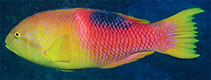
Espinas dorsales (total) : 12; Radios blandos dorsales (total) : 10; Espinas anales: 3; Radios blandos anales: 11. This species is distinguished by the following characters: D XII,10; A III,11; pectoral rays 17; lateral line smoothly curved, following the dorsal contour of body, lateral pored scales 30-31; scales above origin of lateral line to origin of dorsal fin 8; small predorsal scales, becoming embedded anteriorly, ending in posterior interorbital; cheek with a patch of very small scales, posterior to center of eye, except for the broad naked flange of the preopercle; without scales on lower jaw; a broad sheath of scales basally on median fins; total gill rakers 18-21; dorsal profile of snout to above eye is straight, becoming smoothly convex on nape; snout length 2.7-3.0 in head length (HL); orbit diameter varying from 4.7 in HL in an 8.8-cm specimen to 9.3 in a 43.0-cm specimen; mouth is slightly oblique, forming an angle of about 20° to horizontal axis of body, the maxilla reaching to below anterior half of eye; front of jaws with 2 pairs of canine teeth that interdigitate when mouth closed, the middle pair of upper jaw and lateral pair of lower jaw are the largest and recurved, the middle pair of lower jaw about half length of lateral pair; side of jaws with a dental ridge of coalesced teeth bearing a row of small, stout, close-set, conical teeth, of which a series of 5 or 6 in middle of jaws are the largest; toothless palate; labial flaps are well-developed; dorsal spines progressively longer, with the last spine 2.0-2.2 in HL, the membranes deeply incised; 7th or 8th dorsal soft ray longest, 2.0-2.1 in HL; 3rd anal spine longest, about 2.0-2.4 in HL; caudal fin of juveniles is truncate, of adults double emarginate with long pointed lobes; pectoral fins are relatively short, 3.9-4.25 in SL; pelvic fins just reaching anus in 8.8-cm juvenile, reaching beyond third anal spine in a 36.0-cm adult; diagnostic color differences from B. perditio include the central white bar of the juvenile narrowing to a spindle-shaped whitish to pink mark on the upper body extending below the lateral line (vs. a dorsal oval yellow spot) and the caudal peduncle of the juvenile with a white bar extending full width (vs. a central white patch surrounded by dark) (Ref. 96378).
Body shape (shape guide): fusiform / normal; Cross section: compressed.
A common species of deeper rock and coral reefs of South Africa. Reported to feed mainly on sea urchins, crabs, gastropod mollusks, and other hard-shelled invertebrates, which are
crushed in the powerful pharyngeal plates that are studded with large molariform teeth.
Life cycle and mating behavior
Madurez | Reproducción | Puesta | Huevos | Fecundidad | Larva
Randall, J.E. and B.C. Victor, 2013. Bodianus atrolumbus (Valenciennes 1839), a valid species of labrid fish from the southwest Indian Ocean. J. Ocean Sci. Found. 8:44-61. (Ref. 96378)
IUCN Red List Status (Ref. 130435: Version 2025-1)
Threat to humans
Harmless
Human uses
Herramientas
Special reports
Download XML
Fuentes de Internet
Estimates based on models
Phylogenetic diversity index (Referencia
82804): PD
50 = 0.5000 [Uniqueness, from 0.5 = low to 2.0 = high].
Bayesian length-weight: a=0.01230 (0.00569 - 0.02662), b=3.05 (2.87 - 3.23), in cm total length, based on LWR estimates for this Genus-body shape (Ref.
93245).
Nivel trófico (Referencia
69278): 3.5 ±0.5 se; based on size and trophs of closest relatives
Resiliencia (Referencia
120179): Medio, población duplicada en un tiempo mínimo de 1.4-4.4 años (Preliminary K or Fecundity.).
Fishing Vulnerability (Ref.
59153): Low to moderate vulnerability (27 of 100).
🛈