Elasmobranquios (tiburones y rayas) (sharks and rays) >
Rajiformes (Skates and rays) >
Arhynchobatidae (Softnose skates)
Etymology: albilabiata: Name from Latin 'albus' for white and 'labiatus' for lipped, referring to its distinct white-edged mouth which strongly contrasts against a very dark, beard-like patch below the mouth.
More on authors: Last & McEachran.
Environment: milieu / climate zone / rango de profundidad / distribution range
Ecología
marino batidemersal; rango de profundidad 900 - 1000 m (Ref. 58023). Deep-water
Southwest Pacific: New Zealand.
Tamaño / Peso / Age
Madurez: Lm ? range ? - ? cm
Max length : 64.6 cm TL macho / no sexado; (Ref. 58023)
Short description
Claves de identificación | Morfología | Morfometría
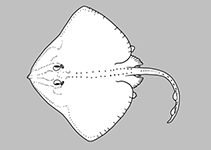
This species is characterized by the following: very long tail, 1.4-1.5 times disc length, 2.8-3.0 times ventral head length, 6.2-6.6 times snout length; orbit is moderately large, 2.5-2.7 in preorbital snout length; tail base relatively broad, width at pelvic-fin insertions 2.7-3.0 times width at midlength; anterior lobe of pelvic fin spatulate; dorsal disc largely naked; middorsal surface of tail naked, apart from non-linear row of paired thorns extending onto posterior disc; dorsolateral surface of tail lacking thorns; snout length 2.4-2.6 times distance from snout tip to rostral thorn; calcified rostral shaft short; single preorbital thorn, posterior thorns absent; ventral disc and tail naked; alar and malar thorns of mature males united to form a broad patch over most of outer pectoral fin; ventral surface much darker than dorsal surface; very dark, beard-like patch beneath mouth, edge of mouth white; no rows of pale-edged pores on ventral surface; nuchal pore band very distinct; total pectoral radials 68-70; predorsal vertebrae 106-110; tooth rows in upper jaw 45-60 (Ref. 58023).
Body shape (shape guide): other.
Male paratypes were found to be immature at 50.7 cm TL, no information re juveniles (Ref. 58023).
Life cycle and mating behavior
Madurez | Reproducción | Puesta | Huevos | Fecundidad | Larva
Last, P.R. and J.D. McEachran, 2006. New softnose skate genus Brochiraja from New Zealand (Rajidae: Arhynchobatinae) with description of four new species. N. Z. J. Mar. Freshwater Res. 40(1):65-90. (Ref. 58023)
IUCN Red List Status (Ref. 130435: Version 2025-1)
Threat to humans
Harmless
Human uses
Herramientas
Special reports
Download XML
Fuentes de Internet
Estimates based on models
Preferred temperature (Referencia
123201): 1.9 - 3.6, mean 2.6 °C (based on 194 cells).
Phylogenetic diversity index (Referencia
82804): PD
50 = 0.5039 [Uniqueness, from 0.5 = low to 2.0 = high].
Bayesian length-weight: a=0.00562 (0.00288 - 0.01097), b=3.11 (2.94 - 3.28), in cm total length, based on LWR estimates for this (Sub)family-body shape (Ref.
93245).
Nivel trófico (Referencia
69278): 3.8 ±0.7 se; based on size and trophs of closest relatives
Resiliencia (Referencia
120179): Bajo, población duplicada en un tiempo mínimo de 4.5-14 años (Preliminary K or Fecundity.).
Fishing Vulnerability (Ref.
59153): Moderate to high vulnerability (46 of 100).
🛈