Classification / Names
Common names | Synonyms | Catalog of Fishes(genus, species) | ITIS | CoL | WoRMS | Cloffa
Teleostei (teleosts) >
Cypriniformes (Carps) >
Cyprinidae (Minnows or carps) > Torinae
Etymology: Carasobarbus: Latinization of , karass, karausche, European crucian carp + Latin, barbus = barbel (Ref. 45335).
Environment: milieu / climate zone / depth range / distribution range
Ecology
Freshwater; benthopelagic. Tropical
Distribution
Countries | FAO areas | Ecosystems | Occurrences | Point map | Introductions | Faunafri
Asia: Iran.
Size / Weight / Age
Maturity: Lm ? range ? - ? cm
Max length : 19.1 cm SL male/unsexed; (Ref. 132288)
Short description
Identification keys | Morphology | Morphometrics
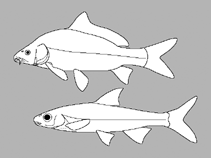
This species is distinguished by the following characters: scales on lateral line 32-34; with slightly developed lower lip lobe; head short 20-24% SL; posterior barbel short 13-20% HL; snout short 25-31% HL; with two pairs of barbels; well-developed median lobe on the lower lip (Ref. 132288).
Cross section: oval.
Usually in deep, swiftly flowing sections of rivers and dam reservoirs, prefers areas with abundant vegetation, and during the summer, it can also be observed in shallower waters. It is generally most abundant in the middle and lower Karkheh drainage. Associated species includes: Luciobarbus esocinus, Capoeta shajariani, Garra gymnothorax, Chondrostoma regium, Alburnus sellal, Squalius lepidus, Squalius berak, Turcinoemacheilus saadii, Glyptothorax cous and G. alidaei (Ref. 132288).
Life cycle and mating behavior
Maturity | Reproduction | Spawning | Eggs | Fecundity | Larvae
Jouladeh-Roudbar, A., C. Kaya, S. Vatandoust and H.R. Ghanavi, 2024. New insights into the phylogeny of Carasobarbus Karaman, 1971 (Actinopterygii, Cyprinidae) with the description of three new species. Scientific Reports 14(21801):1-22. (Ref. 132288)
IUCN Red List Status (Ref. 130435: Version 2025-1)
Threat to humans
Harmless
Human uses
Fisheries: of no interest
Tools
Special reports
Download XML
Internet sources
Estimates based on models
Phylogenetic diversity index (Ref.
82804): PD
50 = 0.5001 [Uniqueness, from 0.5 = low to 2.0 = high].
Trophic level (Ref.
69278): 3.0 ±0.4 se; based on size and trophs of closest relatives
Resilience (Ref.
120179): Medium, minimum population doubling time 1.4 - 4.4 years (Preliminary K or Fecundity.).
Fishing Vulnerability (Ref.
59153): Low vulnerability (13 of 100).
🛈