Teleostei (teleosts) >
Eupercaria/misc (Various families in series Eupercaria) >
Labridae (Wrasses) > Cheilininae
Etymology: Cirrhilabrus: Latin, cirrus = curl fringe + Greek, labros = furious (Ref. 45335); briangreenei: Named for Brian D. Greene, who in addition to collecting the type specimens, has contributed extensively towards the study and exploration of coral-reef diversity (particularly on MCEs); noun in apposition.
Environment: milieu / climate zone / depth range / distribution range
Ecology
Marine; reef-associated; depth range 40 - 100 m (Ref. 121918). Tropical
Western Pacific: Philippines.
Size / Weight / Age
Maturity: Lm ? range ? - ? cm
Max length : 7.4 cm SL male/unsexed; (Ref. 121918); 6.0 cm SL (female)
Short description
Identification keys | Morphology | Morphometrics
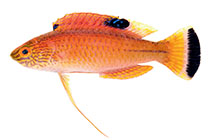
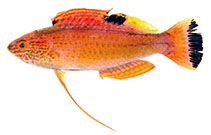
Dorsal spines (total): 11; Dorsal soft rays (total): 9; Anal spines: 3; Anal soft rays: 9; Vertebrae: 25. This species is distinguished from all its congeners by the following set of characters: lateral line with 23-26 pored scales with 16-17 in the dorsoanterior series and 7-9 in the posterior peduncular series; pelvic fins are very long, 56.5-70.0% SL and often reaching past anal-fin terminus in males. Colouration: anterior first to second interspinous membrane spaces of dorsal fin with a metallic blue spot; a large black spot two-thirds distance from dorsal-fin origin; distal third of caudal fin with black margin, iridescent in life (Ref. 121918).
Cross section: compressed.
This species occurs in MCE habitats, on rubble patch reefs (Ref. 121918).
Life cycle and mating behavior
Maturity | Reproduction | Spawning | Eggs | Fecundity | Larvae
Tea, Y.-K., R.L. Pyle and L.A. Rocha, 2020. A new species of fairy wrasse (Teleostei: Labridae: Cirrhilabrus) from mesophotic coral ecosystems of the Verde Island Passage, Philippines. Copeia, 108(1):91-102. (Ref. 121918)
IUCN Red List Status (Ref. 130435: Version 2025-1)
Threat to humans
Harmless
Human uses
Tools
Special reports
Download XML
Internet sources
Estimates based on models
Phylogenetic diversity index (Ref.
82804): PD
50 = 0.5000 [Uniqueness, from 0.5 = low to 2.0 = high].
Bayesian length-weight: a=0.01585 (0.00700 - 0.03587), b=2.95 (2.76 - 3.14), in cm total length, based on LWR estimates for this (Sub)family-body shape (Ref.
93245).
Trophic level (Ref.
69278): 3.3 ±0.4 se; based on size and trophs of closest relatives
Resilience (Ref.
120179): High, minimum population doubling time less than 15 months (Preliminary K or Fecundity.).
Fishing Vulnerability (Ref.
59153): Low vulnerability (10 of 100).
🛈