Teleostei (teleosts) >
Acropomatiformes (Oceanic basses) >
Epigonidae (Deepwater cardinalfishes)
Etymology: Epigonus: Greek, epi = over, in front + Greek, gonio = angle (Ref. 45335).
Environment: milieu / climate zone / depth range / distribution range
Ecology
Marine; bathydemersal; depth range 709 - 721 m (Ref. 132291). Tropical
Western Indian Ocean: off Mozambique.
Size / Weight / Age
Maturity: Lm ? range ? - ? cm
Max length : 13.7 cm SL male/unsexed; (Ref. 132291)
Short description
Identification keys | Morphology | Morphometrics
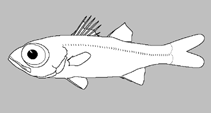
Vertebrae: 25. This species is distinguished from its congeners by the following chatacters: D VII-I,10; pectoral-fin rays 18-19; with a pair of ribs on the last abdominal vertebra; tiny projections 4-5 present on symphysis of lower jaw; total vertebrae 10 + 15; ctenoid scales strong; scales below lateral line 10; total gill rakers 28-29; with pungent opercular spine; no maxillary mustache-like process (Ref. 132291).
Cross section: compressed.
Life cycle and mating behavior
Maturity | Reproduction | Spawning | Eggs | Fecundity | Larvae
Okamoto, M. and O. Gon, 2018. A review of the deepwater cardinalfish genus Epigonus (Perciformes: Epigonidae) of the Western Indian Ocean, with description of two new species. Zootaxa 4382(2):261-291. (Ref. 132291)
IUCN Red List Status (Ref. 130435: Version 2025-1)
Threat to humans
Harmless
Human uses
Fisheries: of no interest
Tools
Special reports
Download XML
Internet sources
Estimates based on models
Phylogenetic diversity index (Ref.
82804): PD
50 = 0.5000 [Uniqueness, from 0.5 = low to 2.0 = high].
Trophic level (Ref.
69278): 3.4 ±0.5 se; based on size and trophs of closest relatives
Resilience (Ref.
120179): Medium, minimum population doubling time 1.4 - 4.4 years (Preliminary K or Fecundity.).
Fishing Vulnerability (Ref.
59153): Low vulnerability (10 of 100).
🛈