Classification / Names
Nombres comunes | Sinónimos | Catalog of Fishes(Género, Especie) | ITIS | CoL | WoRMS | Cloffa
>
Stomiiformes (Lightfishes and dragonfishes) >
Stomiidae (Barbeled dragonfishes) > Melanostomiinae
Etymology: Eustomias: Greek, eu = good + Greek, stoma = mouth (Ref. 45335); medusa: Named for its numerous filaments arising from the distal bulb; noun in apposition.
Eponymy: In Greek mythology, Medusa was a Gorgon whose hair was made up of living snakes. The name is used fancifully for taxa with numerous filaments or barbels. (Ref. 128868), visit book page.
Environment: milieu / climate zone / rango de profundidad / distribution range
Ecología
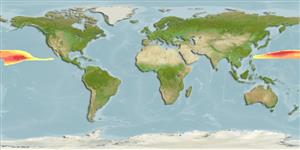
marino batipelágico; rango de profundidad 0 - 710 m (Ref. 11333). Deep-water
North Pacific.
Tamaño / Peso / Age
Madurez: Lm ? range ? - ? cm
Max length : 15.0 cm SL macho / no sexado; (Ref. 11333); 15.2 cm SL (female)
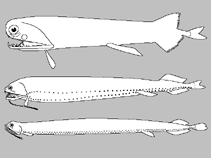
Radios blandos dorsales (total) : 24; Radios blandos anales: 38; Vértebra: 68. Two terminal bulbs separated by an interspace, 1.4-3.6 times the length of distal bulb. Barbel length mostly 36-65% SL. Terminal filaments 7-10, arising together from distal bulb or from a short stem; all prominent bulblets of various sizes and with side branches distally; 1 filament a little thicker than others and usually forked. Pigment in filament axes variably present or absent. Distal bulb small, ovoid, usually with an abruptly narrowed distal end, 1.5- 3 times proximal-bulb length, which is very small. Axis of stem and between bulbs usually pigmented, variably light or dark, sometimes unpigmented. A black spot almost always present at proximal end of distal bulb; usually partially capping base of bulb. External chevron-shaped or roundish striated areas on stem pigmented or not. Middorsal paired spots between occiput and dorsal-fin origin 8, sometimes 7 (Ref. 11333).
Body shape (shape guide): elongated.
Mesopelagic (Ref. 58302).
Life cycle and mating behavior
Madurez | Reproducción | Puesta | Huevos | Fecundidad | Larva
Gibbs, R.H. Jr., T.A. Clarke and J.R. Gomon, 1983. Taxonomy and distribution of the stomioid fish genus Eustomias (Melanostomiidae), I: subgenus Nominostomias. Smithson. Contrib. Zool. 380:139 p. (Ref. 11333)
IUCN Red List Status (Ref. 130435: Version 2025-1)
Threat to humans
Harmless
Human uses
Pesquerías: sin interés
Herramientas
Special reports
Download XML
Fuentes de Internet
Estimates based on models
Preferred temperature (Referencia
123201): 5.8 - 15.2, mean 8.9 °C (based on 6 cells).
Phylogenetic diversity index (Referencia
82804): PD
50 = 0.5000 [Uniqueness, from 0.5 = low to 2.0 = high].
Bayesian length-weight: a=0.00302 (0.00116 - 0.00786), b=3.12 (2.89 - 3.35), in cm total length, based on LWR estimates for this (Sub)family-body shape (Ref.
93245).
Nivel trófico (Referencia
69278): 4.3 ±0.8 se; based on size and trophs of closest relatives
Resiliencia (Referencia
120179): Medio, población duplicada en un tiempo mínimo de 1.4-4.4 años (Assuming tmax>3).
Fishing Vulnerability (Ref.
59153): Low vulnerability (10 of 100).
🛈