Issue
This species is often confused with Nezumia sclerorhynchus (Valenciennes, 1838).
Environment: milieu / climate zone / rango de profundidad / distribution range
Ecología
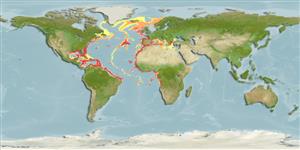
marino bentopelágico; no migratorio; rango de profundidad 200 - 2320 m (Ref. 3587), usually 200 - 1000 m (Ref. 2683). Deep-water; 70°N - 12°S, 98°W - 30°E (Ref. 1371)
Atlantic Ocean: Eastern Atlantic: Faroe Bank to northern Angola and the Mediterranean Sea. Western Atlantic: Davis Straits to northern Brazil.
Length at first maturity / Tamaño / Peso / Age
Madurez: Lm 4.5, range 4 - ? cm
Max length : 36.0 cm TL macho / no sexado; (Ref. 3587); common length : 25.0 cm TL macho / no sexado; (Ref. 2683); edad máxima reportada: 9 años (Ref. 58045)
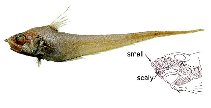
Espinas dorsales (total) : 2; Espinas anales: 0. Head short, completely scaled except for naked strip on the ventral surface of the snout; Eyes relatively large, 29 to 42% of head length; snout short, pointed; chin barbel very short. Body scales with lanceolate to shield-shaped spinules. Overall color is bluish to violet, head somewhat tawny to swarthy; ventral portions silvery when fresh; pelvic fins black except outermost ray which is pale to white; oral cavity grayish; branchial cavity mostly black.
Body shape (shape guide): elongated; Cross section: oval.
Feeds on benthic as well as pelagic animals like mysids, amphipods, small shrimps, copepods, isopods, ostracods and polychaete worms (Ref. 6187).
Life cycle and mating behavior
Madurez | Reproducción | Puesta | Huevos | Fecundidad | Larva
Cohen, D.M., T. Inada, T. Iwamoto and N. Scialabba, 1990. FAO species catalogue. Vol. 10. Gadiform fishes of the world (Order Gadiformes). An annotated and illustrated catalogue of cods, hakes, grenadiers and other gadiform fishes known to date. FAO Fish. Synop. 125(10). Rome: FAO. 442 p. (Ref. 1371)
IUCN Red List Status (Ref. 130435: Version 2025-1)
Threat to humans
Harmless
Human uses
Pesquerías: escaso valor comercial
Herramientas
Special reports
Download XML
Fuentes de Internet
Estimates based on models
Preferred temperature (Referencia
123201): 4.7 - 15.7, mean 9.3 °C (based on 786 cells).
Phylogenetic diversity index (Referencia
82804): PD
50 = 0.5000 [Uniqueness, from 0.5 = low to 2.0 = high].
Bayesian length-weight: a=0.00186 (0.00113 - 0.00306), b=3.12 (2.97 - 3.27), in cm total length, based on LWR estimates for this species & (Sub)family-body (Ref.
93245).
Nivel trófico (Referencia
69278): 3.3 ±0.1 se; based on diet studies.
Resiliencia (Referencia
120179): Bajo, población duplicada en un tiempo mínimo de 4.5-14 años (Preliminary K or Fecundity.).
Fishing Vulnerability (Ref.
59153): Low to moderate vulnerability (26 of 100).
🛈
Nutrients (Ref.
124155): Calcium = 21.3 [10.3, 49.2] mg/100g; Iron = 0.34 [0.16, 0.70] mg/100g; Protein = 15.9 [14.1, 17.5] %; Omega3 = 0.248 [0.102, 0.566] g/100g; Selenium = 26.9 [9.5, 68.2] μg/100g; VitaminA = 16.6 [3.0, 84.1] μg/100g; Zinc = 0.505 [0.312, 0.823] mg/100g (wet weight);