Teleostei (teleosts) >
Ophidiiformes (Cusk eels) >
Ophidiidae (Cusk-eels) > Ophidiinae
Etymology: Ophidion: Diminutive of Greek, ophis = serpent (Ref. 45335); dromio: Named for Dromio (The Comedy of Errors); noun in apposition.
Eponymy: In Shakespeare’s play: The Comedy of Errors, the identities of the brothers Dromio were confused throughout the play. [...] (Ref. 128868), visit book page.
More on authors: Lea & Robins.
Environment: milieu / climate zone / depth range / distribution range
Ecology
Marine; benthopelagic; depth range 51 - 183 m (Ref. 81834), usually ? - 100 m (Ref. 81834). Subtropical
Western Atlantic: USA. off Colombia, Venezuela and Guyana.
Size / Weight / Age
Maturity: Lm ? range ? - ? cm
Max length : 14.6 cm SL male/unsexed; (Ref. 81834)
Short description
Identification keys | Morphology | Morphometrics
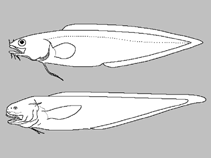
Dorsal soft rays (total): 116 - 129; Anal soft rays: 92 - 102; Vertebrae: 67 - 69. This species is characterized by the following features: D 116-129 (usually 119-125); A 92-102 (usually 98-100); pectoral fin rays 19-21 (rarely 20); precaudal vertebrae 16-17 (usually 17); caudal vertebrae 50-52 (usually 51), total vertebrae 67-69 (usually 68); gill rakers on first gill arch with 2 rudiments above, 4 developed but short gill rakers below; short, blunt and bulbous head; dorsal tissue of head usually flaccid, inflated; subterminal mouth; dorsal and ventral profiles of body nearly parallel for much of its length; unmarked body; short and unequal pelvic-fin rays, longer reaching under anterior third of opercle (Ref. 81834).
Body shape (shape guide): eel-like.
Occurs over sand and mud bottom (Ref. 81834). Reproductive strategy possibly similar to other members of this family featuring oviparity, with oval pelagic eggs floating in a gelatinous mass (Ref. 205).
Life cycle and mating behavior
Maturity | Reproduction | Spawning | Eggs | Fecundity | Larvae
Lea, R.N. and C.R. Robins, 2003. Four new species of the genus Ophidion (Pisces: Ophidiidae) from the western Atlantic Ocean. University of Kansas Museum of Natural History, Scientific Papers No. 31:1-9. (Ref. 81834)
IUCN Red List Status (Ref. 130435: Version 2025-1)
Threat to humans
Harmless
Human uses
Tools
Special reports
Download XML
Internet sources
Estimates based on models
Preferred temperature (Ref.
123201): 17.5 - 26.5, mean 23 °C (based on 70 cells).
Phylogenetic diversity index (Ref.
82804): PD
50 = 0.5000 [Uniqueness, from 0.5 = low to 2.0 = high].
Bayesian length-weight: a=0.00102 (0.00046 - 0.00225), b=3.06 (2.88 - 3.24), in cm total length, based on all LWR estimates for this body shape (Ref.
93245).
Trophic level (Ref.
69278): 3.5 ±0.7 se; based on size and trophs of closest relatives
Resilience (Ref.
120179): High, minimum population doubling time less than 15 months (Preliminary K or Fecundity.).
Fishing Vulnerability (Ref.
59153): Low vulnerability (10 of 100).
🛈