Classification / Names
Common names | Synonyms | Catalog of Fishes(genus, species) | ITIS | CoL | WoRMS | Cloffa
Teleostei (teleosts) >
Beloniformes (Needle fishes) >
Adrianichthyidae (Ricefishes) > Oryziinae
Etymology: Oryzias: Greek, oryza = rice; because of the habitat used by this fish (Ref. 45335); chenglongensis: Named for its type locality, Chonglong wetland, western Taiwan.
Environment: milieu / climate zone / depth range / distribution range
Ecology
Freshwater; benthopelagic. Subtropical
Distribution
Countries | FAO areas | Ecosystems | Occurrences | Point map | Introductions | Faunafri
Asia: Taiwan.
Size / Weight / Age
Maturity: Lm ? range ? - ? cm
Max length : 2.5 cm SL male/unsexed; (Ref. 133052); 2.7 cm SL (female)
Short description
Identification keys | Morphology | Morphometrics
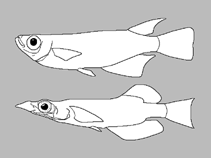
Dorsal soft rays (total): 6; Anal soft rays: 19 - 20. This species is distinguished from its ongeners by the following set of characters: D 6, A 19-20, pelvic-fin rays 6, pectoral-fin rays 10, principle caudal-fin rays i,4/5-i (i,4/5,i; body compressed laterally, its body depth at pelvic origin 24.0-24.3, body depth at anal fin origin 15.5-20.4; dorsal-fin origin inserted almost at the vertical of 14th anal-fin rays, the membrane between dorsal-fin 5th and 6th rays without the distinct notch in adult male. Colouration: body translucent, light yellowish green or brown, scattered with minute melanophores, and a narrowly dotted, longitudinal black line along the middle forward to vertical above pelvic fin; male with a T-shape black mark of caudal fin base; operculum and pre-pectoral region slivery, without any silvery scales on lateral body, lip color grayish or creamy yellow and eye bluish silvery dorsally (Ref. 133052).
Cross section: compressed.
This fish was collected from brackish habitat around 20-30 for salinity and recorded localities are also brackish habitats of wetlands and estuaries. In its breeding experiment, this fish can also survive well in fresh water, that it might be more widely distributed around the lowland freshwater to brackish region around Taiwan (Ref. 133052).
Life cycle and mating behavior
Maturity | Reproduction | Spawning | Eggs | Fecundity | Larvae
Chen, I-S. and H.-T. Lai, 2024. A new ricefish of genus Oryzias (Teleostei: Adrianichthyidae) from western Taiwan. Zootaxa 5550(1):320-327. (Ref. 133052)
IUCN Red List Status (Ref. 130435: Version 2025-1)
Threat to humans
Harmless
Human uses
Fisheries: of no interest
Tools
Special reports
Download XML
Internet sources
Estimates based on models
Phylogenetic diversity index (Ref.
82804): PD
50 = 0.5000 [Uniqueness, from 0.5 = low to 2.0 = high].
Trophic level (Ref.
69278): 3.2 ±0.4 se; based on size and trophs of closest relatives
Fishing Vulnerability (Ref.
59153): Low vulnerability (10 of 100).
🛈