Environment: milieu / climate zone / depth range / distribution range
Ecology
Marine; demersal. Subtropical
Indo-West Pacific: Western Australia; Japan, Taiwan and the Philippines.
Size / Weight / Age
Maturity: Lm ? range ? - ? cm
Max length : 9.7 cm SL male/unsexed; (Ref. 625)
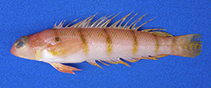
Dorsal spines (total): 5; Dorsal soft rays (total): 22 - 24; Anal spines: 1; Anal soft rays: 18 - 19; Vertebrae: 32. Characterized by the following: 5 dark transverse bars dorsally on the sides; predorsal scale count 9, with predorsal scales extending only to a vertical from the hind margin of the preopercle; 6-8 (usually 8) teeth in the outer row of the lower jaw; pectoral-fin ray count 18-20, modally 19; opercle may have a diffusely yellowish blotch, no vertical bar nor spot above pectoral-fin axil (Ref. 117414).
Body shape (shape guide): elongated; Cross section: oval.
Life cycle and mating behavior
Maturity | Reproduction | Spawning | Eggs | Fecundity | Larvae
Johnson, J.W. and J.W. Wilmer, 2018. Three new species of Parapercis (Perciformes: Pinguipedidae) and first records of P. muronis (Tanaka, 1918) and P. rubromaculata Ho, Chang & Shao, 2012 from Australia. Zootaxa 4388(2). (Ref. 117414)
IUCN Red List Status (Ref. 130435: Version 2025-1)
Threat to humans
Harmless
Human uses
Tools
Special reports
Download XML
Internet sources
Estimates based on models
Preferred temperature (Ref.
123201): 14.3 - 28.2, mean 26.5 °C (based on 557 cells).
Phylogenetic diversity index (Ref.
82804): PD
50 = 0.5000 [Uniqueness, from 0.5 = low to 2.0 = high].
Bayesian length-weight: a=0.00692 (0.00314 - 0.01524), b=3.06 (2.88 - 3.24), in cm total length, based on LWR estimates for this Genus-body shape (Ref.
93245).
Trophic level (Ref.
69278): 3.4 ±0.4 se; based on size and trophs of closest relatives
Resilience (Ref.
120179): High, minimum population doubling time less than 15 months (Preliminary K or Fecundity.).
Fishing Vulnerability (Ref.
59153): Low vulnerability (10 of 100).
🛈