Classification / Names
Common names | Synonyms | Catalog of Fishes(genus, species) | ITIS | CoL | WoRMS | Cloffa
Teleostei (teleosts) >
Perciformes/Scorpaenoidei (Scorpionfishes) >
Scorpaenidae (Scorpionfishes or rockfishes) > Scorpaeninae
Etymology: Phenacoscorpius: Greek, phenax, -akos = deceptive + Greek, skorpion = scorpion (Ref. 45335); trispinis: Name from Latin words 'tri' and 'spinis', meaning 'three' and 'spine', referring to three spines on the lacrimal bone of the holotype.
Environment: milieu / climate zone / depth range / distribution range
Ecology
Marine; demersal; depth range ? - 160 m (Ref. 132491). Temperate
Northwest Pacific: Japan and Taiwan.
Size / Weight / Age
Maturity: Lm ? range ? - ? cm
Max length : 7.3 cm SL male/unsexed; (Ref. 132491)
Short description
Identification keys | Morphology | Morphometrics
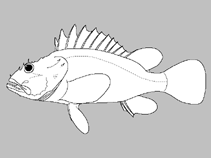
Dorsal spines (total): 12; Dorsal soft rays (total): 8 - 9. This species is distinguished from its congeners by the following set of characters: 16-17 pectoral-fin rays, middle rays branched; 4 pored lateral-line scales; 6 upper gill rakers, 14 lower gill rakers (10 and 4 on ceratobranchial and hypobranchial, respectively), 20 total gill rakers; slit behind last gill arch absent; palatine teeth absent; anterodorsal and lateral lacrimal spines present; second preopercular spine smaller than third or fourth spines; nuchal and parietal spines distinct; head length 45.2% of SL; body depth 38.1% of SL; head width 17.2% of SL; snout length 11.2% of SL; maxillary depth 7.6% of SL; postorbital length 21.2% of SL; first dorsal-fin spine length 6.8% of SL; second dorsal-fin spine length 13.6% of SL; pelvic-fin spine length 19.9% of SL; longest pelvic-fin ray 23.2% of SL; longest pectoral-fin ray 39.0% of SL; caudal-fin length 25.3% of SL; caudal peduncle length 17.2% of SL (Ref. 132491).
Body shape (shape guide): short and / or deep; Cross section: compressed.
Life cycle and mating behavior
Maturity | Reproduction | Spawning | Eggs | Fecundity | Larvae
Matsumoto, T. and H. Motomura, 2025. Phenacoscorpius trispinis, a new species of scorpionfish (Teleostei: Scorpaenidae) from Sagami Bay, Japan. Ichthyol. Res. 2025 (Ref. 132491)
IUCN Red List Status (Ref. 130435: Version 2025-1)
Threat to humans
Harmless
Human uses
Tools
Special reports
Download XML
Internet sources
Estimates based on models
Phylogenetic diversity index (Ref.
82804): PD
50 = 0.5020 [Uniqueness, from 0.5 = low to 2.0 = high].
Trophic level (Ref.
69278): 3.5 ±0.6 se; based on size and trophs of closest relatives
Resilience (Ref.
120179): High, minimum population doubling time less than 15 months (Preliminary K or Fecundity.).
Fishing Vulnerability (Ref.
59153): Low vulnerability (10 of 100).
🛈