Классификация / Names
народные названия | синонимы | Catalog of Fishes(род, виды) | ITIS | CoL | WoRMS | Cloffa
Пластиножаберные (акулы и скаты) (sharks and rays) >
Myliobatiformes (Stingrays) >
Potamotrygonidae (River stingrays) > Potamotrygoninae
Etymology: Potamotrygon: Greek, potamos = river + Greek, trygon = a sting ray (Ref. 45335); boesemani: Named for the late Dutch biologist Marinus Boeseman, for his substantial contribution to the knowledge of both South American ichthyology (including chondrichthyans) and zoological history.
Eponymy: Dr Marinus Boeseman (1916–2006) was a Dutch ichthyologist, working in the Department of Zoology, Rijksmuseum van Natuurlijke Histoire, Leiden, becoming Curator of Fishes (1947–1981). [...] (Ref. 128868), visit book page.
Environment: milieu / climate zone / пределы глубины / distribution range
экология
; пресноводный донно-пелагический. Tropical
South America: Corantijn river drainage in Suriname.
Size / Вес / Возраст
половая зрелость: Lm ? range ? - ? cm
Max length : 41.3 cm WD самец/пол неопределен; (Ref. 75012); 42.7 cm WD (female)
Краткое описание
определительные ключи | морфология | морфометрия
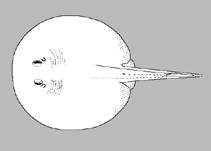
позвонки: 119 - 129. Diagnosed by the dorsal region of disc of dark brown background coloration, with deep orange to red ocellated spots of irregular form, encircled by relatively broad black rings, in irregular concentric series, and frequently in pairs around disc center; buccal cavity dark-pigmented with orange spots in adults. Differs from the ocellated congeners Potamotrygon motoro, Potamotrygon henlei and Potamotrygon leopoldi by having more intensely colored ocelli, usually yellow in the latter species; from Potamotrygon motoro by having darker dorsal background coloration, broader black contour of the dorsal ocelli, and irregular form of the ocelli (vs. rounded in shape). Can be differentiated from Potamotrygon henlei and Potamotrygon leopoldi by the absence of ocelli on tail; and from tentatively identified specimen Potamotrygon ocellata (which also has dark orange ocelli) by the irregular contour of the ocelli which is also distinctive. Teeth relatively smaller and in greater number up to 45 rows in the upper jaw (vs. 23-32 in Potamotrygon motoro; 24 in specimen 19.0 cm DW of Potamotrygon ocellata; and pectoral fin radials 98-104 (vs. 94 in Potamotrygon ocellata) (Ref. 75012).
Body shape (shape guide): other.
Life cycle and mating behavior
половая зрелость | размножение | нерест | икра | Fecundity | личинки
Rosa, R.S., M.R. de Carvalho and C. de Almeida Wanderley, 2008. Potamotrygon boesemani (Chondrichthyes: Myliobatiformes: Potamotrygonidae), a new species of neotropical freshwater stingray from Surinam. Neotrop. Ichthyol. 6(1):1-8. (Ref. 75012)
Статус Красного Списка МСОП (Ref. 130435: Version 2025-1)
Угроза для людей
Harmless
Использование человеком
дополнительная информация
инструменты
Специальные отчеты
Скачать в формате XML
ресурсы в Интернет
Estimates based on models
Phylogenetic diversity index (ссылка
82804): PD
50 = 0.5000 [Uniqueness, from 0.5 = low to 2.0 = high].
Bayesian length-weight: a=0.01000 (0.00244 - 0.04107), b=3.04 (2.81 - 3.27), in cm total length, based on all LWR estimates for this body shape (Ref.
93245).
Trophic level (ссылка
69278): 3.2 ±0.4 se; based on size and trophs of closest relatives
Fishing Vulnerability (Ref.
59153): High vulnerability (58 of 100).
🛈