Classification / Names
Common names | Synonyms | Catalog of Fishes(genus, species) | ITIS | CoL | WoRMS | Cloffa
Teleostei (teleosts) >
Cypriniformes (Carps) >
Cyprinidae (Minnows or carps) > Smiliogastrinae
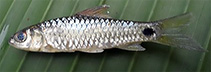
Etymology: Puntius: Lantin, punctum = point, the point of the sword (Ref. 45335); euspilurus: Name from Greek word, 'eu' for well, 'spilos' for blot and 'urus' for tail, referring to the distinct black basal spot on the caudal fin.
Environment: milieu / climate zone / depth range / distribution range
Ecology
Freshwater; benthopelagic. Tropical
Distribution
Countries | FAO areas | Ecosystems | Occurrences | Point map | Introductions | Faunafri
Asia: India.
Size / Weight / Age
Maturity: Lm ? range ? - ? cm
Max length : 6.6 cm SL male/unsexed; (Ref. 132394)
Short description
Identification keys | Morphology | Morphometrics
Dorsal soft rays (total): 8; Anal soft rays: 5. This species is distinguished from all its congeners by the following characters: body slender, BDD 23.8-26.3% SL; last undivided dorsal fin ray is feebly osseous and flexible, elongated pectoral fin reaching to ventral fin; lateral line scales 23-24; scales between lateral line and ventral fin 2.5 (Ref. 132394).
Cross section: compressed.
This edible fish occurring in the water bodies of Wayanad prefers rapidly flowing shallow and clear waters. According to local fishermen, it appears in great numbers in paddy fields during the onset of southwest monsoon. Since it is said to occur only in unpolluted areas, protection of water bodies is inevitable for the survival of this fish (Ref. 132394).
Life cycle and mating behavior
Maturity | Reproduction | Spawning | Eggs | Fecundity | Larvae
Plamoottil, M., 2016. Puntius euspilurus, a new fish species (Cypriniformes: Cyprinidae) from Kerala, India. International Journal of Research Studies in Biosciences 4(issue 9):1-6. (Ref. 132394)
IUCN Red List Status (Ref. 130435: Version 2025-1)
Threat to humans
Harmless
Human uses
Tools
Special reports
Download XML
Internet sources
Estimates based on models
Phylogenetic diversity index (Ref.
82804): PD
50 = 0.5000 [Uniqueness, from 0.5 = low to 2.0 = high].
Trophic level (Ref.
69278): 2.7 ±0.1 se; based on size and trophs of closest relatives
Resilience (Ref.
120179): High, minimum population doubling time less than 15 months (Preliminary K or Fecundity.).
Fishing Vulnerability (Ref.
59153): Low vulnerability (10 of 100).
🛈