Classification / Names
Common names | Synonyms | Catalog of Fishes(genus, species) | ITIS | CoL | WoRMS | Cloffa
Teleostei (teleosts) >
Carangiformes (Jacks) >
Rachycentridae (Cobia)
Etymology: Rachycentron: Greek, rhachis, -ios = spine + Greek, kentron = sting (Ref. 45335); makranesis: Named for the Makran coast that fall into the provincial jurisdiction of the Balochistan, Pakistan.
Environment: milieu / climate zone / depth range / distribution range
Ecology
Marine; reef-associated. Tropical
Western Indian Ocean: Arabian Sea: Pakistan.
Size / Weight / Age
Maturity: Lm ? range ? - ? cm
Max length : 7.5 cm TL (female); max. published weight: 0.00 g
Short description
Identification keys | Morphology | Morphometrics
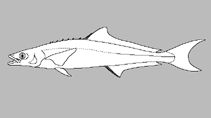
Dorsal spines (total): 8; Dorsal soft rays (total): 24; Anal spines: 2; Anal soft rays: 23. This species is distinguished from its congeners by the following characters: dorsal fin with eight small separated and 24 dorsal rays; anterior profile distinctly differs in terms of head length, depression and the lower jaw projection; head relatively short, rounded, depressed and somewhat pointed anteriorly; presence of a wide gap between the posterior part of the head to the first dorsal origin; pelvic fin reaching mid of the pectoral fin; pectoral fin base narrow, its length comparatively shorter than the other species; body is greenish dorsally with pallid band laterally, white bands extending from lower jaw or snout to caudal peduncle; villiform teeth on jaws, roof of mouth, and tongue (Ref. 132435).
Cross section: oval.
Food in all four stomachs examined were completely digested, but remnants of crab parts indicate that this species is an opportunistic feeder mainly feeding on the crustaceans, cephalopods and small fishes. A highly sought fish species, and is usually sold prior to auction (Ref. 132435).
Life cycle and mating behavior
Maturity | Reproduction | Spawning | Eggs | Fecundity | Larvae
Panhwar, S.K. and I. Kashani, 2024. Discovery of two new species of cobia (Pisces; Rachycentridae) inhabiting the makran coast of the northern Arabian Sea with notes on their biology and ecology. Zoologischer Anzeiger 313(2024):298-305. (Ref. 132435)
IUCN Red List Status (Ref. 130435: Version 2025-1)
Threat to humans
Harmless
Human uses
Fisheries: highly commercial
Tools
Special reports
Download XML
Internet sources
Estimates based on models
Phylogenetic diversity index (Ref.
82804): PD
50 = 0.7500 [Uniqueness, from 0.5 = low to 2.0 = high].
Trophic level (Ref.
69278): 3.4 ±0.5 se; based on size and trophs of closest relatives
Resilience (Ref.
120179): High, minimum population doubling time less than 15 months (Preliminary K or Fecundity.).
Fishing Vulnerability (Ref.
59153): Low vulnerability (10 of 100).
🛈