Schistura aurantiaca

You can sponsor this page

Schistura aurantiaca Plongsesthee, Page & Beamish, 2011

Carregue seu(sua) Fotos e vídeos
Imagem do Google
Image of Schistura aurantiaca
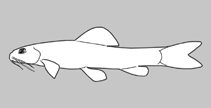
No image available for this species;
drawing shows typical species in Nemacheilidae.

Classificação / Nomes Nomes comuns | Sinônimos | Catalog of Fishes(Gênero, Espécies) | ITIS | CoL | WoRMS | Cloffa

> Cypriniformes (Carps) > Nemacheilidae (Brook loaches)
Etymology: Schistura: Greek, schizein = to divide + Greek, oura = tail; an allusion to forked caudal fins (Ref. 45335)aurantiaca: The name, aurantiaca, Latin adjective for orange-colored, is in reference to the orange bars on this species (Ref. 87184).

Environment: milieu / Zona climática / intervalo de profundidade / distribution range Ecologia

; Água doce demersal. Tropical; 15°N - 14°N, 98°E - 99°E

Distribuição Países | Áreas da FAO | Ecossistemas | Ocorrências | Mapa de pontos | Introduções | Faunafri

Asia: Thailand. Known only from the Kwai Noi, Mae Khlong basin, in the Thong Pha Phum District of Kanchanaburi Province (Ref. 87184).

Tamanho / Peso / Idade

Maturidade: Lm ?  range ? - ? cm
Max length : 4.1 cm SL macho/indeterminado; (Ref. 87184)

Descrição suscinta Chaves de identificação | Morfologia | Morfometria

Member of genus Schistura as defined by Kottelat (1990a). Schistura aurantiaca is distinguished from all other species of Schistura by unique color pattern of 3-9 orange bars on side of body; 1st bar immediately behind head, 2nd bar near dorsal-fin origin; most of nape and anterior side of body uniformly brown (Ref . 87184).
Body shape (shape guide): elongated; Cross section: oval.

Biologia     Glossário (p.ex. epibenthic)

Ciclo de vida ou comportamento de acasalamento Maturidade | Reprodução | Desova | Ovos | Fecundidade | Larvas

Referência principal Carregar suas referências | Referências | Coordenador | Colaboradores

Plongsesthee, R., L.M. Page and W. Beamish, 2011. Schistura aurantiaca, a new species from the Mae Khlong basin, Thailand (Teleostei: Nemacheilidae). Ichthyol. Explor. Freshwat. 22(2):169-178 (Ref. 87184)

Status na Lista Vermelha da UICN (Ref. 130435: Version 2025-1)


CITES

Not Evaluated

CMS (Ref. 116361)

Not Evaluated

Ameaça para os humanos

  Harmless


Uso pelos humanos

FAO - Publication: search | FishSource |

Mais informação

Ecologia Trófica
Food items (preys)
Composição da dieta
Consumo alimentar
Food rations
Predadores
Ecologia
Ecologia
Home ranges
Population dynamics
Parâmetros de crescimento
Max. ages / sizes
Length-weight rel.
Length-length rel.
Frequências de comprimento
Conversão de massa
Recrutamento
Abundância
Life cycle
Reprodução
Maturidade
Maturity/Gills rel.
Fecundidade
Desova
Spawning aggregations
Ovos
Desenvolvimento dos ovos
Larvas
Dinâmica larval
Distribuição
Países
Áreas da FAO
Ecossistemas
Ocorrências
Introduções
BRUVS - Videos
Anatomy
Área branquial
Brain
Otolith
Physiology
Body composition
Nutrients
Consumo de oxigênio
Tipo de natação
Velocidade de natação
Visual pigments
Fish sound
Diseases & Parasites
Toxicity (LC50s)
Genética
genoma
Genética
Heterozygosity
Hereditariedade
Human related
Aquaculture systems
Perfis para aquacultura
Estirpes
Ciguatera cases
Stamps, coins, misc.
Outreach
Colaboradores
Taxonomy
Nomes comuns
Sinônimos
Morfologia
Morfometria
Fotos
Referências
Referências

Ferramentas

Relatórios especiais

Baixar XML

Fontes da internet

AFORO (otoliths) | Aquatic Commons | BHL | Cloffa | Websites from users | Checar Observador de Peixes (FishWatcher) | CISTI | Catalog of Fishes: Gênero, Espécies | DiscoverLife | ECOTOX | FAO - Publication: search | Faunafri | Fishipedia | Fishtrace | GloBI | Google Books | Google Scholar | Google | IGFA World Record | OneZoom | Open Tree of Life | Otolith Atlas of Taiwan Fishes | PubMed | Reef Life Survey | Socotra Atlas | TreeBase | Árvore da vida | Wikipedia: Ir para, procura | World Records Freshwater Fishing | Zoobank | Registro zoológico

Estimates based on models

Índice de diversidade filogenética (Ref. 82804):  PD50 = 0.5000   [Uniqueness, from 0.5 = low to 2.0 = high].
Bayesian length-weight: a=0.00692 (0.00310 - 0.01545), b=3.02 (2.85 - 3.19), in cm total length, based on LWR estimates for this Genus-body shape (Ref. 93245).
Nível Trófico (Ref. 69278):  3.0   ±0.3 se; based on size and trophs of closest relatives
Fishing Vulnerability (Ref. 59153):  Low vulnerability (10 of 100). 🛈